
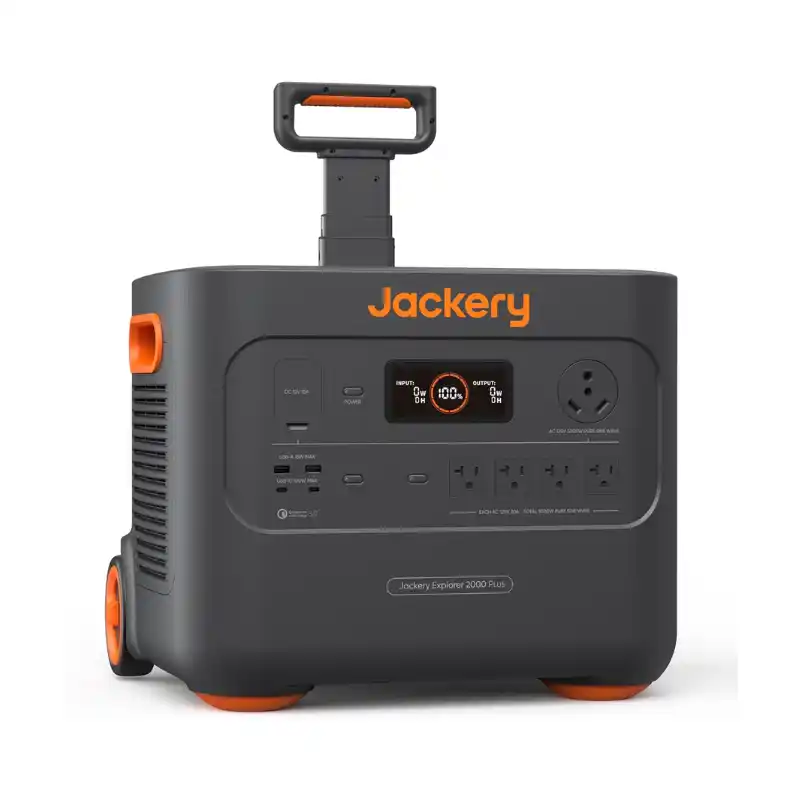
Jackery Explorer 2000 Plus Review

The Jackery Explorer 2000 Plus delivers 1,780Wh of its 2,042Wh rating, powered by a 3,000W inverter with a 6,000W surge. Solar input reaches 1,400W at 24 amps, the second-highest at this capacity, and electrical noise measures a clean 750 mV. Upper mid-range price tier, good value.
My Quick Verdict
Jackery advertises 4,000 charge cycles for this unit, matching the longest-lived packs at their capacity and comfortably beating the 3,000-cycle rivals sitting beside it on a shelf.
The figure is measured at 70% of the original capacity. Everyone else in this data measures at 80%.
That difference is not a technicality. A cell rated for 4,000 cycles to 70% has not been shown to reach 4,000 cycles to 80%, so the headline number cannot be compared with the one printed on a competitor’s box, even though every retail listing invites you to do exactly that.
Set that aside, and the unit is strong: a 3,000-watt inverter, the second-highest solar input at this capacity, and one of the cleanest electrical outputs measured here.
Best for: Overland and RV setups running a big array, plus household backup in homes that are seldom left empty.
Not for: unattended backup, or anyone comparing cycle ratings across brands without reading the footnotes.
Key Stats
| Badge | Stats |
|---|---|
| Battery chemistry and longevity | LiFePO4 | 4,000 cycles to 70% |
| Continuous AC power output | 3,000W AC | 6,000W peak |
| Energy storage capacity | 2,042Wh | 1,780Wh usable |
| Rapid AC wall recharge | 1,500W input | 1,800W dual |
| Uninterrupted emergency backup | 12.8ms UPS | Manual arm |
| Maximum solar input and MPPT | 1,400W solar | 24A MPPT |
| Ultra-fast USB-C power delivery | Two 100W USB-C ports |
| Low-noise operational level | 53dB | Moderate under load |
| Inverter electrical noise | 750mV | Among the cleanest |
| Modular capacity expansion | Expandable | Extra battery port |
Introduction
Cycle ratings are the specification buyers trust most and understand least. The number implies a lifespan, and comparing two numbers feels like comparing two lifespans.
It only works if both were measured the same way. A charge cycle rating is always stated against a capacity threshold (the point at which the pack is considered worn out), and the industry convention in this category is 80%.
Jackery states 4,000 cycles to 70%. Running a pack a further ten percentage points down before calling it finished is a materially easier test, and it means this unit’s headline figure is not interchangeable with the 4,000-cycle ratings elsewhere in this data.
What It Can Actually Run
The inverter sustains 3,000W with a 6,000W peak, among the largest at this capacity, and is enough to handle heating loads alongside other equipment.
Nominal storage reads 2,042Wh. The outlets returned 1,780 Wh, which is 87% of the label’s promise. That is the basis for every calculation below.
- Refrigerator at 150W: close to twelve hours.
- CPAP at 40W, humidifier switched off: a shade over forty-four hours.
- Starlink dish at 50W: a little over thirty-five hours.
- Laptop at 70W: around 25 full charges; 2 ports available.
The measured output was 120 volts with 1.30% distortion, and electrical noise was 750 mV, among the lowest recorded, which is a good sign for sensitive equipment.
Charging and Smart Features
The main input reaches 1,500W, though only across two speed settings rather than the finer stages some rivals offer.
Solar is a genuine strength: 1,400W accepted between 11 and 60 volts at 24 amps, the second-highest input figure at this capacity and backed by an unusually generous current allowance.
Handover took 12.8 milliseconds, and the inverter must be switched on manually. The array can remain attached, and both inputs together can reach 1,800W when panels are prioritized.
Upper mid-range price tier and good value tier. It is not the cheapest route to two kilowatt-hours.
Charging Speed Benchmarks
Charging speed for the Jackery Explorer 2000 Plus, measured against the 26 machines in our database that fall inside the 2,000Wh to 3,000Wh capacity class. Wall input averages 1,641W across that group and solar averages 1,123W. The rating bands are internal to the class, which is why they cannot be read across to a smaller or larger bracket.
Wall charging is the weaker channel here. 1,500W is 141W below the 1,641W class average, keeping it in the lower half of the Average band, and combined AC and solar caps at 1,800W where several rivals reach 2,400W or 2,600W. A 2,042Wh pack therefore needs around 1.4 hours to come back from empty. Two selectable speeds is also the coarsest control on any machine in this comparison, so there is no gentle profile for an overnight charge that does not need to be quick.
Panels are where this unit earns its place. 1,400W runs a quarter over the 1,123W class mean and earns a solid High rating, second only to the units accepting 1,800W and above in this bracket. More important than the wattage is the 24-amp current allowance, which is what actually stops a large low-voltage array from delivering its nameplate figure on most machines. A full solar refill runs to roughly 1.5 hours, faster than its own mains charging, which almost nothing else here can claim.
Need faster grid recharging to match? The Bluetti AC200L pulls 2,400W from a wall socket, 60 percent more than the Explorer 2000 Plus, and refills 2,048Wh in about 0.9 hours against 1.4 here. Solar drops to 1,200W, so the choice is straightforward: keep the Jackery if the array does the work, move to the AC200L if the grid does.
Real Capacity: What You Actually Get
Delivery is solid on both paths, and unusually the twelve-volt side comes out ahead.
The AC outlets produced 1,780 Wh out of a claimed 2,042 Wh, or 87%, which sits comfortably above the class line.
Twelve-volt delivery reached 1,821 Wh, an 89% return, and two points better. The gap is small, but it runs in the direction most buyers would hope, so DC loads are marginally the more efficient choice here.
Drain while idle measures around 1.15% an hour with the inverter awake, dropping to 0.3% on the DC side. Neither figure is remarkable in either direction.
My takeaway: Reckon on 1,780 Whh from the outlets and 1,821 Whh from the 12-volt side. Both are healthy, and because they sit so close together, you can arrange loads based on convenience rather than efficiency.
Power Output and Surge: What It Can Turn On
A 3,000-watt sustained rating places this among the larger inverters in terms of capacity and lifts it into whole-circuit territory. Heating appliances run without shedding everything else.
With 6,000 watts available in a burst, nothing in an ordinary house draws enough on startup to bother it.
The quieter achievement is electrical cleanliness. Noise measured 750 mV, while much of the field exceeded 2,000 mV, and distortion was 1.30%.
The car socket deserves a mention too, rated at 155 watts. That is one of the few in this data to clear the 150-watt mark, so ordinary twelve-volt accessories will not hit a ceiling.
Real Appliance Runtimes
1,780 Wh converted to hours, using the appliance loads for every review on this site.
| Appliance | Power Draw | Runtime | What That Means |
|---|---|---|---|
| Full-size refrigerator | 150W | About 11.9 hours | Comfortably through a night and into the next day. |
| CPAP machine (no humidifier) | 40W | About 44.5 hours | Four nights of use before it needs anything. |
| Starlink dish | 50W | About 35.6 hours | The dish remains linked from Friday to Sunday. |
| Pellet grill or smoker | 100W | About 17.8 hours | A full overnight cook and then some. |
| Laptop (70W) | 70W | About 25 recharges | Two ports at 100W each. |
An 87% conversion puts these figures in the upper half of the field at this capacity, though the 1,400-watt solar ceiling matters more here: on a multi-day trip, how fast you refill it decides more than how much it holds.
Recharging: Wall and Solar
From a Wall Outlet
The mains input takes 1,500W, filling an empty pack in roughly ninety minutes.
Rate control is limited to two settings. That is coarser than the four- and five-stage systems on some rivals, so there is no gentle overnight trickle to select when time is not pressing.
Feed it from both sources at once, and the ceiling is 1,800W. Modest at this size, and clearly behind the machines reaching 2,400 and 2,600.
From Solar Panels
This is where the Explorer 2000 Plus makes its strongest case.
Panel capacity is 1,400W, accepted between 11 and 60 V at 24 A. Only one unit at this size takes more.
The 24-amp allowance is the detail worth noting. Current, not wattage, is usually what prevents a large array from working, and few units here permit this much current. It means that substantial panels wired in parallel deliver all the power they generate rather than being clipped.
The 60-volt ceiling is conventional, so series strings of four or five panels remain out of scope.
Under good conditions, the pack refills in about 2.5 hours, and the array does not need to be disconnected between sessions.
Blackout Backup: The Part I Care About Most
Backup performance is the ordinary part of an otherwise capable unit.
Handover measured 12.8 milliseconds, which is inside the safety threshold with a reasonable margin and roughly twice the time the leaders at this capacity take.
The inverter will not come up on its own, so it must be armed deliberately and left armed. A standby drain of 1.15% per hour makes that a viable habit, though not a costless one. Left running untouched for a fortnight, the pack would be a third down.
Why this matters to me: thirteen milliseconds is fine for a fridge, a router, and lighting, and questionable for a desktop. Combined with a manual switch, this unit protects a house where someone is living rather than one standing empty.
Noise and Living With It
Fifty-three decibels under load, which sits just above the line I use for rooms where anyone is sleeping.
It is a working hum rather than a whine, and it disappears entirely in a garage or a vehicle. In a small bedroom, it would be noticed, though it is far from the loudest here.
On the scale, it reads 61.5 pounds (27.8 kilograms). Substantial for what it stores, and not something you shift single-handedly.
Connectivity includes both Wi-Fi and Bluetooth, with a telephone line covered by the five-year warranty.
Where It Falls Short
Four points to weigh, and the first is the one that will not appear on any comparison chart.
1. The Cycle Rating Uses a Different Threshold
Four thousand cycles sound identical to the 4,000-cycle ratings on rival units at this capacity. It is measured at 70% of original capacity, whereas those are measured at 80%.
A pack allowed to fall a further ten percentage points before being declared worn out has had an easier test. The number is not dishonest, but it is not comparable, and every retail listing that places it beside a competitor’s figure invites a false comparison.
Treat it as a strong rating with a caveat rather than as equivalent to the class leaders.
2. Modest Dual Charging and Only Two Wall Speeds
Combined input caps at 1,800 W, whereas several rivals reach 2,400W or 2,600W, so topping up quickly from two sources is slower here.
Two charging speeds also mean no gentle overnight setting, which, over a decade of ownership, is a real, if minor, loss.
3. Sixty-One and a Half Pounds
Heavy for two kilowatt-hours, and a two-person lift on stairs. It suits a fixed installation or a vehicle rather than anything you carry.
4. A Manually Armed Inverter
Twelve point eight milliseconds is respectable, and it only counts when the inverter was already on. Three units at this capacity wake themselves; this is not one of them.
How It Compares
The two closest comparisons are the AFERIY P280, which competes directly on longevity claims, and the EcoFlow Delta 3 Max Plus, the strongest unit at this capacity.
| Feature | Jackery Explorer 2000 Plus | AFERIY P280 | EcoFlow Delta 3 Max Plus |
|---|---|---|---|
| Price tier | Upper mid-range | Mid-range | Upper mid-range |
| Value tier | Good | Exceptional | Good |
| Usable through AC | 1,780Wh (87%) | 1,880Wh (91%) | 1,740Wh (84%) |
| Cycle rating | 4,000 to 70% | 4,000 to 80% | 3,500 to 80% |
| Warranty | 5 years | 7 years | 5 years |
| Sustained output | 3,000W | 2,800W | 3,000W |
| Solar input | 1,400W at 24A | 1,200W dual port | 1,000W dual port |
| UPS switchover | 12.8ms | 8ms | 7.9ms |
| Self-arming inverter | No | No | Yes |
| Electrical noise | 750mV | Over 2,000mV | 830mV |
| Fan noise | 53dB | 57dB | 42dB |
Against the AFERIY P280, the comparison is instructive precisely because both advertise 4,000 cycles. The AFERIY’s figure is 80% and comes with a seven-year warranty; this one is 70% and comes with a five-year warranty. The AFERIY also converts four points better and costs a price tier less.
What Jackery offers is 200 more watts of solar input, an inverter 200 watts larger, four decibels less noise, and dramatically cleaner electrical output at 750 mV rather than over 2,000 mV.
The Delta 3 Max Plus remains the better unit overall, since it wakes itself, crosses over in half the time,e and runs eleven decibels quieter. But its solar ceiling is 400 watts lower, which,h for a large array, is the one place the Jackery pulls decisively ahead.
Who Should Buy It, and Who Should Skip It
Buy It If
- You are running a large parallel array and need 24 amps of current from solar.
- You want a 3,000W inverter with unusually clean electrical output.
- The unit stays in a vehicle or a fixed spot and gets recharged where it sits.
- Twelve-volt accessories are on your list, and you want a socket that clears 150 watts.
Skip It If
- You are comparing cycle ratings across brands and expect the numbers to mean the same thing.
- The house needs to be protected while it’s empty.
- You want the fastest possible top-up from both mains and solar.
- Weight is a consideration at all.
The Bottom Line
Judged by what it does, the Explorer 2000 Plus is a capable unit with a genuine strength: 1,400 watts of solar at 24 amps, backed by a 3,000-watt inverter with some of the cleanest output measured here.
Judged by what it claims, one number needs to be read carefully. A 4,000-cycle rating at 70% capacity is not the same product as one at 80%, and a competitor’s box sitting beside it on a shelf makes that distinction invisible.
Buy it for the solar input and the inverter, not for the longevity figure. On those terms, it earns its price tier, though it will not protect a house that nobody is standing in.


There are no reviews yet.