
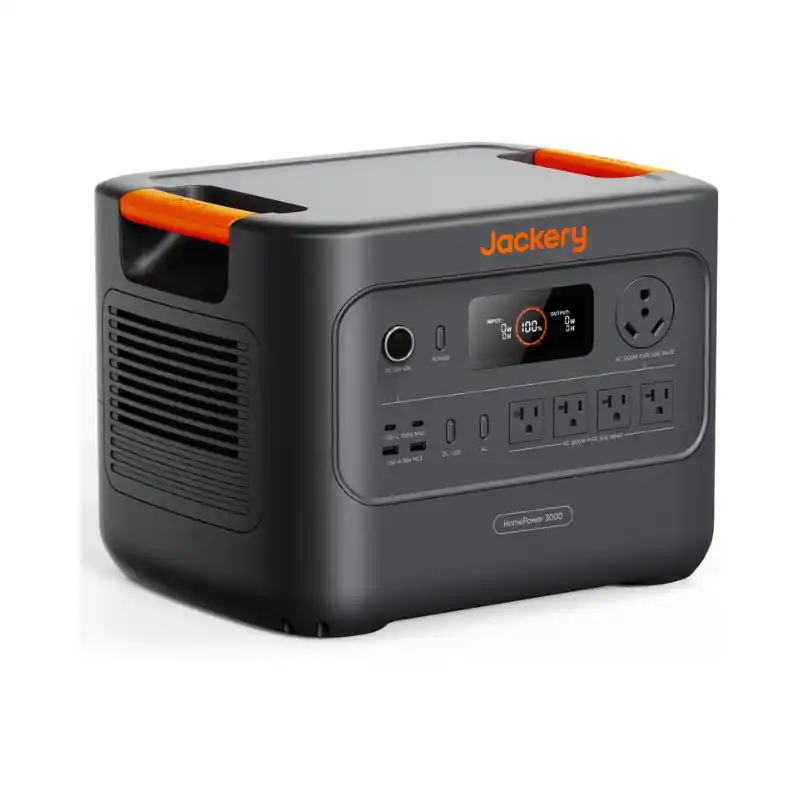
Jackery SG HomePower 3000 Review

The Jackery SG HomePower 3000 delivers 2,820 Wh of its 3,072 Wh rating, with a 91% conversion efficiency, powered by a 3,600W inverter. At 59 pounds, it is among the lightest machines in this capacity, with 4,000-cycle cells and a standby drain of less than 1 percent per hour.
My Quick Verdict
Fifty-nine pounds holding 3,072 Wh puts this among the lightest machines at capacity in the whole dataset. Most rivals at three kilowatt-hours weigh between 79 and 136.
It converts 91% of that pack’s energy into usable power, one of the highest figures recorded here, and it holds a charge at 0.83% per hour.
So it is light, efficient, and retentive; the three things that make a large battery genuinely useful.
What it will not do is grow. Expansion is not offered at all, fixing capacity at 3,072Wh for good, and neither charging route is quick enough to make refilling anything but an overnight task.
Best for: Households that need to shift their backup between rooms or vehicles, and anyone storing it charged for months.
Not for: systems you expect to expand, or anyone recharging under time pressure.
Key Stats
| Badge | Stats |
|---|---|
| Battery chemistry and longevity | LiFePO4 | 4,000 cycles |
| Continuous AC power output | 3,600W AC | 7,200W peak |
| Energy storage capacity | 3,072Wh | 2,820Wh usable |
| Weight for capacity | 59 lbs | Among the lightest at 3kWh |
| AC wall recharge | 1,800W input | Two speeds |
| Uninterrupted emergency backup | 13.3ms UPS | Manual arm |
| Maximum solar input and MPPT | 1,000W solar | 24A allowance |
| Ultra-fast USB-C power delivery | 100W USB-C PD |
| High-output DC | 169W car socket |
| Modular capacity expansion | Not supported |
Introduction
Weight is the specification that quietly decides how a large power station is used. Once a machine weighs about eighty pounds, it stops being something you reposition and becomes something you install.
This one holds three kilowatt-hours in fifty-nine pounds, which is roughly what a good two-kilowatt-hour machine weighs. It can go from a garage into a house or into a vehicle without a second person or a plan.
The pack is lithium iron phosphate, with 4,000 cycles claimed under a five-year warranty, or roughly eleven years of daily cycling to 80%.
What It Can Actually Run
3,600 watts continuous, 7,200 in a burst, at 120 volts. That figure tops the Heavy-Duty Household Class and handles a home’s essential circuits without strain.
Rated at 3,072 Wh, the sockets returned 2,820 Wh. 91% is among the strongest conversion rates in this dataset. Everything below uses 2,820Wh.
- Refrigerator at 150W: nearly nineteen hours.
- CPAP at 40W without the humidifier: seventy hours.
- Starlink dish at 50W: fifty-six hours.
- Laptop at 70W: around forty charges.
Voltage sat at 120 and distortion at 1.20%, but electrical noise climbed past 2,000mv, untidy by the standards here.
Charging and Smart Features
Main input stops at 1,800 watts. Against a 3,072 Wh pack that runs for two hours from flat, adding panels alongside the socket lifts nothing.
The panel input accepts 1,000 watts at 12 volts, up to 60 amps at full 24 volts. Amps are plentiful, watts are not, and the grading sheet notes that panels alone miss the refill window that their competitors hit.
The changeover came in at 13.3 milliseconds, safely inside the limit, on an inverter somebody must switch on first.
Premium price tier, good value tier.
Charging Speed Benchmarks
Where the Jackery SG HomePower 3000 lands on charging within the Over 3,000Wh capacity class, drawn from the 16 machines we hold input data for. Across that group mains charging averages 2,802W and solar averages 2,681W. The three bands are terciles inside the bracket, so each rating measures this unit against its own size peers.
Wall charging of 1,800W sits on the floor of the Average band and roughly a thousand watts under the 2,802W class average, giving about 1.7 hours to refill 3,072Wh. The unusual detail is that running panels alongside mains does not raise that ceiling at all, so unlike most of this bracket there is no combined figure to fall back on. Against a class that reaches 6,000W, 1,800W into three kilowatt-hours is a closed system charging at the pace of a much smaller one.
Solar tops out at 1,000W, tied for the lowest panel ceiling in this class, well beneath the 2,681W class average, and a Low rating where the bracket high stands at 6,400W. That works out at roughly 3.1 hours of unbroken sun and will not complete a recharge inside the window its rivals meet. The 24-amp current allowance is generous relative to the wattage, so a parallel bank of low-voltage panels is the arrangement that suits it, but the ceiling caps the array regardless.
Need faster recovery at the same capacity? The Anker SOLIX F3000 holds the same 3,072Wh but charges at 3,840W from mains and 2,400W from panels through a 165-volt path, so empty to full drops to about 0.8 hours on AC or 1.3 hours on solar. It weighs 91 pounds against 59 here, which is the cost of that recovery speed and the reason this machine still makes sense if you need to move it.
Real Capacity: What You Actually Get
This is where the machine earns its place.
Metered at the outlets, 2,820 Wh was recorded against a 3,072 Wh claim. 91% is beaten by only a handful of machines across every capacity of power stations we have tested, putting this unit ahead of several rivals with more on paper.
The twelve-volt route returned 2,759Wh, or 89%, two points behind. Both paths are strong enough that you can arrange loads around convenience.
Idling with the inverter live costs roughly 0.83% per hour, dropping to 0.08% at 12 volts. Charged and stored, this machine will still be close to full months later.
My takeaway: Work from 2,820 Wh, a figure that sits unusually close to the label’s claim. Combined with sub-one-percent standby, what you charge is very nearly what you get back whenever you get around to using it.
Power Output and Surge: What It Can Turn On
The inverter is generous for the capacity and the class. 3,600 watts of continuous power can run a refrigerator, a freezer, heating, and lighting without approaching its limit.
With 7,200 watts available at the moment, household motors starting up are not an issue.
The car socket is worth pointing out: 169 watts, which clears the 150-watt threshold that most sockets in this data miss. A twelve-volt fridge or a modest vehicle accessory will run from it without hitting a ceiling.
There is one 100-watt USB-C outlet; given noise readings above 2,000 mV, check your own tolerances before connecting delicate equipment.
Real Appliance Runtimes
2,820Wh converted to hours, against the fixed appliance loads used in every review on this site.
| Appliance | Power Draw | Runtime | What That Means |
|---|---|---|---|
| Full-size refrigerator | 150W | About 18.8 hours | Most of a day on the fridge before cycling stretches it. |
| CPAP machine (no humidifier) | 40W | About 70.5 hours | Seventy hours of overnight use. |
| Starlink dish | 50W | About 56.4 hours | Fifty-six hours of connection off the grid. |
| Pellet grill or smoker | 100W | About 28.2 hours | Twenty-eight hours of cooking on one charge. |
| Laptop (70W) | 70W | About 40 recharges | Through the single 100W port. |
Note how close these come to machines with larger nominal packs. A 91% conversion from 3,072Wh beats an 85% conversion from 3,532Wh, making this the clearest argument on this site for shopping based on tested figures rather than ratings.
Recharging: Wall and Solar
From a Wall Outlet
Eighteen hundred watts into a three-kilowatt-hour pack means the better part of two hours from flat.
Rate control offers two settings rather than the four or five that several rivals provide, so there is no finely judged overnight trickle.
The combined figure is the more limiting one. Running mains and panels together also caps at 1,800 watts, so adding solar does not shorten the wait; it only displaces some of the mains draw. On most machines at this capacity, two sources together are meaningfully faster than a single source.
From Solar Panels
A thousand watts is the weakest solar ceiling at this capacity, and it has a stated consequence in the grading data: a full solar recharge cannot be completed within the two-and-a-half-hour window most rivals meet.
Input runs 12 to 60 volts at 24 amps. That current allowance is genuinely generous (current is usually what stops a large parallel bank from delivering), so the panels you can connect will give everything they generate.
Capped at 60 volts, lengthy series strings are off the table, and a sizeable array therefore wants parallel wiring with thicker cable over distance.
The wide 12-volt floor means foldable panels work straight away, which not every machine at this capacity can manage.
Panels can stay connected around the clock, and the unit runs loads while charging.
Blackout Backup: The Part I Care About Most
Backup performance is adequate rather than good, and unfinished in the usual way.
At 13.3 milliseconds, it passes the twenty-millisecond bar with something to show for it, while running about 50% behind the quickest machines of this size.
It waits to be raised by hand before the main falls, and then is left undisturbed.
Shedding only 0.83% an hour keeps that practice cheap, while several competitors bleed two or three times as fast while sitting armed.
Why this matters to me: on a machine light enough to be moved around, a manually armed inverter is a smaller problem than on an installed system; you are more likely to handle it and think about it. It still means an empty house is not covered.
Noise and Living With It
Fifty-two decibels under load, a shade above what a room with a sleeper will tolerate and quiet by the standards of this capacity.
Several rivals at three kilowatt-hours run three to eight decibels louder, and for a machine that might be carried into living space, that difference is worth having.
The weight is the headline specification. Fifty-nine pounds, 27 kilograms, holding 3,072Wh. That is close to a one-person carry for short distances, and it is the reason to consider this machine over heavier rivals with better charging.
Wi-Fi and Bluetooth are both available, with a phone number behind the five-year warranty.
Where It Falls Short: There are three limitations, and the first is permanent.
1. No Expansion Battery Support
The capacity you buy is the capacity you keep. There is no module to add and no port to add it through.
At three kilowatt-hours, that matters less than it would if it lowered the range, since most households will not exceed it. But growing this system later means buying a second complete machine, and several rivals at this capacity do offer a path.
2. Both Recharge Routes Are Slow
Eighteen hundred watts from the wall is close to two hours from empty, and running solar alongside does not lift the ceiling.
The 1,000-watt solar input cannot complete a recharge inside the window rivals meet either. Plan to refill this overnight rather than between outages.
3. A Manually Armed Inverter and Noisy Output
A 13.3-millisecond handover only protects a house with someone in it if the inverter has been switched on.
Electrical noise above 2,000mv also sits at the higher end of this field, which is worth confirming before running sensitive equipment.
How It Compares
The natural comparisons are the Pecron F3000 and the Anker SOLIX F3000, both at identical capacity.
| Feature | Jackery SG HomePower 3000 | Pecron F3000 | Anker SOLIX F3000 |
|---|---|---|---|
| Price tier | Premium | Upper mid-range | Upper mid-range |
| Value tier | Good | Exceptional | Exceptional |
| Rated capacity | 3,072Wh | 3,072Wh | 3,072Wh |
| Usable through AC | 2,820Wh (91%) | 2,750Wh (89%) | 2,760Wh (89%) |
| Weight | 59 lbs | 63 lbs | 91 lbs |
| Wall charging | 1,800W | 1,800W | 3,840W |
| Solar input | 1,000W at 24A | 1,600W, 25V floor | 2,400W to 165V |
| UPS switchover | 13.3ms | 8.6ms | 9.8ms |
| Expansion battery | No | Yes | Yes |
| Idle drain per hour | 0.83% | 1.25% | 0.66% |
| Fan noise | 52dB | 56dB | 53dB |
The Pecron F3000 weighs four pounds more, converts two points worse, and charges no faster, but costs a price tier less, hands over five milliseconds quicker,r and accepts an expansion battery. On value,ue it is the better buy.
Anker’s F3000 more than doubles the mains rate, converts 2,400 watts of solar to 165 volts, and accepts modules, though it costs thirty-two more pounds for the privilege.
So this machine’s case rests almost entirely on being the lightest of the three while converting the best. If you carry it, that is a real argument. If it stays put, both rivals do more for less.
Who Should Buy It, and Who Should Skip It
Buy It If
- You need three kilowatt-hours in something one person can move.
- The machine will be stored charged for long periods between uses.
- You run 12-volt gear and want an outlet rated for more than 150 watts.
- Usable energy per rated watt-hour is the figure you shop on.
Skip It If
- You expect to add capacity later. There is no path.
- You need to fill it quickly before the weather comes.
- Solar is your main recharge route.
- The house must be protected when no one is in it.
The Bottom Line
As a battery, this is excellent. 91% conversion, under one percent standby drain, 4,000 cycles, and a 3,600-watt inverter, all inside fifty-nine pounds.
As a system,m it is closed and slow. No expansion path, 1,800 watts from the wall, 1,000 from panels, and no benefit from running both.
Buy it because you have to carry three kilowatt-hours, and you want most of them to reach you. On any other basis, both rivals in this capacity offer more for less.


There are no reviews yet.