
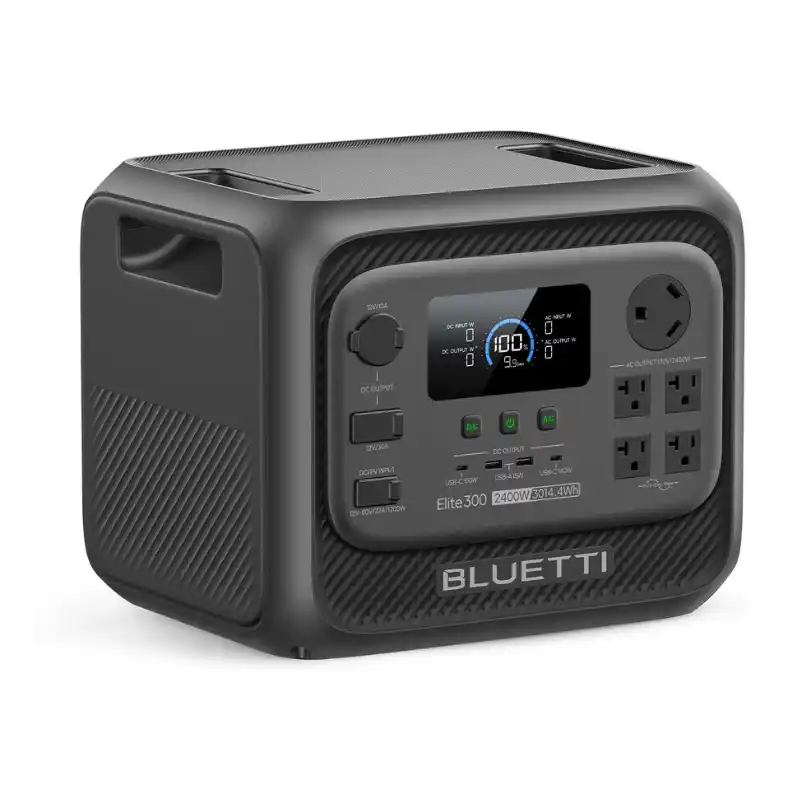
Bluetti Elite 300 Review

The Bluetti Elite 300 delivers 2,760Wh of its 3,014Wh rating, a 91% conversion efficiency, and an 8.1ms handover for its inverter. Cells are rated for 4,000 cycles; a 140W USB-C port and a 400W XT90 output are available; and it weighs 57 pounds. Upper mid-range price tier, exceptional value.
My Quick Verdict
Three kilowatt-hours usually arrive with a weight penalty, a price penalty, or both. This one weighs 57 pounds and sits in the exceptional value tier, which is the cheapest tier for three kilowatt-hours in this data.
It also converts unusually well in both directions, at 91% through the outlets and 93% through DC, and it arms its own inverter with an 8.1-millisecond handover.
That last point matters more than it sounds. Most machines reviewed here cannot wake themselves, and the ones that can have generally been the expensive ones.
The catch is singular and permanent: it accepts no expansion battery. Three thousand and fourteen watt-hours is the ceiling, forever.
Best for: Emergency Home Resilience where a large sealed unit will do, and Medical or CPAP Backup needing multi-night runtime.
Not for: anyone who expects the system to grow or who needs more than 2,400 watts of inverter capacity.
Key Stats
Introduction
There is a persistent assumption in this category that more capacity means a heavier, costlier machine that has given something up elsewhere. The Elite 300 mostly declines to follow it.
Three thousand and fourteen watt-hours at 57 pounds is lighter than several two-kilowatt-hour units reviewed here, and it lands in the exceptional value tier rather than the premium one.
Lithium iron phosphate cells sit behind it: 4,000 cycles claimed, five years covered; call it eleven years of daily cycling to the 80% mark.
What It Can Actually Run
The inverter sustains 2,400W with a peak of 4,800W. That is a modest figure for three kilowatt-hours, and it is the specification that decides who this machine suits.
Rated storage is 3,014Wh. The outlets returned 2,760Wh, a 91% result. Figures below use 2,760Wh.
- Refrigerator at 150W: better than eighteen hours.
- CPAP at 40W with humidifier off: sixty-nine hours, six nights.
- Starlink dish at 50W: around fifty-five hours.
- Laptop at 70W: about thirty-nine refills, at full 140W speed.
The waveform read 121 volts at 0.70% distortion, comfortably inside half the usual figure for this field, and clean enough for medical gear.
Charging and Smart Features
Main input reaches 1,800W with stepped rate control, and both sources together take 2,400W with panels served first.
Solar contributes up to 1,200W at 12-60 V and 22 A, a generous current allowance that suits rigid panels.
Handover measured 8.1 milliseconds, and the inverter raises itself, so an empty house is still covered.
Upper mid-range price tier and exceptional value tier, which for three kilowatt-hours is the strongest position in this data.
Charging Speed Benchmarks
Recharge speed for the Bluetti Elite 300 compared with the Over 3,000Wh capacity class, measured across the 16 machines in our charging database. That bracket averages 2,802W on mains and 2,681W on solar, both figures inflated by the split-phase installations at the top of it. Ratings are internal to the class.
Mains charging of 1,800W is a thousand watts under the 2,802W class average and sits at the bottom of the Average band, taking around 1.7 hours to fill 3,014Wh. Dual charging raises the combined ceiling to 2,400W, which is adequate rather than generous for a pack this size. The context is worth stating plainly: this is a sealed machine you can carry, not a split-phase installation, and the charging hardware is sized accordingly against a class that reaches 6,000W.
Panels top out at 1,200W at 22 amps, which is less than half the 2,681W class average and the only Low rating on this machine, against a 6,400W class ceiling. A full solar refill takes roughly 2.5 hours in ideal light and considerably longer once cloud and panel angle take their usual 20 to 30 percent. A 60-volt input window rules out long series strings on top of that, so treat the Elite 300 as a grid-charged machine that accepts panels rather than a solar-first one.
Charging from an array rather than a socket? The Anker SOLIX F3000 holds a comparable 3,072Wh but accepts 2,400W of solar through a 165-volt path, double the wattage and nearly triple the voltage headroom, alongside 3,840W from mains. Both channels fill the pack in well under 1.5 hours. It weighs ninety-one pounds against fifty-seven here, so the gain in charging comes at the cost of ever moving it.
Real Capacity: What You Actually Get
Conversion is strong on both sides, and the gap between them is narrow enough that port choice barely matters.
The AC outlets returned 2,760 Wh out of a claimed 3,014 Wh. 91% puts it among the best AC results recorded here.
The twelve-volt route reached 2,826Wh, or 93%, two points ahead. A modest advantage, so twelve-volt loads gain a little without the reorganisation being worth much effort.
Idle drain is 0.5% per hour with the inverter live and 0.16% on DC. It’s small enough that keeping it on standby for months is a sensible way to keep it.
My takeaway: Work from 2,760Wh; more spendable energy than anything else covered here to date. Six nights of CPAP runtime from a single sealed unit is a different proposition from anything at two kilowatt-hours.
Power Output and Surge: What It Can Turn On
This is where the machine draws its boundary, and it is worth being precise about it.
Twenty-four hundred watts sustained is the same rating as several two-kilowatt-hour units, with 50% more storage. It runs a heating appliance in the room beside it, and nothing more.
So the extra capacity buys duration rather than capability. If your problem is running a refrigerator, a router, and lighting for a very long time, this is well-suited to the task. If it is running a heating appliance on the same circuit as the kitchen, the inverter is the limiting factor, and no amount of stored energy helps.
Peak output of 4,800W comfortably covers compressor starts. The ports are strong: 140 watts via USB-C and a 400-watt XT90 for 12-volt equipment.
One number goes the other way. Noise measured beyond 2,000mv, up at the busy end of this field, which sits oddly against so clean a distortion result.
Real Appliance Runtimes
Converting 2,760 Wh into hours, measured on the same appliance list every review here uses.
The CPAP figure is the standout. Six nights from a sealed unit that one person can move means a week-long outage is no longer a planning problem for anyone dependent on overnight medical equipment.
Recharging: Wall and Solar
From a Wall Outlet
Mains charging draws 1,800 W at a steady rate, replenishing 3 kilowatt-hours in a little over an hour and a half.
That is quick for the capacity without being exceptional; a handful of machines here accept 2,400W or more.
Together, both sources reach 2,400W, which is adequate rather than generous for a pack this size.
From Solar Panels
Panels feed in at 1,200W between 12 and 60 volts at 22 amps.
Twenty-two amps is a comfortable current allowance, and it keeps rigid panels usable rather than restricting the array to foldables. The 60-volt ceiling is conventional, so a long series string is out of scope.
Decent sun brings it back inside roughly two and a half hours, brisk going for a three-kilowatt-hour pack.
The array may remain wired in permanently, and the unit continues to supply loads throughout a charge. cycle
Blackout Backup: The Part I Care About Most
Backup is properly done, and at this price tier,er that is not something to take for granted.
The handover measured 8.1 milliseconds, comfortably below the 11-millisecond threshold that separates a real backup system from a battery-with-a-relay setup.
The inverter raises itself, so nobody needs to be present or remember anything.
Keeping it armed costs half a percent an hour, which is close to free. Fast, self-arming, and cheap to keep ready is the combination that actually matters, and relatively few machines in this dataset manage all three.
Why this matters to me: the recurring failure across this category is a fast handover attached to an inverter that somebody has to switch on. This unit closes that gap at a price tier where most of its rivals do not.
Noise and Living With It
Fifty-two decibels under load, marginally above the line I draw for rooms with sleepers in them and unremarkable elsewhere.
For a machine whose strongest case is six nights of CPAP runtime, that is a slight irony: it is quiet enough to be tolerable beside a bed but not quiet enough to disappear.
Weight is 57 pounds (26.3 kilograms). For three kilowatt-hours, that is genuinely light, lighter than several two-kilowatt-hour units reviewed here, though still a two-handed lift.
It speaks Wi-Fi and Bluetooth, and Bluetti staffs a line behind the five-year cover.
Where It Falls Short
One limitation here is permanent. Two others are worth weighing.
1. No Expansion Battery
3,014 watt-hours is a hard ceiling. The unit accepts no add-on battery and never will.
For a machine at this capacity, it is a more consequential omission than it would be at lower capacities, because buyers reaching three kilowatt-hours are often building toward whole-home coverage rather than away from it. The answer to needing more is buying a second complete unit.
2. A 2,400-Watt Inverter on a 3kWh Pack
The same sustained rating that several two-kilowatt-hour units carry, with 50% more storage.
The extra capacity, therefore, buys runtime rather than capability. Anyone expecting three kilowatt-hours to unlock heavier simultaneous loads will be disappointed.
3. Electrical Noise Above 2,000mv
Despite an excellent 0.70% distortion reading, electrical noise was measured at the high end of this field.
For appliances and tools, this is immaterial. For sensitive measurement or audio equipment, it is worth noting that it sits oddly beside the otherwise clean waveform.
How It Compares
The natural comparisons are its own stablemate, the Bluetti Apex 300, and the Anker SOLIX C2000 Gen 2, the strongest unit a capacity class below.
Compared to the Apex 300, this unit stores more energy, converts AC more efficiently, weighs 26 pounds less, and is priced in a lower tier. What it gives up is split-phase output, 1,440 watts of inverter capacity, 2,000 cycles, and any expansion path.
For a household backing up circuits rather than a panel, the Elite 300 is the better purchase, and it is not close. For an installation needing 240 volts or room to grow, it cannot compete.
The Anker SOLIX C2000 Gen 2 is an interesting alternative for anyone unsure about capacity. It stores a third less, weighs sixteen pounds less, hands over marginally faster, and does take an expansion battery. Two of those C2000 units would cost more than one Elite 300 and store less, but they would grow.
Who Should Buy It, and Who Should Skip It
Buy It If
- You want the longest runtime available from a single sealed unit that one person can move.
- Overnight medical equipment needs to be covered through a multi-day outage.
- You want cover that works unattended without moving up to premium pricing.
- Your loads are a refrigerator, networking equipment, lighting, and electronics, rather than heavy simultaneous draws.
Skip It If
- You expect to add capacity later. This unit cannot.
- You need more than 2,400 watts of inverter capacity, whereas three kilowatt-hours might have implied more.
- Split-phase 240-volt output is required.
- You are wiring a high-voltage series array.
The Bottom Line
The Elite 300 does almost everything well. 91% conversion, a self-arming inverter with an eight-millisecond handover, 4,000 cycles, 0.5% hourly standby, and 57 pounds for three kilowatt-hours, all at the exceptional value tier.
It is the cheapest three kilowatt-hours in this dataset and among the best-behaved machines in it.
The permanent capacity ceiling is the one thing to think hard about, because buyers arriving at this size are often building toward something larger. If 3,014 Wh is genuinely enough, then this is an easy recommendation. If it might not be, the ceiling is not negotiable later.


There are no reviews yet.