
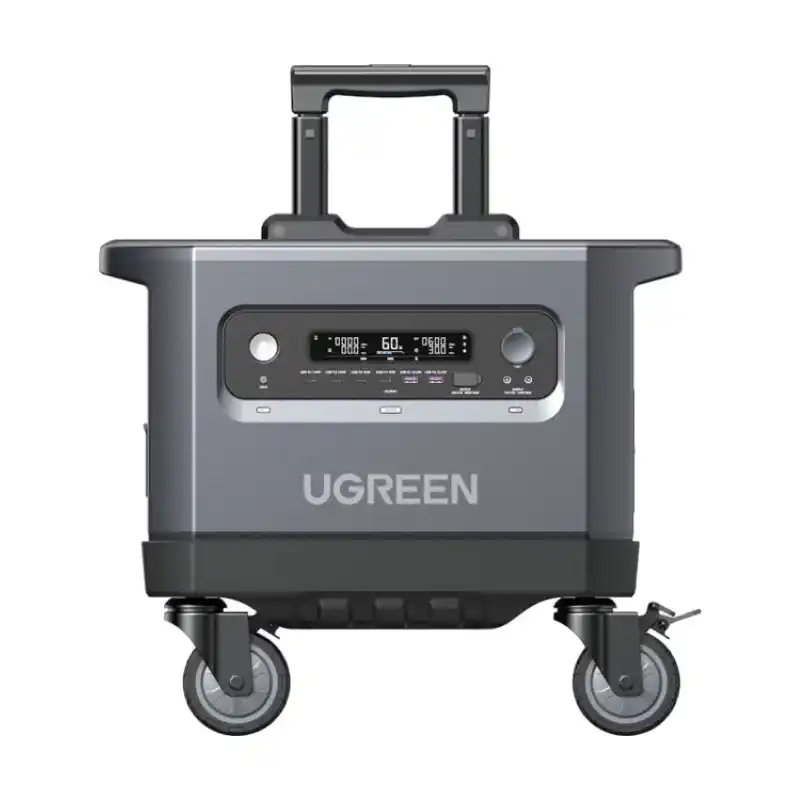
UGREEN PowerRoam 2200 Review

The UGREEN PowerRoam 2200 delivers 1,800Wh of its 2,048Wh capacity through the outlets and 1,835Wh through DC, powered by a 2,400W inverter. It switches over in 9.8ms, carries a 140W USB-C port, and takes an expansion battery.
My Quick Verdict
Every figure we have on this machine is good. It delivers 87% through the outlets and 89% through DC, switches over in 9.8 milliseconds, sheds only 0.8% of its charge per hour, and supports a 140-watt USB-C port.
At 56.5 pounds, it is also reasonable for two kilowatt-hours, and it takes an expansion battery.
The problem is what has not been measured. This unit has not been through our current twenty-criterion grading standard, so there is no fan noise reading, no harmonic distortion figure, no confirmation of whether the inverter arms itself, and no price in our data at all.
The score below is provisional. Treat it as a promising machine with an incomplete file rather than a proven one.
Best for: Emergency Home Resilience and general household backup, subject to confirming the unmeasured specifications.
Not for: buyers who need certainty about noise, waveform quality, or automatic operation before committing.
Key Stats
Introduction
This review comes with a caveat I do not usually have to write. The PowerRoam 2200 appears in our bench-testing data but has not been evaluated against the current twenty-criterion grading standard, so several specifications that normally determine a score are simply absent.
What exists is genuinely encouraging. Conversion, switchover speed, standby retention, and port selection are all above the class average, and the electrical noise reading is among the cleanest at this capacity.
Chemistry is lithium iron phosphate with 3,000 cycles claimed, par for this class, not an advantage.
I would rather publish the figures with the gaps marked than pretend the file is complete.
What It Can Actually Run
2,400 watts held continuously, with 4,800 in a burst. Resistive heating appliances fit inside that, with spare capacity for a second load.
Rated at 2,048 Wh, the sockets returned 1,800 Wh (87%), comfortably above the class line. Everything below uses 1,800Wh.
- Refrigerator at 150W: twelve hours.
- CPAP without humidification at 40W: forty-five hours.
- Starlink dish at 50W: thirty-six hours.
- Laptop at 70W: around 26 charges, and quick ones at 140W.
Electrical noise was measured at 1,045 mV, which is on the cleaner side for this field. Harmonic distortion was not measured, so waveform quality remains partly unknown.
Charging and Smart Features
Mains input reaches 1,800 watts, enough to refill the pack in a little over an hour.
Solar takes 1,200 watts across two ports, each accepting 12 to 75 volts at 15 amps. That 75-volt ceiling is above the 60 volts most machines of this size allow, and the low floor keeps foldables usable.
Crossover clocked 9.8 milliseconds, inside the eleven-millisecond band that marks real protection. Whether it comes up unprompted is absent from our records.
One restriction is confirmed: there is no dual charging, so the two inputs never run together.
Charging Speed Benchmarks
Where the UGREEN PowerRoam 2200 sits on recharging speed within the 2,000Wh to 3,000Wh capacity class. The 26 units in that class average 1,641W from a socket and 1,123W from panels. Ratings of Low, Average and High are worked out among these units alone, not across every machine in the database.
Mains input reaches 1,800W, finishing the Average band and running ahead of the 1,641W typical for this bracket, which gives roughly 1.1 hours to fill 2,048Wh from empty. The class itself covers a huge spread, 470W to 5,000W. The real charging limitation on this machine is not the figure but the absence of dual charging: mains and panels cannot feed it at the same time, so unlike most rivals here it has no combined rate to fall back on, and 1,800W is genuinely the ceiling rather than a starting point.
Solar accepts 1,200W across two independently tracked channels reaching 75 volts, which beats the 1,123W class average and rests exactly on the High threshold, so it records as Average. Panels alone fill the pack in about 1.7 hours in strong light. Seventy-five volts is above the 60-volt norm at this capacity, which buys an extra panel in series, and dual tracking means two arrays at different orientations are handled separately. Both are the marks of a machine intended for a real installation.
Want mains and solar working together? The Bluetti AC200L charges at 2,400W on mains and supports dual input, so grid and panels stack instead of taking turns. It fills the same 2,048Wh of capacity in around 0.9 hours against 1.1 here, matches the 1,200W solar ceiling, and pushes the input voltage window to 145 volts for longer series strings.
Real Capacity: What You Actually Get
Both paths deliver well, and the twelve-volt side is marginally stronger.
The sockets delivered 1,800 Wh from a 2that of ,048 Wh label. That 87% beats pricier power stations we have tested holding the same nominal charge.
The DC route returned 1,835Wh, or 89%, two points better. Two points apart is close enough that convenience, not efficiency, should decide where things plug in.
Charge retention is a highlight: 0.8% per hour armed, and nothing the meter could detect at 12 volts. Fill it, shelve it, and it stays filled.
My takeaway: Reckon on 1,800 Wh at the sockets, or 1,835 Wh at 12 volts. Both hold up, and with the drain this low, the figure you charge to is close to the figure waiting for you next season.
Power Output and Surge: What It Can Turn On
The inverter is properly sized for the capacity. 2,400 watts of sustained power runs a space heater alongside a refrigerator, and 4,800 watts of surge power covers any household motor start.
The port array is the standout. One hundred and forty watts over USB-C keeps a laptop at full speed even with its charger left at home, something only a few machines this size offer.
An electrical noise level of 1,045 mV is cleaner than most in this field.
What is missing is a figure showing harmonic distortion. Electrical noise and distortion are separate measurements, and a good reading on one does not guarantee a good reading on the other. Get the distortion number from UGREEN in writing before a CPAP machine or any medical device goes anywhere near it.
Real Appliance Runtimes
What 1,800Wh buys in time, on the appliance figures, this site never varies.
These are strong figures for the capacity, and the 87% conversion is why. From the same nominal pack, a machine returning 82% would hand you roughly a hundred watt-hours less.
Recharging: Wall and Solar
From a Wall Outlet
Eighteen hundred watts from a socket takes an empty pack to full in a little over an hour, which is quick for two kilowatt-hours.
The limitation is that dual charging is not supported. The two inputs are exclusive, so under grey skies,s you cannot ask the socket to top up whatever the panels fall short by.
Most machines at this capacity accept both inputs simultaneously, and their absence here is a genuine feature gap rather than a rounding difference.
From Solar Panels
Panels feed in at 1,200 watts across two independent 600-watt ports, each accepting 12 to 75 volts at 15 amps.
Seventy-five volts is above the 60-volt ceiling most machines of this size impose, which allows a longer series string of rigid panels than the class norm.
The 12-volt floor keeps small foldable panels usable, so both ends of the range are covered.
Separate tracking on each port keeps a shadowed bank from forcing a sunlit one onto a shared operating point.
For a machine at this capacity, this is a better-than-average solar implementation.
Blackout Backup: The Part I Care About Most
The measured figure here is good, and the surrounding information is missing.
Switchover came in at 9.8 milliseconds, comfortably below the 11-millisecond threshold that separates a battery with a relay from one without. Nothing with a processor should register the transition.
What our data does not record is whether the inverter arms itself. Across this dataset, fewer than a third of machines can, and it is the difference between a house protected while empty and one that is not.
A standby drain of 0.8% per hour would make leaving it armed practical if it does need to be armed by hand. That is worth confirming before you rely on it.
Why this matters to me: a 9.8-millisecond switchover is only half the answer. Until the self-arming question is settled, treat this as a machine that protects an occupied house rather than an empty one.
Noise and Living With It
There is no fan noise measurement in our data for this unit, which is a significant gap. Noise decides which room a machine can live in more often than any other specification.
The one comparable data point is UGREEN’s smaller PowerRoam 1200, which measured 45 decibels; quiet by class standards. That is suggestive rather than conclusive, since larger inverters generally run louder.
Weight is 56.5 pounds (25.6 kilograms), which sits mid-field for two kilowatt-hours. A two-handed lift without being a struggle.
The app connects over Wi-Fi and Bluetooth.
Where It Falls Short
Two confirmed limitations and a set of gaps that matter as much as either.
1. Four Specifications Are Not Measured
This unit has not been through our current grading standard, so there is no fan noise reading, no harmonic distortion figure, no confirmation of self-arming, and no warranty or support data.
Noise decides where the machine can live. Distortion determines whether medical equipment is safe to use. Self-arming decides whether an empty house is covered. Those are three of the most consequential specifications in this category, and all three are open.
The provisional score reflects the strong measured figures. It could move in either direction once the gaps close.
2. No Dual Charging
Socket and panels will not run at once, an arrangement most machines this size do allow. When the cloud cuts the panels back and you would rather the socket carry the difference, you must pick one or the other.
3. No Price in Our Data
Without a price, we cannot place this machine in a price or value tier, which are two of the standard comparisons in every other review here.
Given how strong the measured figures are, value could be the deciding factor either way. Check the current price before comparing it against anything else on this site.
4. Three Thousand Cycles
The class baseline is a strength rather than a weakness. A fair few machines this size are now rated 4,000, and stretched over ten years, that gap counts.
How It Compares
The natural comparisons are the two strongest machines at this capacity, both fully graded.
On the figures we have, this machine holds its own. It converts two points better than the Anker through AC, matches it closely on DC, and accepts more solar at a higher voltage ceiling.
Where it clearly trails are cycle life, weight, and dual charging, and Anker’s confirmed self-arming inverter is a decisive advantage that this machine cannot yet claim.
The AFERIY P280 converts four points better and carries a seven-year warranty, at the cost of 57-decibel fans and no self-arming either.
Until the gaps close, both rivals are the safer recommendation simply because their files are complete.
Who Should Buy It, and Who Should Skip It
Buy It If
- You want strong conversion and a fast switchover at two kilowatt-hours.
- A 140-watt USB-C port matters for charging work equipment.
- You are building a series string and want the 75-volt ceiling.
- You can first confirm the noise and distortion figures directly with UGREst.
Skip It If
- You need certainty on fan noise before deciding where the machine will live.
- Medical equipment is on your list, and distortion is unconfirmed.
- Feeding it from the socket and panels together is part of your plan.
- A fully documented rival at the same capacity would serve you equally well.
The Bottom Line
Everything measured on this machine is good, and some of it is very good. 87% conversion, a sub-ten-millisecond switchover, 0.8% standby drain, and a 140-watt USB-C port are the specifications of a machine worth shortlisting.
But four of the specifications that most often decide a purchase (noise, distortion, self-arming, and price) are not in our data, and I am not going to guess at them.
Shortlist it, then close those gaps with UGREEN before you buy. If they come back well, this is a strong machine at two kilowatt-hours. Until then, two fully graded rivals are the safer recommendation.


There are no reviews yet.