
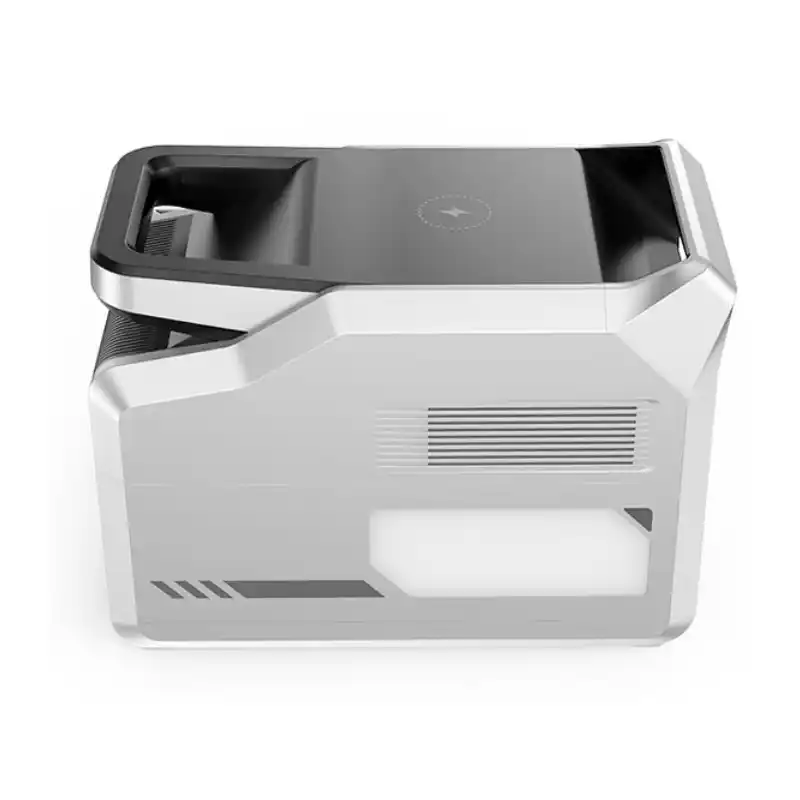
VigorPool Captain 1200 Review

The VigorPool Captain 1200 returns 1,269 Wh of its 1,280 Wh rating through DC, a 99% yield, the highest we have measured. It runs a 1,200W inverter, hands over in 10ms, and takes an expansion battery.
My Quick Verdict
Run this machine’s twelve-volt output, and 99% of the rated pack reaches you. Nothing else measured for this site comes close, and the meter found no standby loss on that path at all.
It is a startling figure for a category where 85 to 90% is considered good, and it changes what the machine is for. Anyone building around DC loads should be looking at this.
The AC side is, by comparison, at 85%, leaving an unusually wide gap between the two paths.
The bigger limitation is the inverter. 1,200 watts is low for 1,280 Wh, and it rules out most heating appliances.
Best for: Overland and camp builds running 12-volt equipment, and light household backup with modest loads.
Not for: space heaters, kettles, or anything needing more than 1,200 watts sustained.
Key Stats
Introduction
Conversion figures in this category cluster tightly. Most machines return between 78% and 91% of their rated capacity, and a two-point difference between rivals is notable.
The Captain 1200 returns 99% through its twelve-volt output. Out of 1,280Wh rated, 1,269Wh reaches you, and the meter recorded no measurable standby loss on that path at all.
No other machine measured at this site comes close to that. Second place on that measure is 96%, with most machines nearer 85.
Lithium iron phosphate cells claiming 3,500 cycles sit behind a two-year warranty, sound chemistry, brief coverage.
What It Can Actually Run
Twelve hundred watts sustained with 2,400 in a burst. That is modest for a 1,280Wh pack and the specification that defines what this machine can and cannot do.
Through the AC outlets, 1,100 Wh came back, an 85% return. The figures below use 1,100 Wh for AC loads and the much higher 1,269 Wh where DC applies.
- Refrigerator at 150W through the inverter: about 7 1/3 hours.
- CPAP at 40W without humidification: twenty-seven and a half hours.
- Starlink dish at 50W: twenty-two hours.
- Twelve-volt camp fridge at 45W, run on DC: better than 28 hours, based on the 1,269 Wh figure.
The line held a correct 120 volts, the inverter stayed quiet, and electrical noise read 1,465mv, tidier than most of this field.
Charging and Smart Features
Wall input reaches 800 watts with adjustable speed. That is slow in absolute terms, though the pack is small enough that a full charge still takes less than two hours.
The panel side accepts 400 watts at 12 volts (12 amps), and there is no need to disconnect the array afterwards.
The switchover measured 10 milliseconds, inside the band where a transfer is genuinely reliable.
Dual charging is listed as supported on the older grading sheet and not supported in the current testing data, so treat it as unconfirmed. Premium price tier, luxury value tier.
Charging Speed Benchmarks
Wall and panel recharge times for the VigorPool Captain 1200, set against the 30 machines our database holds in the 1,000Wh to 1,999Wh capacity class. Wall input across that group averages 1,085W and solar averages 641W. Bands are terciles calculated inside this class, so they place the unit among its own size peers rather than site-wide.
Mains charging of 800W falls below the 933W line that separates Low from Average in this bracket, so it takes a Low rating at roughly three quarters of the 1,085W class average. Filling 1,280Wh at that rate needs about 1.6 hours. This is the fastest charging class on the site, where inputs reach 2,400W and internal chargers are the norm, so a sub-1,000W figure stands out more here than the number alone suggests.
Panels are the weaker channel again. 400W is well under the 641W class average which rates Low where the class ceiling stands at 1,400W, taking roughly 3.2 hours of clear sun to refill the pack. That is double the wall socket time on a machine whose headline strength is delivery rather than input: it returns 99 percent through DC, the highest yield we have measured, so what it holds it hands back, but getting the energy in is the slow part.
Want both inputs roughly doubled? The EcoFlow Delta 3 Plus charges at 1,500W from a socket and 1,000W from panels, which brings a 1,024Wh pack back in about 0.7 hours on AC or 1.0 hour on solar. No other machine reviewed in this bracket returns to full faster, and the wall rate steps down for gentler overnight charging.
Real Capacity: What You Actually Get
The two paths on this machine diverge by 14 points, the widest gap in the database, and it runs strongly in the direction most buyers want.
Through the twelve-volt output: 1,269Wh of a rated 1,280Wh. 99%, and the highest DC yield recorded anywhere in our testing.
Through the AC outlets: 1,100Wh, or 85%. Perfectly respectable, and utterly ordinary next to the DC result.
Standby follows the same split. Roughly a percent and a half per hour while armed; on twelve volts, nothing registered at all.
In practice, that means a machine that loses almost nothing when used as it was clearly designed to be used, and behaves like any other unit when it is not.
My takeaway: 1,269 Wh at 12 volts versus 1,100 Wh through the sockets. That 169Wh gap is the largest in this database, making it unusually worthwhile to route loads onto DC here.
Power Output and Surge: What It Can Turn On
The inverter is where the machine grounds, and it provides quite a lot of it.
At 1,200 watts, the machine holds steady, stopping short of the 1,500 watts required for resistive heating, putting heaters, kettles, and hair dryers well beyond it. Most machines at this capacity offer 1,800 watts.
Twenty-four hundred watts of surge handles a refrigerator compressor starting, though with less margin than the 3,600-watt units at this size.
The DC side is the opposite story. A 145-watt twelve-volt socket is just under the 150-watt mark, but combined with the 99% yield, it makes twelve-volt equipment genuinely efficient to run here.
Waveform quality is good: 120 volts measured, no audible inverter noise, and 1,465mv of electrical noise.
Real Appliance Runtimes
Runtimes below use 1,100Wh for AC loads and 1,269Wh when the load runs on 12 volts.
The camp fridge line is the one worth studying. Running that load at 12 volts rather than through the inverter yields nearly 6 extra hours from the same pack, a larger gain than any other machine here offers.
Recharging: Wall and Solar
From a Wall Outlet
Eight hundred watts is slow by current standards, where machines of this capacity commonly take 1,200 to 1,440 watts.
The saving grace is that the pack is small. Even at 800 watts, a full charge lands inside two hours from empty, which is tolerable for most planning.
Charging speed is adjustable, so a gentler overnight rate is available.
Our two sources disagree on dual charging: the older grading sheet records it as supported, the current testing data does not. Confirm with VigorPool if running mains and panels together matters to you.
From Solar Panels
Panel input draws 400 watts at 12-56 volts and 12 amps.
That is a low ceiling even for a 1,280Wh pack, and it means solar alone will not refill the machine inside a typical charging window.
The voltage window is workable, wide enough at the bottom for a single foldable panel, and 56 volts allows two rigid panels in series.
Twelve amps is a modest current allowance, so a large parallel bank will hit the limit before the wattage does.
Panels may live permanently attached, and loads run throughout a charge.
Blackout Backup: The Part I Care About Most
Ten milliseconds is a genuinely good figure and one of the better transfer times at this capacity.
That sits inside the sub-eleven band, where a handover is reliable rather than merely legal, so a desktop, a router, or a network drive should continue through a mains failure without restarting.
Our records say nothing about whether it has its own inverter. That question has decided more purchases in this category than any other specification, so put it to VigorPool before you leave the machine to look after a house.
A standby drain of 1.5% per hour on the AC side makes leaving it armed more practical than leaving it free.
Why this matters to me: a ten-millisecond transfer on a machine this quiet, with a working app and an expansion port, is a genuinely capable backup package. The open self-arming question is the only thing stopping me from recommending it outright for that job.
Noise and Living With It
Forty-eight decibels under load, which is quiet by the standards of this capacity and beneath the threshold for a room where someone is sleeping.
Nothing audible comes from the inverter according to the sheet, leaving the fans to make all the noise on their own.
Weight is 33 pounds (14.9 kilograms), which is light for 1,280Wh and a comfortable one-handed carry over short distances.
Wi-Fi and Bluetooth are both supported. Two years of cover sits behind it, with a promise to answer within the day.
Where It Falls Short
Three limitations, the first of which determines what the machine can run.
1. A 1,200-Watt Inverter
Below the 1,500-watt threshold at which resistive heating appliances start, a space heater, kettle, or hair dryer will not run at all.
Most machines at this capacity offer 1,800 watts. This is the specification that will catch buyers out, because capacity and output are different constraints,s and this machine is generous on one and short on the other.
2. Four Hundred Watts of Solar and 800 Watts From the Wall
Both recharge routes are slow. Solar cannot refill the pack in a normal charging window, and the socket takes close to two hours.
For a machine otherwise well suited to camp and vehicle use, the modest solar ceiling is the more limiting of the two.
3. A Two-Year Warranty and a Luxury Value Tier
Two years is short where five is the class standard, particularly on cells rated for 3,500 cycles.
And per watt-hour,ur this is expensive, sitting in the luxury value tier while rivals at this capacity reach exceptional.
How It Compares
Two comparisons frame it: the strongest all-rounder at a similar size, and the other machine known for a high DC return.
Compared to the Bluetti Elite 100 V2, this machine wins in capacity, DC efficiency, quiet operation, and expansion support. It loses on inverter size, charging speed, solar input, weight, and warranty length, and BBluetti hasits own inverter.
For general household backup, the Bluetti is the better machine and costs a good deal less per watt-hour.
The Pecron E1000LFP is the closer comparison for anyone chasing DC efficiency, with a 90% return and a 300-watt XT60 output. The VigorPool beats it on yield by nine points but gives up 600 watts of inverter and half the solar input.
Who Should Buy It, and Who Should Skip It
Buy It If
- Your loads run on twelve volts, where nothing else in this database delivers so much of the pack.
- You want a quiet machine that can live in a room where someone sleeps.
- Expansion support matters, and you want it in a 33-pound package.
- Nothing in your load list needs more than 1,200 watts.
Skip It If
- A space heater, kettle, or hair dryer is on your list. The inverter cannot run them.
- Solar is your main recharge route, where 400 watts is too little.
- Warranty length matters:t two years versus a five-year standard.
- Cost per watt-hour is your deciding metric.
The Bottom Line
This machine does one thing better than anything else measured for this site, and it does it by a wide margin. A 99% DC yield with no measurable standby loss on that path is not an incremental improvement over the field; it is a different result altogether.
For a vehicle build, a camp setup, or anything else with 12-volt loads, the Captain 1200 is genuinely worth seeking out.
Ask for a general-purpose household machine, and the 1,200-watt inverter, the 400-watt solar ceiling, and the two-year warranty all start to matter. It is a specialist, and a good one.


There are no reviews yet.