
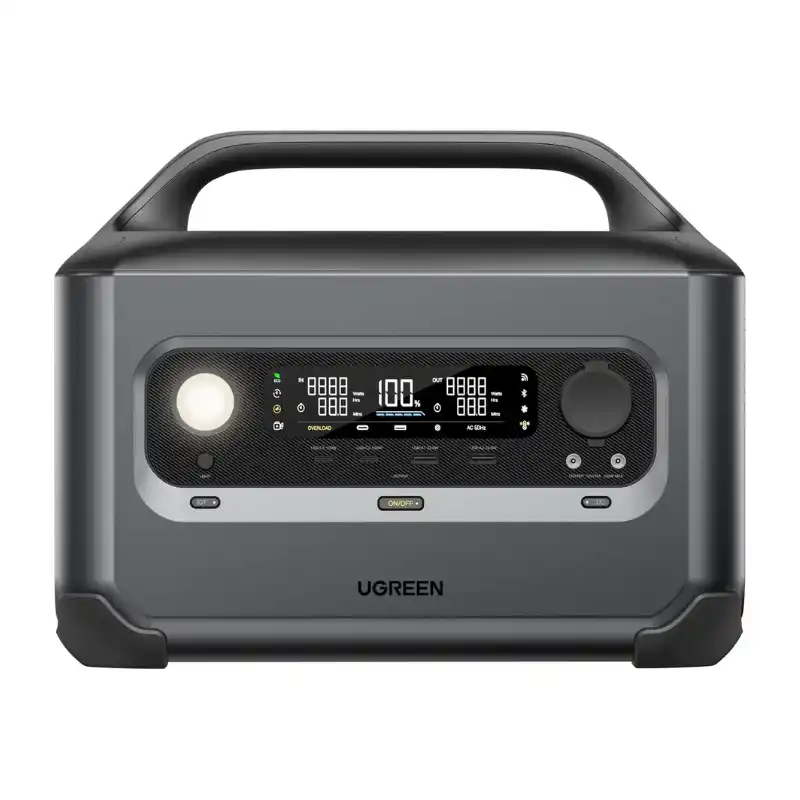
UGREEN PowerRoam 1200 Review

The UGREEN PowerRoam 1200 delivers 880Wh of its 1,024Wh rating, features a 1,200W inverter, runs at 45dB, and charges from the wall at 1,200W with adjustable charging speed. It has Wi-Fi and Bluetooth apps and a five-year warranty.
My Quick Verdict
Forty-five decibels puts this among the quieter machines we have measured, and it is the quietest of anything at 1kWh with a real app behind it.
It charges from a wall socket at 1,200 watts, refills in under an hour, and adjusts the rate so you can go gently overnight. Very few machines in this price band do all three.
The handover measured exactly 20 milliseconds, the threshold itself rather than a comfortable distance within it.
It also has no expansion path, no dual charging, and its DC side returns less than its AC side, which is unusual and worth planning around.
Best for: Camping and light household backup where quiet operation matters and the loads are modest.
Not for: protecting a computer, growing the system later, or twelve-volt-heavy builds.
Key Stats
Introduction
Most machines at this capacity make you choose. You can have quiet operation or fast charging, an app or a low price, but rarely all of the above.
The PowerRoam 1200 gets closer than most. Forty-five decibels under load, 1,200 watts of internal wall charging with adjustable speed, a working Wi-Fi and Bluetooth app, and five years of warranty behind 3,000-cycle cells.
That is a well-rounded specification sheet for a mid-size machine, and it is why this one grades better than several better-known rivals.
The compromises are real but are confined to specific areas rather than spread throughout the design.
What It Can Actually Run
Twelve hundred watts sustained with 2,400 in a burst. That covers a refrigerator, a television, and networking gear, though it falls short of the 1,500 watts a domestic space heater draws.
From a 1,024 Wh label, the outlets gave up 880 Wh. That 85% lands precisely on the class bar. Every figure below uses 880Wh.
- Refrigerator at 150W: nearly six hours.
- CPAP without humidification at 40W: twenty-two hours.
- Starlink dish at 50W: 17.5 hours.
- Laptop at 70W: about twelve charges over the 100-watt USB-C port.
The line held exactly 120 volts, the inverter made no sound of its own, and the electrical noise was 1,770 mV.
Charging and Smart Features
Wall input reaches 1,200 watts through an internal charger, with an adjustable rate. From empty, that is around fifty minutes.
Panels deliver up to 400 watts across a 12 to 48-volt range at 15 amps, and nothing needs to be unplugged afterwards.
The handover measured 20 milliseconds, which sits exactly on the safety threshold rather than inside it.
There is no dual charging here; the two inputs never operate at once. Upper mid-range price tier, exceptional value tier.
Charging Speed Benchmarks
Input speeds for the UGREEN PowerRoam 1200 plotted against the 1,000Wh to 1,999Wh capacity class, a bracket of 30 machines averaging 1,085W of mains input and 641W of solar. Low, Average and High are worked out inside this class, which is why the same wattage would read very differently on a 3kWh unit.
Wall charging is the stronger half. 1,200W is over the 1,085W class average and holds a mid-table Average rating, with adjustable speed behind it, refilling 1,024Wh in roughly 0.9 hours. In a bracket where inputs run from 200W to 2,400W, that puts the PowerRoam 1200 comfortably in the faster half without approaching the leaders, and the adjustment is worth using on a machine that will spend most of its life waiting on a shelf.
Panels are the shortfall. 400W is under two thirds of the 641W class average and a Low rating in a bracket reaching 1,400W, needing about 2.6 hours of unbroken sun to refill the pack, and realistically most of a usable daylight window once conditions take their share. Anyone pairing this with more than roughly 400W of panel is buying wattage the controller will discard, so size the array to the ceiling rather than to the pack.
Building an array around a 1kWh machine? The Dabbsson 1000 Pro carries the same 1,024Wh but accepts 1,200W of solar at 25 amps, three times the PowerRoam 1200 and the most generous current allowance in this bracket, which fills the pack from panels in about 0.9 hours. Its weakness is a 3.6% hourly standby drain, so treat it as a working solar machine rather than a standby unit.
Real Capacity: What You Actually Get
Conversion meets the class line on AC but falls below it on DC, the reverse of what most buyers expect.
Against a 1,024 Wh claim, the sockets delivered 880 Wh. 85% is exactly the figure machines at this capacity are expected to reach.
Twelve volts yielded 840Wh, 82%, trailing by three. Shifting loads to 12 volts buys nothing on this machine, and at 137 watts, the car outlet stays under the 150-watt limit regardless.
Retention holds up well, at roughly 0.9% per hour while armed, and a fifth of that at twelve volts. Charged and stored, this machine holds its state well.
My takeaway: Work from 880 Wh and favour the outlets over 12 volts. Here the sockets are the better route, which is the opposite of the usual advice.
Power Output and Surge: What It Can Turn On
The inverter is the one component for which the specification sheet is genuinely modest. Twelve hundred watts sustained handles a fridge, a television and lighting comfortably, but a 1,500-watt heater is beyond it entirely.
Most machines at this capacity offer 1,800 watts, so this is a real 600-watt gap rather than a rounding difference. Check your load list against it.
Twenty-four hundred watts of surge covers a refrigerator compressor starting, which is the load that matters most for household backup.
Output quality is good: a correct 120 volts, no audible whine from the inverter, and 1,770mv of electrical noise, which is mid-field.
Real Appliance Runtimes
880Wh converted into hours, on the loads applied uniformly across this site.
The CPAP line is where this machine makes its strongest case. Twenty-two hours is ordinary at this capacity; twenty-two hours at 45 decibels is not, and that is the difference between a machine you can sleep beside and one you cannot.
Recharging: Wall and Solar
From a Wall Outlet
Twelve hundred watts through an internal charger takes an empty pack to full in around fifty minutes.
Quick for what it costs, and delivered without a separate brick to transport or misplace, something several machines at a similar price still require.
The rate steps down as you like, so an overnight trickle is there when the clock allows, and the cells stay cooler as a result.
The limitation is that dual charging is not supported. The two inputs are exclusive, so under cloud cover you cannot ask the wall to make up whatever the panels are short by.
From Solar Panels
The panel input draws 400 watts at 12-48 volts and 15 amps.
Four hundred watts is not much compared to a kilowatt-hour, yet the grading sheet confirms that panels alone will fill it within the standard window, something a number of larger machines fail to do.
Engaging from 12 volts up, a single folding panel registers straight away, making occasional solar charging effortless.
Forty-eight volts at the ceiling is the tighter constraint. Two rigid panels in series will work; a longer string will not.
Leave the panels wired in indefinitely; the output continues throughout a charge.
Blackout Backup: The Part I Care About Most
This is the specification that decides where the machine sits.
The handover measured 20 milliseconds. That is the safety threshold itself, not a figure comfortably inside it, and at that speed whether a desktop or a network drive survives depends on the power supply inside it rather than on the power station.
For a refrigerator, lighting, or a router, 20 milliseconds is fine. For anything with a processor you care about, it is a gamble.
Our records do not indicate whether it has its own inverter; check with UGREEN if you need it to work with no one home. A standby drain of 0.9% per hour would at least make leaving it armed practical.
Why this matters to me: sitting exactly on a threshold is not the same as clearing it. If a computer is what you are protecting, several machines at this capacity hand over in under nine milliseconds, and this is not one of them.
Noise and Living With It
Forty-five decibels under load, which is quiet by the standards of this category and beneath the threshold for a room where someone is sleeping.
The inverter itself produces no audible noise either, so the fans are the sole source of noise, a distinction that several machines in this price band cannot claim.
For a machine likely to run a CPAP overnight or sit in a tent, that combination is the strongest thing on the specification sheet.
It reads 26 pounds, 12 kilograms; fair for a kilowatt-hour, and light enough to shift with one arm across a room. Both Wi-Fi and Bluetooth work, backed by five years of coverage and a same-day response pledge.
Where It Falls Short
Three limitations: first, check against your own appliance list.
1. A 1,200-Watt Inverter
It falls 600 watts below the 1,800 typical here and below the 1,500 a household heater pulls.
A fridge, a television, lighting, and networking gear all run comfortably. A heater, a kettle, or a hair dryer will not run at all.
2. A 20-Millisecond Handover
Exactly on the safety threshold rather than inside it. At that speed,d the outcome depends on the equipment plugged in.
Several machines at this capacity hand over in under nine milliseconds. If blackout protection for a computer is your reason for buying, look at those instead.
3. No Expansion, No Dual Charging, and a Weaker DC Path
There is no support for expansion batteries, so 1,024 Wh is a permanent ceiling.
Mains and solar cannot run together, and the 12-volt side returns 82% versus 85% on AC with a 137-watt socket, which falls short of the useful threshold.
How It Compares
Two comparisons at the same capacity: the strongest all-rounder, and the machine most buyers cross-shop this against.
Against the Bluetti Elite 100 V2, this machine wins on quietness by six decibels and loses on nearly everything else: 600 watts of inverter power, more than twice the handover speed, and 600 watts of solar input.
The Anker SOLIX C1000 converts marginally better and adds an expansion path, but runs 14 dB louder, which, for a bedroom machine, is the more consequential difference.
So the case here is specific rather than general. If the machine will live in a room where someone sleeps, and your loads stay under 1,200 watts, the PowerRoam 1200 is the quietest option. On any broader measure, both rivals are stronger.
Who Should Buy It, and Who Should Skip It
Buy It If
- The machine will run where someone sleeps, or in a tent.
- Your loads are a fridge, a television, lighting,g and devices rather than heating appliances.
- You want fast internal charging and an app without paying a premium tier.
- It will be stored charged between uses, where 0.9% an hour holds up well.
Skip It If
- A heater, kettle, or hair dryer is on your list. The 1,200W inverter cannot run them.
- You are protecting a computer or network drive through outages.
- You expect to add capacity later.
- Feeding it from socket and panels at once is part of your plan.
The Bottom Line
The PowerRoam 1200 is a well-judged machine that knows what it is for. Quiet, quick to charge, sensibly light, with a real app and a five-year warranty at a price that undercuts several rivals.
Two specifications draw the boundary. A 1,200-watt inverter rules out heating appliances entirely, and a 20-millisecond handover sits on the line rather than inside it.
Stay inside those two limits, and this is among the more pleasant machines to live with at 1kWh. Cross either, and there are better options for the same money.


There are no reviews yet.