

Bluetti EB70 Review

The Bluetti EB70 runs at 48dB, among the quietest machines in its class, and delivers 580 Wh of its 716 Wh rating via DC at 86% efficiency. Mains power arrives at 200W via a separate brick, with no handover function and no connectivity.
My Quick Verdict
Forty-eight decibels is genuinely quiet for a power station with a fan, and it puts the EB70 among the few units at this size you could sleep beside.
For camping, that is worth more than most specifications on the sheet, and rivals at this capacity run a full twelve decibels louder.
The rest belongs to an earlier generation. Two hundred watts through an external charging brick, no transfer function at all, no app, and an output measuring 110 volts.
It’s behind other Bluetti power stations, not because any single thing is broken, but because five ordinary things are a generation behind.
Best for: Quiet camping and tent use where the machine charges overnight beforehand and nothing needs monitoring.
Not for: backup, fast recharging, motors, or anyone comparing against current alternatives.
Key Stats
Introduction
Noise decides more about a camping machine than most buyers expect. Canvas absorbs nothing, and 60 decibels an arm’s length away decides whether you sleep.
The EB70 measures 48 decibels under load. Among machines of this capacity, it is genuinely quiet, and its closest rivals run 10 to 12 decibels louder.
That single figure is the reason to consider it, and almost everything else about the machine dates it.
The pack claims 2,000 lithium iron phosphate cycles against a two-year warranty; no machine this size offers less of either.
What It Can Actually Run
Seven hundred watts sustained with 1,400 in a burst. That runs a refrigerator, a television, and devices, and stops well short of any heating appliance.
From a 716Wh label,l the outlets delivered 580Wh, an 81% return that sits below the class bar. Everything below uses 580Wh.
- Refrigerator at 150W: nearly four hours.
- CPAP at 40W with the humidifier off: 14.5 hours.
- Starlink dish at 50W: 11.5 hours.
- A 45W twelve-volt camp fridge on DC: near thirteen and a half hours, drawn on the better 616Wh route.
The line read 110 volts, below the accepted band, with 1,928 mV of electrical noise and a whine coming from the inverter.
Charging and Smart Features
Wall input is 200 watts through an external charging brick, at a single fixed rate. From empty, that is more than three and a half hours.
Panels contribute 175 watts at 12-28 volts and 8 amps. Stopping at 28 volts makes this one of the tightest panel windows on record here.
Dual charging is not supported, so mains and panels cannot run together.
There is no UPS mode and no app. Upper mid-range price tier, luxury value tier.
Real Capacity: What You Actually Get
The twelve-volt path is the better of the two by five points, which is worth planning around.
A meter on the sockets recorded 580 Wh, compared with a claimed 716 Wh. Four points adrift of where this class is supposed to land.
The DC route returned 616Wh, or 86%, and clears that line comfortably. On a pack this size, the 36 Wh difference amounts to nearly an extra hour for a camp fridge.
No standby loss figures exist here for either path, leaving months-long storage an unknown for Bluetti.
One discrepancy to note: our grading sheet lists this machine at 672 Wh, while the testing data records 716 Wh. We have used the tested figure throughout.
My takeaway: 580 Wh through the sockets and 616 Wh through DC. Route twelve-volt loads accordingly, and bear in mind the AC side also delivers at 110 volts rather than 120.
Power Output and Surge: What It Can Turn On
Seven hundred watts continuous is modest and matched to the capacity. A refrigerator, lighting, a television, and devices all run; a kettle or a heater does not.
Fourteen hundred watts of surge covers a domestic compressor start with a reasonable margin.
Two 100-watt USB-C ports are genuinely generous at this size, whereas several rivals fit a single port or cap at 60 watts. Two laptops charge at full rate simultaneously.
The voltage is the problem. Ten volts below nominal makes a motor pull harder, heat up, and age sooner. Resistive loads and switching supplies are unaffected.
The inverter also produces an audible whine of its own, separate from the fans, which slightly undercuts the machine’s headline strength.
Real Appliance Runtimes
AC lines below use 580Wh; anything on twelve volts uses the better 616Wh measurement.
The CPAP line is where this machine earns its place. Fourteen hours is ordinary; fourteen hours at 48 decibels in a tent is not, and no rival at this capacity offers it.
Recharging: Wall and Solar
From a Wall Outlet
Charging a 716Wh pack at 200 watts takes more than three and a half hours from empty, and it charges via an external brick rather than a built-in charger.
The brick travels apart from the machine, needs somewhere to live, and eventually fails; with it gone, mains charging is impossible.
There is no adjustable rate either, so slow is the only speed.
For comparison, the EcoFlow River 2 Pro, with a similar capacity, charges internally at 940 watts and refills in under an hour. That is the gap between generations rather than between brands.
From Solar Panels
The solar input is the most restrictive specification on the machine after the charging brick.
One hundred and seventy-five watts between 12 and 28 volts at 8 amps. All three numbers are low.
The 28-volt ceiling is the binding one. Anything rigid generally sits above 28 volts and goes unrecognized, so parallel-wired foldables are all that remain.
The sheet notes that 175 watts will not complete a charge within the standard window, making panels a top-up rather than a plan.
The array can stay permanently connected, and pass-through charging is supported, both of which this implementation allows.
Blackout Backup: The Part I Care About Most
There is no automatic transfer function on this machine.
Its grading row lists the UPS mode as not applicable, meaning the sockets go dead in step with the mains.
That is expected at this capacity (most machines under 800Wh have no transfer function), but it is worth stating plainly, because the category name implies otherwise.
Treat the EB70 as a quiet camping battery rather than backup equipment, and it does that job well.
Why this matters to me: at this size, a missing transfer function is less damning than it would be on a 2kWh machine, because nobody wires a 716Wh unit into a house. It does mean that the “backup” should not appear in your reasoning.
Noise and Living With It
Forty-eight decibels under load, which is the single best thing about this machine.
For context, the EcoFlow River 2 Pro at a similar capacity reads 60 decibels, and the EcoFlow River Pro also reads 60. Twelve decibels is a substantial difference in perceived loudness.
Under canvas, in a small van, or in a bedroom, that decides whether the thing can stay in the room overnight.
The caveat is that the grading sheet records an audible whine from the inverter itself, so the fans are not the only source of the noise. Weight is 21.4 pounds (0.7 kilograms), which is reasonable rather than light for 716Wh. There is no app, and the warranty runs for two years.
Where It Falls Short
Four limitations, and none of them touches the reason to buy it.
1. Two Hundred Watts Through an External Brick
Three and a half hours plus from flat, one speed only, dependent on a part that lives outside the machine.
Current machines of this size draw 600 to 940 watts from a built-in charger and are fully charged within the hour.
2. Output Measured 110 Volts
Below the band, this category is considered safe. Undervoltage leads to higher current, higher winding temperature, and earlier failure during repeated starts.
Heating elements, lamps, and switching supplies notice nothing, so camp duties are unaffected.
3. A 28-Volt Solar Ceiling at 175 Watts
Among the narrowest solar windows we have measured, excluding most rigid panels outright.
Nor will 175 watts of panel finish a charge inside the standard window.
4. Two Thousand Cycles, Two Years, and No App
The shortest cell rating and warranty pairing at this capacity, around five and a half years at one cycle a day.
Neither wireless standard is fitted, so throughout its entire life nothing can be monitored or improved.
How It Compares
Two comparisons at a similar capacity, both charging far faster and both considerably louder.
The EcoFlow River 2 Pro charges nearly five times faster, outputs a true 120 volts, offers 1,000 more cycles, and includes an app. It runs 12 decibels louder, which, for a tent, is the whole argument against it.
The Acevolt Campower 700 is the more uncomfortable of the two. It is two decibels quieter still, converts seven points better with AC, outputs the correct voltage, charges two and a half times faster, and weighs four pounds less.
If quiet is genuinely your priority, the Acevolt does the same job better. The EB70’s case rests on Bluetti’s support network and the two USB-C ports.
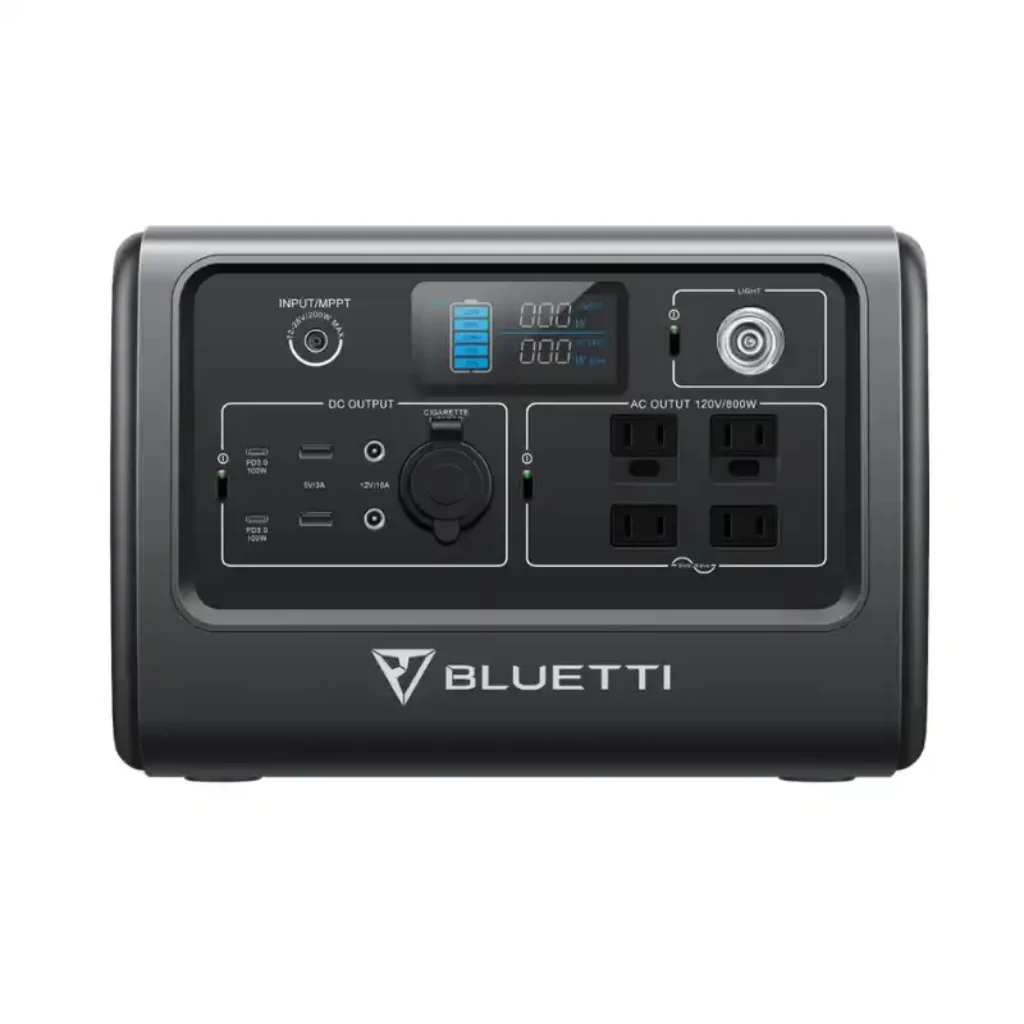
The BLUETTI EB70S (the upgraded version of the popular EB70) remains a highly practical and reliable mid-capacity choice, pairing a 716Wh LiFePO4 battery with an 800W continuous pure sine wave inverter (surging to 1,400W). Rated for over 3,000 charge cycles to 80% capacity and equipped with dual 100W USB-C PD ports, four standard AC outlets, a built-in LED utility lantern, and an integrated wireless charging pad on top, this 21.4-pound unit provides a versatile and lightweight off-grid foundation for camping, road trips, and essential emergency backup.
Who Should Buy It, and Who Should Skip It
Buy It If
- Quiet operation is your priority, and the machine sleeps in the same space as you.
- It gets charged overnight before planned use rather than between uses.
- Two USB-C ports at full rate matter for your kit.
- You want Bluetti’s support network behind a small machine.
Skip It If
- You need it full in under 3.5 hours.
- A refrigerator or pump will run on it repeatedly, where 110 volts matters.
- You own rigid solar panels, which a 28-volt ceiling excludes.
- The Acevolt Campower 700 is available and is quieter and better by nearly every other measure.
The Bottom Line
The EB70 does one thing genuinely well. Forty-eight decibels is quiet enough to sleep beside, and among machines at this capacity that is a real and rare quality.
Everything else has been overtaken. A 200-watt charging brick, 110-volt output, a 28-volt solar ceiling, 2,000 cycles, two years of warranty, and no app.
Buy it because it is quiet and you charge it overnight. Compare it to anything else, and current machines at this size do more for the same money.


There are no reviews yet.