
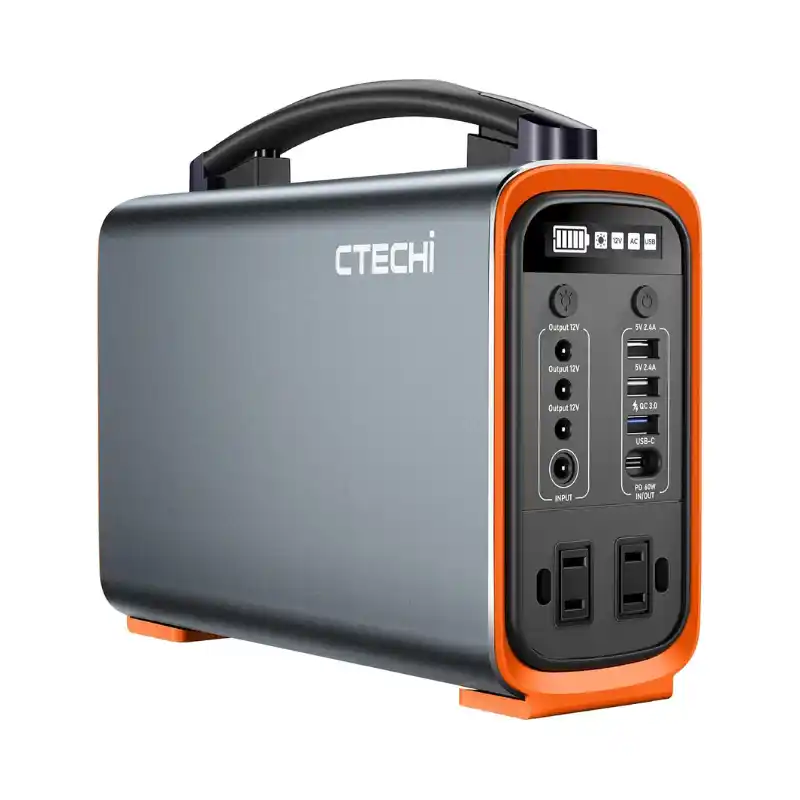
CTechi 240wh Review

The CTECHi GT200 240Wh portable power station is the smallest machine we have tested, weighing 7.9 pounds and delivering 190Wh at the correct 120 volts. Its 200W inverter is the smallest in our database.
My Quick Verdict
At 240 Wh, the CTECHi GT200 240Wh portable power station is the smallest machine we have tested, and at 7.9 pounds, the second-lightest.
It is also the cheapest energy at this capacity by a comfortable margin, and it delivers a correct 120 volts, which several larger machines fail to manage.
The inverter is 200 watts, the smallest in our database, so this is a device-charging machine and nothing more.
It charges at 60 watts via an external brick, which takes 4 hours from empty, and at 60 watts from solar, both of which are among the lowest figures we have recorded.
Best for: Backpacking and device charging on the smallest, cheapest machine that still does the job properly.
Not for: household appliances, quick refills, panel-led charging, or loads past a laptop and a lamp.
Key Stats
Introduction
This is the smallest machine in our database. Two hundred and forty watt-hours, a 200-watt inverter, 7.9 pounds, and a price that undercuts everything else at this size.
There is a real argument for a machine this modest. If your loads are a laptop, a camera, some lighting, and a phone, a larger unit is weight and money you are carrying for nothing.
It also gets one thing right that several machines four times its size do not: output measures a correct 120 volts.
The pack claims 2,000 lithium iron phosphate cycles, which is par here.
What It Can Actually Run
Two hundred watts sustained with 400 in a burst. That is the smallest continuous output in our database, and it defines what the machine is for.
Rated at 240Wh, the sockets returned 190Wh (79%), six points below the class line. Everything below uses 190Wh.
- Laptop at 70W: two and three-quarter hours of continuous running.
- CPAP at 40W with the humidifier off: four and three-quarter hours.
- Starlink dish at 50W: nearly four hours.
- A 45W twelve-volt camp fridge on DC: past four and a half hours, drawing on 209Wh.
Output measured a correct 120 volts. Electrical noise went unmeasured here.
Charging and Smart Features
Wall input is 60 watts through an external charging brick at a single fixed rate. From empty,y that is around four hours.
Solar takes about 60 watts, which is among the lowest ceilings we have recorded.
Feeding both inputs at once reaches 120 watts, cutting the wait in half when the sun cooperates.
There is no UPS mode and no app. Entry-price tier; premium-value tier.
Charging Speed Benchmarks
Time to full for the CTechi 240Wh, plotted against the Under 300Wh capacity class, a bracket of 24 machines averaging 131W of mains input and 97W of solar. Low, Average and High are calculated within this class, and the bands sit so close together at this size that the raw wattage is the more useful number.
Wall charging of 60W technically holds an Average rating, since Low in this bracket means under 60W, but it sits at the very bottom of that band and is under half the 131W class average. Filling 240Wh at that rate needs about 4.0 hours. Put against the 600W class maximum, which does the same job in half an hour, the gap is tenfold. For the smallest machine we have tested, paired with a 200W inverter, an overnight charge is the realistic pattern rather than a top-up between uses.
Panels match the socket exactly at 60W, below the 97W class average and again sitting on the lowest rung of the Average band, which comes to roughly 4.0 hours of clear sun before the pack is full. Neither channel is faster than the other, so there is no tactical choice to make between them. A single 60W folding panel is the whole array this machine can use, which at least keeps the kit small and the cost down.
Want a compact unit that refills in under an hour? The EcoFlow River 2 charges internally at 360W, six times the CTechi, and brings a comparable 256Wh pack back in roughly 0.7 hours instead of four. Solar rises to 110W. At 7.4 pounds it is also the lightest machine in our database, so the smaller footprint that makes the CTechi appealing is not what you would be giving up.
Real Capacity: What You Actually Get
The twelve-volt path is 8 points stronger than the other.
A meter on the sockets recorded 190 Wh, compared with a claimed 240 Wh. Six points under the standard this class is held to.
Twelve volts returned 209 Wh (87%) over the bar. On a pack this small, routing loads onto twelve volts and USB is worth doing.
Standby loss went unrecorded on both paths, so shelf behaviour is unknown.
For context, the EcoFlow River 2 at a similar capacity returns 74% through AC. This machine is five points better through the sockets and two points behind on DC.
My takeaway: Plan on 190 Wh at the outlets, 209 Wh at 12 volts. With only 240 Wh in hand, each point matters, so favour 12 V and USB wherever the kit allows.
Power Output and Surge: What It Can Turn On
Two hundred watts continuous is the smallest inverter in our database, and it sets a hard boundary on what this machine is for.
A laptop, lighting, a router, a phone charger, and a camera charger are all running. A 150-watt television works but leaves almost nothing spare. Anything beyond that does not run at all.
The 400-watt burst covers whatever the inverter can hold steady.
What it does well is deliver clean power. A proper 120 volts is better than what four compact machines in our database can handle, and it means the small things you do run are handled properly.
The 60-watt bidirectional USB-C port charges phones and tablets at full speed, charges a laptop at a reduced rate, and can also recharge the device from a compatible source.
Real Appliance Runtimes
AC lines below use 190 Wh; the 12-volt line uses the higher 209 Wh measurement.
These are short figures, and honestly so. A 240Wh machine is a device battery, and judged against that job rather than against a larger unit, it does what it should.
Recharging: Wall and Solar
From a Wall Outlet
Charging 60 W into a 240 Wh pack takes around 4 hours from empty, which is slow in absolute terms, though less painful than it sounds for a pack this small.
Power comes from a brick in the cable, another item to pack and eventually renew.
There is no adjustable rate, so slow is the only speed.
Dual charging is the saving feature: mains and panels together deliver 120 watts, which halves the wait when the sun is out and gets you a full charge inside in about two hours.
From Solar Panels
Panel input takes around 60 watts, which is among the lowest ceilings in our database; only the Energiser 320Wh accepts less.
No voltage range appears in our records, so ask CTechi directly before committing to panels.
Sixty watts takes up most of the day, and the sheet confirms that sunshine alone falls short of the standard refill window.
Running both inputs at once genuinely helps, taking the total to 120 watts.
The array can stay permanently connected, and pass-through charging is supported.
Blackout Backup: The Part I Care About Most
There is no automatic transfer function on this machine, which is entirely expected at 240Wh.
Only one machine at this capacity offers a transfer function at all, and it drains itself while waiting for a power cut.
Treat this as a device battery you carry, and the absence costs nothing at all.
Why this matters to me: with 240Wh behind a 200-watt inverter, protection was never what this was selling. This machine is competing on weight and price, and it should be judged on those.
Noise and Living With It
No fan noise measurement exists in our data for this machine, which is a gap for a compact unit likely to be used in a tent.
The comparable data point is CTechi’s own 500 Wh machine, which measured 45 dB and had a silent inverter. That is suggestive rather than conclusive.
Weight is 7.9 pounds (3.5 kilograms), making this the second-lightest machine in our database, behind the EcoFlow River 2 at 7.4.
No connectivity at all, so nothing can be watched, altered or improved.
Where It Falls Short
Three limitations, and the first is simply what a machine this size is.
1. A 200-Watt Inverter
No machine here delivers less continuously, which confines it to laptops, lamps, networking kit and chargers.
That is not so much a flaw as a definition, but it is worth being clear about before buying. A 150-watt television uses three-quarters of the ceiling.
2. Sixty Watts of Charging and Sixty Watts of Solar
Around four hours from empty through an external brick, with a solar ceiling among the lowest we have recorded.
Dual charging at 120 watts combined is what rescues it, halving the wait when the sun cooperates.
3. Seventy-Nine Per cent Through AC, No App, No Noise Data
Six points adrift of the standard, leaving 50 watt-hours of a modest battery unreachable.
There is also no Bluetooth or Wi-Fi, and no fan or electrical noise is present in our data.
How It Compares
Two comparisons at the smallest end of our data.
This machine wins on price and AC conversion, beating the EcoFlow River 2 by five points at the sockets, which, on packs this small, is a meaningful gap.
It loses on nearly everything else. Both rivals charge five to seven times faster, both carry apps, both have longer warranties, and both offer more inverter.
The case for the CTechi is that it costs considerably less and does the one job a 240Wh machine should do. If that is genuinely all you need, it is honest value.
Who Should Buy It, and Who Should Skip It
Buy It If
- Your loads are a laptop, lighting, a phone and a camera, and nothing more.
- Price is the deciding factor at this capacity.
- Weight matters, and 7.9 pounds is manageable for how far you carry it.
- Correct output voltage matters to you on a budget machine.
Skip It If
- Anything on your list draws more than 200 watts.
- You need it full in under four hours.
- Solar is part of your plan, at around 60 watts.
- Connectivity, longer cover or a working handover matter to you.
The Bottom Line
This is the smallest and cheapest machine in our database, and judged against what a 240Wh unit should do, it is honest.
A correct 120-volt output, 87% through DC, dual charging and 7.9 pounds are all appropriate to the job, and the price undercuts everything at this size.
What you cannot do is run appliances, charge quickly, or rely on solar. Buy it as a device battery for trips, and it delivers. Ask more of it, and the 200-watt inverter answers immediately.


There are no reviews yet.