
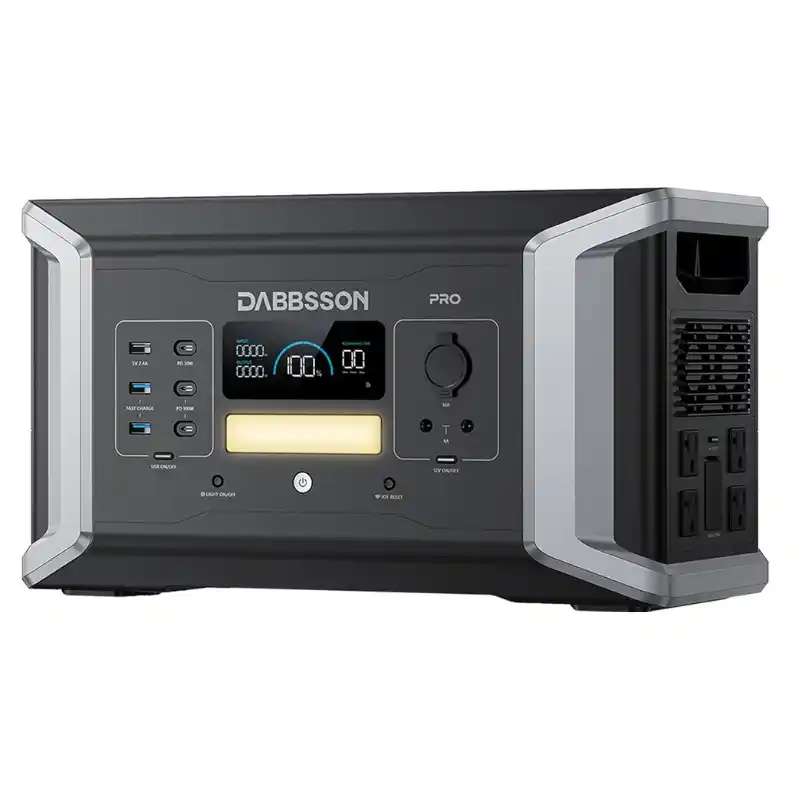
Dabbsson 1000 Pro Review

The Dabbsson 1000 Pro pairs 1,024Wh with a 2,000W inverter and a 4,000W surge, and its lithium iron phosphate cells carry a 4,500-cycle rating—the longest life measured in this class. Solar input reaches 1,200W at 25 amps, fans stay at 47dB, and it lands in the mid-range price tier.
My Quick Verdict
Two numbers in this unit sit at opposite ends of the dataset and belong to the same machine.
Its cells carry a 4,500-cycle rating. That is the highest figure I have on record anywhere, from any maker, at any capacity. Cycled daily, it would outlast the vehicle it’s carried in.
It also sheds 3.6% of its charge every hour it sits idle with the inverter awake. That is the worst standby figure in the dataset, and it means a fully charged unit is flat in a day and a half with no activity at all.
A pack built to last twelve years, attached to electronics that cannot be left alone for two days. How you feel about that contradiction decides this purchase.
Best for: Remote Work and DIY Tools, and Overland or RV use where the unit is in regular rotation rather than stored.
Not for: sitting in a cupboard waiting for a blackout. It will not be full when you get there.
Key Stats
| Badge | Stat |
| Battery Chemistry and Longevity | LiFePO4 | 4,500 Cycles |
| Continuous AC Power Output | 2,000W AC | 4,000W Peak |
| Energy Storage Capacity | 1,024Wh | 860Wh Usable |
| Rapid AC Wall Recharge | 1,200W Input | Adjustable Speed |
| Uninterrupted Emergency Backup | 13.3ms UPS | Manual Arm |
| Maximum Solar Input and MPPT | 1,200W Solar | 25A, 75V VOC |
| Ultra-fast USB-C Power Delivery | 100W USB-C PD |
| Low-noise Operational Level | 47dB | Whisper Quiet |
| Modular Capacity Expansion | Expandable | Extra Battery Port |
| Smart App Remote Control | Wi-Fi + Bluetooth App |
Introduction
Cycle ratings in this category cluster around 3,000 to 4,000, and the difference between them rarely changes a buying decision. Nobody cycles to a power station daily for a decade.
The Dabbsson 1000 Pro claims 4,500, the highest value in the dataset by a clear margin. Taken at face value, it is a 12-pack in a category where 8 is considered generous.
The specification that undercuts it does not appear on any marketing page. Left switched on and idle, this unit loses roughly 3.6% an hour, which is more than three times what the best units in this class lose and enough to empty a full pack inside two days.
What It Can Actually Run
Sustained output is 2,000W with a 4,000W peak. That sustained figure pushes it into the Heavy-Duty Household Class despite having only a kilowatt-hour of storage, so it will power a space heater or a portable air conditioner that smaller inverters cannot.
Storage reads 1,024Wh. Metered at the sockets, it returned 860 Wh, an 83.9% return that is among the weaker conversion figures here. Calculations below use 860Wh.
- Full-size refrigerator at 150W: a little under six hours.
- CPAP at 40W with humidifier off: roughly 21 hours.
- Starlink dish at 50W: about 17 hours.
- Laptop at 70W: a dozen refills through USB-C.
Voltage held at 121. Harmonic distortion was not measured in the available bench data; confirm it with Dabbsson before running the medical equipment.
Charging and Smart Features
Wall input peaks at 1,200W with stepped rate control, filling an empty pack in a little under an hour.
The solar side is genuinely strong. Up to 1,200W across a 12 to 60 volt band at 25 amps, with a 75-volt open-circuit ceiling. Twenty-five amps is the most generous current allowance in this comparison, and it enables serious arrays rather than foldable panels.
Crossover came in at 13.3 milliseconds, and the inverter will not self-arm. Leave the array connected indefinitely if you wish; it powers loads while taking charge, and the combined inputs cap at 1,200W.
Price tier: mid-range; value tier: good. You are paying a premium over the entry-tier units, and the cycle rating is what that premium buys.
Charging Speed Benchmarks
Recharge speeds for the Dabbsson 1000 Pro plotted next to the slowest, typical and quickest inputs across the 1,000Wh to 1,999Wh capacity class. That bracket holds 30 machines in our charging database at an average of 1,085W on mains and 641W on solar. Each rating below is a within-class tercile rather than a site-wide score.
Wall input reaches 1,200W, slightly over the 1,085W bracket average and inside the Average band, refilling the 1,024Wh pack in approximately 0.9 hours at full rate. The bracket itself spans 200W to 2,400W. Charging is adjustable, which is worth using on this particular machine: it sheds 3.6% of its charge every hour the inverter idles, so the sensible pattern is a slow overnight charge immediately before use rather than filling it and leaving it standing.
Solar is the standout input. 1,200W is nearly twice the 641W bracket average and a firm High rating, close to the 1,400W ceiling for this class, and it fills 1,024Wh in about 0.9 hours of strong light. The 25-amp current allowance behind it is the most generous in this comparison, which matters because current, not voltage, is what usually stops a wide array of low-voltage panels delivering its rating. With a 75-volt open-circuit ceiling on top, this is a machine built to live beside an array and be cycled daily.
Want faster grid charging with the same solar headroom? The Bluetti AC240 draws 2,400W from a socket, double the Dabbsson figure, and fills a bigger 1,536Wh pack in roughly 0.6 hours. Solar comes down to 900W, so the swap trades some array headroom for the ability to refill half again as much capacity in two thirds of the time.
Real Capacity: What You Actually Get
This is the section where the Dabbsson gives up ground, and it gives up more than any other unit reviewed here.
Metered output on the AC side was 860 Wh against a claimed 1,024 Wh, for a ratio of 83.9%. The 12-volt side was worse at 835 Wh, an 81.5% return, which is unusual since DC typically outperforms AC.
Both figures sit below the 85% line that most units in this class clear comfortably. On conversion alone, you lose the better part of a fridge-hour compared with the leaders.
Then there is standby. With the inverter awake and nothing connected, the meter recorded 3.6% per hour. On the DC side, it settles at a more ordinary 1%, but the AC figure governs how this unit behaves in a cupboard.
My takeaway: 860 Wh is your working number, and 3.6% per hour determines where this unit lives. Charge it, leave it armed on a Friday, and by Sunday morning it is empty.
Power Output and Surge: What It Can Turn On
The gap between sustained and peak output is generous here, which is why this unit sits a power class above its capacity.
Two kilowatts, held continuously, is enough for heating appliances that defeat smaller inverters. Four thousand watts of peak power swallow a refrigerator compressor’s startup demand with nearly three times the required margin
For a kilowatt-hour unit that is unusual. Most stations at this capacity pair an 1,800W inverter with 2,400W to 3,600W of peak, and they are working harder to do less.
The catch is that a 2,000W load drains 860 Wh in about 25 minutes. The inverter can start almost anything; the battery cannot run it long.
Real Appliance Runtimes
Eight hundred and sixty watt-hours, expressed as time. The loads are the standard set used throughout this site.
Appliance
Power Draw
Runtime
What That Means
Full-size refrigerator
150W
About 5.7 hours
An evening, extending as the compressor rests between cycles.
CPAP machine (no humidifier)
40W
About 21.5 hours
Two nights, though with less margin than most units here.
Starlink dish
50W
About 17.2 hours
Enough for a shift online and some of the night.
Pellet grill or smoker
100W
About 8.6 hours
A long cook, comfortably.
Laptop (70W)
70W
About 12 recharges
Via the 100W USB-C port.
These figures are shorter than they should be for a kilowatt-hour unit, and the 83.9% conversion is why. A rival returning 86% of the same rated capacity buys you roughly 20 minutes of extra fridge time.
Recharging: Wall and Solar
From a Wall Outlet
Mains charging reaches 1,200W and steps up or down rather than offering a simple choice of two speeds.
Empty-to-full runs just short of sixty minutes. Middle of the field, and neither an argument for nor against the unit.
From Solar Panels
Here, the Dabbsson is one of the best units on this site, and it is the clearest reason to buy it.
Panel input reaches 1,200W across a 12- 60 V operating range, with a 75 V open-circuit voltage and a 25 A current limit.
Twenty-five amps is the headline. Most units in this class stop at 10 to 20 amps, and current is usually the limit you hit before wattage. A generous current ceiling means you can run substantial rigid panels at a modest voltage without the controller clipping you.
Good sun brings an empty pack back in around two and a half hours. Panels may remain wired permanently; loads run during charging; and mains and sun together accept 1,200W.
Blackout Backup: The Part I Care About Most
Backup performance is middling, and the standby problem compounds it in a way it does not on other units.
Crossover measured 13.3 milliseconds, safely inside the 20-millisecond line but well behind the sub-9 figures posted by the best units.
The inverter cannot arm itself. Arming it is a manual act, and it stays armed only as long as you leave it that way.
On most units, that is an inconvenience. Here, it is close to a disqualification because leaving the inverter armed costs 3.6% per hour. Arm it, and the pack drains itself in under two days. Leave it off,ff and it protects nothing.
Why this matters to me: every other manually armed unit on this site at least lets you leave it armed. This one punishes you for doing so. As an unattended backup, it is effectively unusable, and no firmware update will change that.
Noise and Living With It
Forty-seven decibels under load, which is genuinely quiet and one of the better readings on this site.
That is roughly a still room with a fridge humming somewhere in it. You could sleep beside this unit without difficulty, which sits oddly against everything else about its character.
Weight is 34 pounds (15.6 kilograms). Heavy for a kilowatt-hour, and the price of carrying a 2,000W inverter in a small case. Two hands, and you will notice on the stairs.
Both Wi-Fi and Bluetooth are supported. The first lets you watch it from indoors; the second keeps working when there is nothing to connect to.
Where It Falls Short
One flaw here is severe enough to define the unit. Three others are worth weighing.
1. Standby Drain of 3.6% an Hour
This is the worst idle figure in the dataset by a wide margin, and it changes what the unit can be used for.
A full pack of left-armed empties in roughly 28 hours. A power station built for blackouts spends almost its entire life idle, so this specification eliminates the category’s primary use case.
Switching the inverter off avoids the drain and also removes any possibility of it catching an outage. There is no configuration where this unit is good at waiting.
2. The Weakest Conversion Figures Here
An 83.9% return through AC and 81.5% through DC are both below the class line, and the DC figure being lower than AC is backward from the norm.
Practically, a 1,024Wh unit that behaves like an 860Wh one is competing against rivals that deliver 890Wh or 910Wh from the same nominal capacity.
3. Heavy for What It Stores
Thirty-four pounds for 1,024Wh is poor by the standards of this class, where 25 to 29 pounds is normal. The 2,000W inverter accounts for it, but the weight is real whether or not you use that headroom.
4. Distortion Was Not Measured
No harmonic distortion figure is present in the available bench data. For tools, laptops, and lighting,g that is immaterial. Before running a CPAP machine or medical equipment on it, ask Dabbsson directly rather than assuming.
How It Compares
Two units frame the trade. The Pecron E1000LFP is the closest match in capacity and expansion, and the Montek X1200 is the other Heavy-Duty Household Class unit at roughly the same size.
| Feature | Dabbsson 1000 Pro | Pecron E1000LFP | Montek X1200 |
| Price Tier | Mid-range | Entry | Mid-range |
| Value Tier | Good | Exceptional | Good |
| Rated Capacity | 1,024Wh | 1,024Wh | 1,280Wh |
| Usable Through AC | 860Wh (83.9%) | 880Wh (85%) | 1,190Wh (92%) |
| Cycle Rating | 4,500 | 3,500 | 2,500 |
| Idle Drain Per Hour | 3.6% | 1.5% | 1.3% |
| Sustained Output | 2,000W | 1,800W | 2,000W |
| Surge Output | 4,000W | 2,000W | 7,000W |
| Solar Current Ceiling | 25A | 20A | 20A |
| Fan Noise | 47dB | 53dB | 57dB |
Against the Pecron E1000LFP, the Dabbsson offers 1,000 more cycles, twice the surge headroom, 6 dB less noise, and a higher solar ceiling. The Pecron offers better conversion, less than half the standby drain, and an entry-level price tier.
That exchange is closer than it looks, and the standby figure decides it. If the unit is going to be stored, the Pecron wins outright. If it is going to be used weekly, the Dabbsson’s cycle rating and quiet fans start to matter.
The Montek X1200 makes the Dabbsson look inefficient by comparison, returning 92% versus 83.9% and offering a far higher surge ceiling. What it gives up is 2,000 cycles and ten decibels of quiet. These are two very different bets on how long you intend to own the thing.
Who Should Buy It, and Who Should Skip It
Buy It If
- The unit will be in regular use rather than stored between emergencies.
- You are building a real solar array and want the headroom that 25 amps and 75 volts allow.
- You need a 2,000W inverter in a package this small.
- Quiet operation matters, and you can live with the weight.
Skip It If
- It will sit charged in a cupboard,d waiting for a blackout. This is the wrong unit for that job.
- You want the most usable energy per rated watt-hour. Conversion here is the weakest in this comparison.
- You need unattended UPS protection of any kind.
- Weight matters, or you will be carrying it regularly.
The Bottom Line
The Dabbsson 1000 Pro is built to last. A 4,500-cycle pack, a 2,000W inverter, quiet fans, and the best solar current ceiling here are all real, and none of them is common at this size.
But it leaks. Losing 3.6% an hour on standby is not a rounding error; it is a design characteristic, and it removes the one thing most buyers in this category actually want: a unit that is full when they finally need it.
Buy it as a working tool that lives in rotation and gets recharged often, and the cycle rating starts to pay off. Buy it as an emergency backup, and you will find it flat on the night it mattered.


There are no reviews yet.