
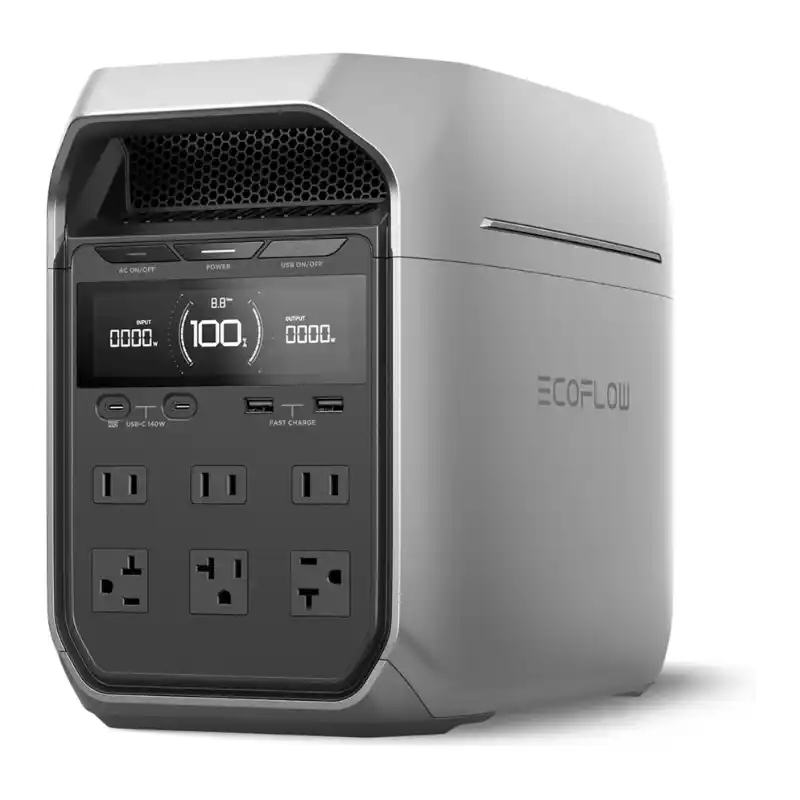
EcoFlow Delta 3 Max Plus Review

The EcoFlow Delta 3 Max Plus holds 2,048Wh behind a 3,000W inverter with 6,000W of surge, crossing over in 7.9ms with a self-arming inverter. Distortion measures 0.30% “the cleanest recorded” fans stay at 42dB, and dual charging reaches 2,600W. Upper mid-range price tier, good value.
My Quick Verdict
Thirteen units into this dataset, a pattern has been impossible to ignore. Nearly everyone carries a defect that decides who should not buy it. Fans are too loud for a bedroom. An inverter that will not arm itself. A solar ceiling that rules out real panels. A pack that empties itself while it waits.
The Delta 3 Max Plus does not have one of those. It is the first unit reviewed here in which the shortcomings are matters of degree rather than exclusion.
It crosses over in 7.9 milliseconds and arms itself. Distortion measures 0.30%, the cleanest waveform in the entire dataset. The fans run at 42 decibels. Dual charging reaches 2,600 watts.
What holds it back from a perfect account is conversion “at 84% through the outlets” and 48 pounds of mass.
Best for: Emergency Home Resilience at whole-circuit scale, and Medical or CPAP Backup where waveform quality and silence both matter.
Not for: buyers optimising purely on cost per watt-hour, or anyone who needs to carry it far.
Key Stats
| Badge | Stat |
| Battery Chemistry and Longevity | LiFePO4 | 3,500 Cycles |
| Continuous AC Power Output | 3,000W AC | 6,000W Peak |
| Energy Storage Capacity | 2,048Wh | 1,740Wh Usable |
| Rapid AC Wall Recharge | 1,800W Input | 2,600W Dual |
| Uninterrupted Emergency Backup | 7.9ms UPS | Self-arming |
| Maximum Solar Input and MPPT | 1,000W Solar | Dual 500W Ports |
| Ultra-fast USB-C Power Delivery | 140W USB-C PD |
| Low-noise Operational Level | 42dB | Whisper Quiet |
| Inverter Waveform Quality | 0.30% THD | Cleanest Measured |
| Modular Capacity Expansion | Expandable | Extra Battery Port |
Introduction
The interesting question about a two-kilowatt-hour unit is rarely how much it stores. At this size, the capacity is a given; what separates the field is whether the engineering around the pack was completed.
Most of it is not. Across the units reviewed on this site, the recurring failures are a crossover too slow to trust, an inverter someone has to remember to switch on, fans that make a room uninhabitable, and solar inputs too narrow for real panels.
This unit closes all four. Lithium iron phosphate cells sit behind it, rated for 3,500 cycles and warranted for five years. Run one cycle a day, and you’ll reach the 80% mark in about a decade.
What It Can Actually Run
Sustained output is 3,000W, with a peak of 6,000W. That is a genuine whole-circuit inverter, comfortably able to hold heating appliances and a second load together.
Rated storage is 2,048Wh. Metering the sockets produced 1,740 Wh, an 84% return, which is the one ordinary number on the specification sheet. Calculations below use 1,740Wh.
- Household refrigerator at 150W: eleven and a half hours.
- CPAP without humidifier at 40W: over forty hours, so four nights.
- Starlink dish at 50W: nearly thirty-five hours.
- Laptop at 70W: around twenty-five refills, at full speed off the 140W port.
Output measured 121 volts with 0.30% distortion. That distortion figure is roughly a fifth of the field average and the lowest recorded across every unit reviewed here.
Charging and Smart Features
The main input reaches 1,800W with stepped control, and when combining wall and solar, it boosts to 2,600W, one of the highest dual-charging figures in this set.
A thousand watts of panel input arrives through a pair of 500W sockets, each accepting 11 to 60 volts at 18 amps. The dual-port arrangement means two separate arrays rather than one, offering more flexibility than a single input of the same rating.
The handover took 7.9 milliseconds, and because the inverter comes up on its own, the protection does not depend on anyone being at home.
Upper mid-range price tier, good value tier. This is not the cheapest way to buy watt-hours, and what follows is an assessment of whether the build quality earns the difference.
Charging Speed Benchmarks
Input performance for the EcoFlow DELTA 3 Max Plus set beside the 26 units we hold input data for in the 2,000Wh to 3,000Wh capacity class. The class averages 1,641W from a wall socket and 1,123W from solar. Low, Average and High are calculated inside this class alone, so each one describes the machine against its own size bracket and nothing larger.
The DELTA 3 Max Plus takes 1,800W from the wall, comfortably past the 1,641W class average and landing on the very last watt of the Average band, since a High rating in this bracket starts above 1,800W. The field around it stretches from 470W to 5,000W. Divided into a 2,048Wh pack, that input gives a best case of roughly 1.1 hours from flat, and EcoFlow's own quoted 64 minutes to 80 percent is the more realistic planning number because input drops away steeply once the cells approach full.
Solar comes in at 1,000W across two independently tracked 500W ports, sitting just under the 1,123W class average and well short of the 2,400W ceiling two units in this class reach. That is an Average rating rather than a weak one, and it brings the pack back in about 2.0 hours under a clear sky. The dual-port arrangement matters more than the headline figure here: two arrays at different angles are tracked separately, so a shaded string does not drag down an unshaded one. What the ceiling does mean is that a third panel string has nowhere to go.
Want more solar headroom at this capacity? The DJI Power 2000 matches the DELTA 3 Max Plus watt for watt on wall charging at 1,800W but accepts 1,800W of solar, 80 percent more, over a 43-amp path that is the largest current allowance in our entire dataset. That turns a two-hour solar refill into roughly 1.1 hours on the same size pack. If your array is already built and you want it to actually reach the battery, that is the swap worth considering.
Real Capacity: What You Actually Get
Conversion is the only place this unit gives ground, and even here the shortfall is small rather than serious.
Metered output at the sockets was 1,740 Wh, compared to a claimed 2,048 Wh, or 84%. That is a point below the line most units at this size clear, and it costs roughly 20 minutes of refrigerator time compared to a rival returning 85%.
The twelve-volt route did considerably better at 1,830 Wh, with an 89% return, so anything that can run on DC should.
Standby behaviour is excellent. Inverter awake and nothing connected, it loses about 0.9% an hour, and 0.33% through the DC path. A unit left armed for a week is still nearly full.
My takeaway: 1,740Wh is the working figure. The 84% conversion is the one specification where a cheaper rival will beat it, and it is worth knowing that before paying the premium.
Power Output and Surge: What It Can Turn On
At this size, the two output figures start to describe genuinely different capabilities rather than degrees of the same one.
Three thousand watts sustained is enough to run a space heater and a refrigerator simultaneously, or a microwave alongside lighting and networking equipment. Units rated 1,800W are choosing between those loads; this one is not.
Six thousand watts of peak means no domestic appliance start will cause trouble.
The waveform is where this unit truly excels. Harmonic distortion of 0.30% is around a fifth of what most rivals produce, and electrical noise measured at 830 mV against a field frequently exceeding 2,000mv. For a CPAP motor, a workstation, or audio equipment, that is a meaningful difference rather than a specification-sheet flourish.
Real Appliance Runtimes
| Appliance | Power Draw | Runtime | What That Means |
| Full-size refrigerator | 150W | About 11.6 hours | A full night and most of a day, longer once the compressor rests. |
| CPAP machine (no humidifier) | 40W | About 43.5 hours | Four nights, on the cleanest waveform in this dataset. |
| Starlink dish | 50W | About 34.8 hours | Thirty-four hours of dish uptime on one charge. |
| Pellet grill or smoker | 100W | About 17.4 hours | Two full cooking sessions between charges. |
| Laptop (70W) | 70W | About 25 recharges | At full 140W speed, so each one is quick. |
Two kilowatt-hours change the unit’s purpose. At eleven and a half hours on a refrigerator, this crosses from covering an outage to covering a day — the point at which a power station starts replacing a generator rather than supplementing one.
Recharging: Wall and Solar
From a Wall Outlet
Mains charging accepts 1,800W with rate control in steps, taking the pack from flat in a little over an hour despite its size.
The more useful figure is dual charging at 2,600W. Feeding the wall and panels together outrun either input alone by a wide margin, and it is the difference between an afternoon and an evening when a storm warning lands with limited notice.
From Solar Panels
Panels contribute up to 1,000W, arranged as two independent 500W inputs running 11 to 60 volts at 18 amps apiece.
Two ports rather than one is a practical advantage that rarely gets mentioned. Two arrays facing different directions can feed it at once without either one pulling the other’s tracking off its best point.
Bright conditions take it from flat to full in something near two and a half hours — brisk for two kilowatt-hours of storage.
The array can remain attached indefinitely; output continues during a charge; and with a 2,600W combined ceiling, the two inputs reinforce each other rather than compete for headroom.
Blackout Backup: The Part I Care About Most
This is the section where most units on this site fall down, and it is where this one is strongest.
The crossover measured 7.9 milliseconds, the second-fastest figure recorded here and well inside the sub-11 band that separates a genuine backup system from a battery with a relay.
More importantly, the inverter arms itself. Of the thirteen units reviewed before this one, only three could do that, and the difference is not subtle: a unit that cannot self-arm protects nothing while a house is empty.
Combined with 0.9% hourly standby loss, this is a unit you can leave armed indefinitely without it draining itself.
Why this matters to me: fast crossover, self-arming, and low standby drain must work together for automatic backup to actually work. Plenty of units here have one or two. This is among the very few with all three.
Noise and Living With It
Forty-two decibels under load, which places it among the quietest units measured anywhere in this set and well beneath the threshold for a room with someone sleeping in it.
For a 3,000-watt inverter, that is a genuine engineering achievement rather than a consequence of low output. Comparable units at this power level frequently sit in the mid-fifties.
Weight is the trade. Forty-eight pounds, 22 kilograms, is a two-handed lift and not something to move regularly. For a two-kilowatt-hour unit, it is reasonable, but it is a fixture rather than gear.
It supports both Wi-Fi and Bluetooth, and EcoFlow’s app is among the better-developed in this market. A telephone line backs the warranty.
Where It Falls Short
Nothing here excludes any category of buyer. There are three things worth weighing.
1. Conversion of 84% is the One Ordinary Number
Most units at this capacity return 85% or better through their AC outlets, and one reaches 91%.
The gap is not large, and the 89% DC path partly offsets it. But it means a rival with the same nominal capacity hands you more energy, and that rival may cost less.
2. Forty-Eight Pounds
Reasonable for two kilowatt-hours and still a two-person job on stairs. This is a unit you sit in once and leave.
If portability is genuinely part of the requirement, the weight-to-capacity ratio here is beaten by lighter units at this size.
3. The Price Premium Is Real
It sits in the upper mid-range price tier and the good-value tier, while several units at this capacity land in the exceptional tier and match much of the specification.
What the premium buys is waveform quality, quiet operation, and a genuinely finished backup implementation. Whether those are worth a tier depends entirely on whether you will use them.
How It Compares
The two closest comparisons are the Anker SOLIX C2000 Gen 2, its nearest rival in terms of specifications, and the Bluetti AC240, the other high-capacity unit reviewed here.
| Feature | EcoFlow Delta 3 Max Plus | Anker SOLIX C2000 Gen 2 | Bluetti AC240 |
| Price Tier | Upper mid-range | Upper mid-range | Upper mid-range |
| Value Tier | Good | Exceptional | Premium |
| Rated Capacity | 2,048Wh | 2,048Wh | 1,536Wh |
| Usable Through AC | 1,740Wh (84%) | 1,760Wh (85%) | 1,310Wh (87%) |
| Sustained Output | 3,000W | 2,400W | 2,400W |
| UPS Switchover | 7.9ms | 7.2ms | 19.2ms |
| Self-arming Inverter | Yes | Yes | No |
| Distortion (THD) | 0.30% | 0.60% | Not measured |
| Solar Input | 1,000W (dual port) | 800W | About 1,000W |
| Fan Noise | 42dB | 44dB | 47dB |
| Weight | 48 lbs | 41 lbs | 72 lbs |
The Anker SOLIX C2000 Gen 2 is a difficult comparison. It crosses over marginally faster, converts marginally better, weighs seven pounds less, and sits in the exceptional value tier rather than the good one.
What the Delta 3 Max Plus answers with is a 3,000W inverter versus 2,400W, half the distortion, dual solar ports instead of a single input, and 2 dB less noise. Those are real advantages if you are running heating loads, sensitive equipment, or two separate arrays.
The Bluetti AC240 is no longer a serious competitor at this level. It holds three-quarters of the capacity, cannot arm its own inverter, and takes nearly twenty milliseconds to cross over. Its virtue is fast wall charging, and that is not enough.
Who Should Buy It, and Who Should Skip It
Buy It If
- You want automatic blackout protection that works when nobody’s home.
- You run sensitive electronics or medical equipment, where 0.30% distortion is a genuine advantage.
- You need a 3,000W inverter to power heating appliances along with other loads.
- The unit will live in a room where noise matters.
Skip It If
- Cost per usable watt-hour is your primary test. Rivals at this capacity deliver more for less.
- You need to move it regularly. At 48 pounds, it is a fixture.
- You want the longest available cycle life; 4,000-cycle units are available at this size.
- Your loads are modest enough that 1,800W of inverter would do.
The Bottom Line
After a dozen units defined by their compromises, the Delta 3 Max Plus is defined by its absence. It arms itself, crosses over in under eight milliseconds, produces the cleanest waveform in the dataset, and runs quietly enough for a bedroom.
The single ordinary number is conversion at 84%, and 48 pounds means it stays where you put it.
You are paying a price tier for engineering rather than for capacity, which is unusual for this category. If the unit’s job is to protect a household automatically and indefinitely, it is worth it.


There are no reviews yet.