
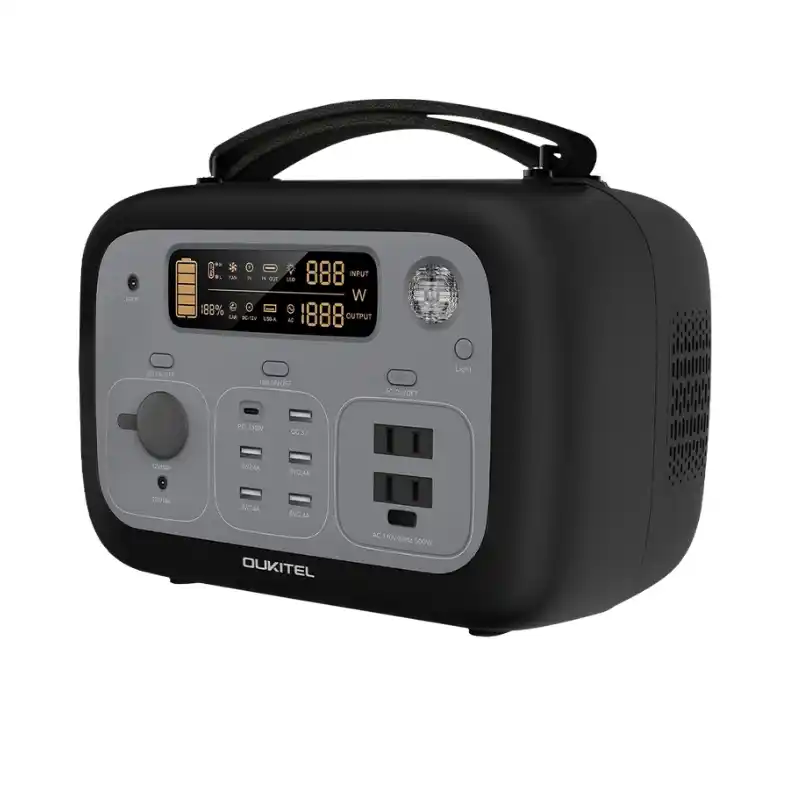
Oukitel P501 Review

The Oukitel P501 uses NMC cells rated for just 500 cycles, the shortest life in our database, and has an automatic shutoff that turns the machine off under light loads. It returns 430 Wh of its 505 Wh rating.
My Quick Verdict
Among the power stations we have reviewed and tested, none has a shorter rated cell life than this one. Five hundred cycles is roughly sixteen months at one charge a day.
Every other machine in our database uses lithium iron phosphate rated for 2,000 or more cycles. This is one of the few power stations we have reviewed and tested that still use NMC, and by some margin the weakest of them.
It also has an automatic shutoff that cannot be disabled, which means the machine turns itself off under light loads.
For a CPAP machine, a camera charging overnight, or a small fridge, that is not a quirk; it is a failure mode.
Best for: Short-term light use where the machine is actively supervised and replaced within a couple of years.
Not for: overnight loads, long-term ownership, medical equipment, or anything left unattended.
Key Stats
Introduction
Two specifications on this machine sit at the extreme end of our measurements, and both work against the buyer.
The cells are NMC rated for 500 charge cycles. Among the power stations we have reviewed and tested, nothing else is rated lower; the next lowest is 800.
Drained and refilled daily, the pack slips to 80% capacity within about 16 months, whereas units this size normally last 5.5 years.
The second is an automatic shutoff that cannot be disabled, and it affects how the machine behaves every time you use it.
What It Can Actually Run
Five hundred watts sustained with 1,000 in a burst. That covers a television, lighting, a router and devices, and excludes refrigerator compressors and heating appliances.
From a 505Wh label, the outlets yielded 430Wh, landing precisely on the class bar at 85%. Everything below uses 430Wh.
- Television at 150W: nearly three hours.
- CPAP at 40W with the humidifier off: 10.5 hours, subject to the shutoff caveat below.
- Starlink dish at 50W: 8.5 hours.
- A 45W twelve-volt camp fridge on DC: past ten hours, using the strong 466Wh route.
Output measured at 110 volts, below the accepted operating range. Electrical noise went unmeasured here.
Charging and Smart Features
Wall input is 122 watts through an external charging brick at a single fixed rate. From empty, that is around four hours.
Solar takes 110 watts, which is modest even for this capacity.
Dual charging is not supported, so mains and panels cannot run together.
There is no UPS mode and no app. Mid-range price tier, premium value tier.
Charging Speed Benchmarks
Time from empty for the Oukitel P501, benchmarked against the 28 machines in the 300Wh to 999Wh capacity class our charging database covers. Typical mains input there is 279W and typical solar is 192W. All bands are internal to this class rather than site-wide.
Wall charging of 122W is under half the 279W class average and holds an Average rating only because Low in this bracket means under 99W. Refilling 505Wh at that rate needs roughly 4.1 hours. The one thing working in its favour is chemistry: with NMC cells rated for just 500 cycles, the shortest life in our database, a slow charge is at least gentler on a pack that has little margin to spare.
Panels accept 110W, well below the 192W class average and again Average only by the narrow banding at this size, against a 600W class ceiling. A full array refill takes about 4.6 hours, slower than the socket. Neither route returns this machine to full inside a working session, and the automatic shutoff under light loads means a solar charge can end early if nothing substantial is drawing from it.
Need it full inside an hour? The EcoFlow River 2 Pro charges at 940W from a socket, close to eight times the P501, and fills a larger 768Wh pack in roughly 0.8 hours against 4.1 here. Solar doubles to 220W. Its cells are rated well beyond 500 cycles, so the machine survives being cycled at that speed.
Real Capacity: What You Actually Get
The two paths diverge by seven points, and the twelve-volt side is much stronger.
A meter on the sockets measured 430 Wh against a claimed 505 Wh. Eighty-five per cent sits exactly on the class line.
Twelve volts gave back 466 Wh (92%), a very good result and among the better twelve-volt figures for this size.
Both figures are recorded with the auto shutoff active, which is worth bearing in mind: the machine ends a discharge on its own terms rather than yours.
No idle drain figure is recorded for either path because the shutoff makes it difficult to measure standby behaviour meaningfully.
My takeaway: Plan on 430 Wh at the outlets, 466 Wh at 12 volts. Both come with the same caveat: the machine decides when the session ends if the draw drops low enough.
Power Output and Surge: What It Can Turn On
Five hundred watts continuous is standard for this capacity. A television, lighting, a router, a laptop and devices all run; heating appliances and refrigerator compressors do not.
A household fridge asks more than 1,000 watts when its compressor engages, putting that beyond sensible planning.
The 100-watt USB-C port is the best thing on the output side, charging a laptop at full rate where several rivals manage only 60.
The voltage works against it. One hundred and ten volts sits below the accepted band, so any motor draws extra current and runs hotter.
Neither distortion nor noise was captured, leaving the voltage reading as the only description of power quality.
Real Appliance Runtimes
AC lines below use 430 Wh; the 12-volt line uses the higher 466 Wh measurement. All are subject to the auto shutoff.
Read every low-draw line here with the shutoff in mind. A machine that turns itself off under light load is not delivering these hours unattended, whatever the arithmetic says.
Recharging: Wall and Solar
From a Wall Outlet
Charging 122 W into a 505 Wh pack takes around 4 hours from empty, which is slow.
Power comes from a brick on the cable (an extra item to transport and replace), and its loss ends mains charging.
Neither rate control nor dual charging is fitted, so sunshine offers no help.
Neither input is quick, and they never combine, so this needs to be filled in the evening beforehand.
From Solar Panels
The panel input is around 110 W, which is modest for a 505 Wh pack.
No voltage range appears in our records, so ask Oukitel directly before committing to panels.
One hundred and ten watts occupies most of a bright day, and the sheet confirms sunshine alone misses the standard refill window.
The array can stay permanently connected and pass-through charging is supported.
Given how slow both routes are, this is a machine to charge deliberately rather than opportunistically.
Blackout Backup: The Part I Care About Most
There is no automatic transfer function, which is standard at this capacity and not a fault of this machine.
What is a fault is the auto shutoff. The grading data records it as fitted, with no way to disable it, which changes how the machine behaves in ordinary use.
Machines with this feature turn themselves off when the draw falls below a threshold (typically a few watts), assuming nothing is connected. A CPAP between breaths, a fridge between compressor cycles, or a camera battery near full can all fall under it.
The result is a machine that stops working while you are asleep, and you find out in the morning.
Why this matters to me: an auto shutoff that cannot be disabled is worse than a missing transfer function at this size, because it fails during normal use rather than only during a power cut. Test any overnight load before you rely on it.
Noise and Living With It
No fan noise measurements exist in our data for this machine, which is a genuine gap for a compact unit likely to be used in a tent.
Mass is where it wins outright: 12.3 pounds (5.57 kilograms). Nothing this size on our scales is lighter, and it fits comfortably in one hand.
There is no app of any kind, so nothing can be monitored, adjusted or updated.
The cover lasts two years and comes with a same-day response pledge, and on 500-cycle cells, it outlasts the pack itself under daily use.
Where It Falls Short
Four limitations, and the first two are the ones that decide against it.
1. Five Hundred Charge Cycles
Nothing else we have tested, at any size or from any maker, claims fewer.
Charged daily, capacity reaches 80% somewhere around month sixteen. The nearest comparison in our data is 800 cycles; most machines at this capacity offer 2,000.
Even at a couple of charges a week, it wears out well ahead of the competition.
2. An Auto Shutoff That Cannot Be Disabled
The machine turns itself off when the draw falls below a threshold, and there is no setting to prevent it.
For a CPAP machine, an overnight camera charge or a cycling fridge, that is a genuine failure mode rather than an inconvenience.
Test any low-draw overnight load before depending on it.
3. Output at 110 volts and 122 Watts of Charging
Below the accepted band, so any motor works harder than it should.
Four hours from flat too, via a brick in the cable, with nothing to accelerate it.
4. No App, No Solar Voltage Data, No Fan Noise Data
Nothing can be monitored or updated, and our data records neither a solar voltage window nor a fan noise figure.
Both are worth confirming with Oukitel before purchase.
How It Compares
Two comparisons at almost identical capacity, both with four times the cycle life.
On the day you buy it, this machine is competitive: it converts best of the three through DC at 92%, matches the class line on AC, and weighs two to three pounds less than either rival.
By year two the comparison has inverted. Five hundred cycles against 2,000 or 4,000 means the pack is degrading while both rivals are barely started.
The auto shutoff is the other separator. Neither rival has one, and neither will turn itself off while your CPAP is running.
Who Should Buy It, and Who Should Skip It
Buy It If
- Weight is your single priority, and 12.3 pounds settles it.
- You expect to replace the machine within a couple of years anyway.
- Your loads are supervised and high enough not to trigger the shutoff.
- Twelve-volt equipment is central, where 92% is genuinely strong.
Skip It If
- Anything runs on it overnight or unattended. The shutoff makes that unreliable.
- You intend to keep it more than about eighteen months of daily use.
- A CPAP machine or any medical equipment is on the list.
- A competitor this size is on the shelf, and both last four to eight times as long.
The Bottom Line
Two specifications rule this machine out for most buyers, and neither is about performance on the day you buy it.
Five hundred cycles is the shortest rated life anywhere in our data, roughly sixteen months at daily use. And an auto shutoff that cannot be disabled means low-draw overnight loads may stop.
It is the lightest machine at its capacity and returns 92% through DC, which are real strengths. They belong on a machine you can rely on for longer than a year and a half.


There are no reviews yet.