
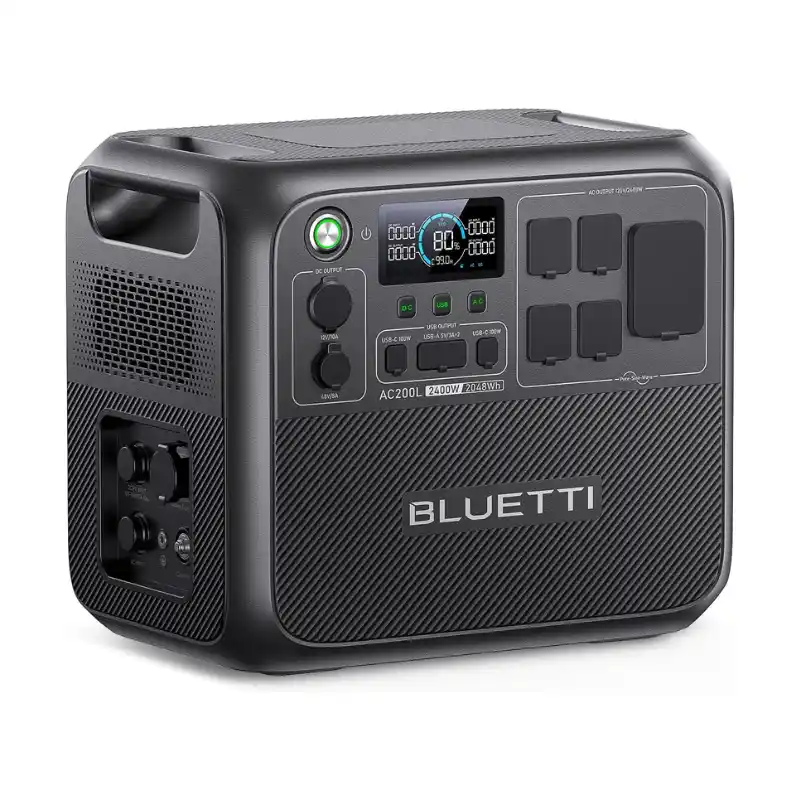
Bluetti AC200L Review

The Bluetti AC200L delivers 1,830 Wh of its 2,048 Wh rated capacity, an 89% return, powered by a 2,400W inverter. Solar accepts up to 145 volts, more than double what most units at this capacity permit, and wall charging reaches 2,400W. Upper mid-range price tier, exceptional value.
My Quick Verdict
One number on this unit is worth more than the rest of the specification sheet combined. The solar input accepts 145 volts.
Every other unit reviewed here stops between 30 and 95 volts, and most stop at 60. At 145, you can wire a genuine series string of rooftop panels, as a permanent installation would, instead of assembling a parallel arrangement to stay under a ceiling.
Around that sit an 89% conversion figure, the second-best in this capacity, 2,400 watts of wall charging, and 48-decibel fans.
It weighs 61 pounds, and the inverter does not arm itself. Those two facts define the unit’s uses.
Best for: Off-grid and RV installations running a fixed array, plus household backup in homes that are rarely empty.
Not for: unattended backup, or anyone who has to move it more than once.
Key Stats
| Badge | Stats |
|---|---|
| Battery chemistry and longevity | LiFePO4 | 3,000 cycles |
| Continuous AC power output | 2,400W AC | 4,800W peak |
| Energy storage capacity | 2,048Wh | 1,830Wh usable |
| Rapid AC wall recharge | 2,400W input | 2,400W dual |
| Uninterrupted emergency backup | 13.8ms UPS | Manual arm |
| Maximum solar input and MPPT | 1,200W solar | 12–145V ceiling |
| Ultra-fast USB-C power delivery | 100W USB-C PD |
| Low-noise operational level | 48dB | Quiet under load |
| Inverter waveform quality | 1.10% THD |
| Modular capacity expansion | Expandable | Extra battery port |
Introduction
Solar voltage ceilings say more about a power station than almost any figure printed on the box, and hardly anyone shopping thinks about them.
Panels produce more voltage when wired in series, which is how permanent installations are built: fewer, longer cable runs, lower current, smaller losses. A unit that stops at 60 volts forces you to abandon that approach and wire everything in parallel instead, which means thicker cable and more of it.
The AC200L accepts 145 volts, well beyond what almost anything of this capacity can handle. Only a handful of units reviewed here reach this territory at all, and none achieve this level of conversion efficiency. The chemistry is lithium iron phosphate, rated for 3,000 cycles with five years of coverage, which works out to nearly eight years of daily cycling.
What It Can Actually Run
The inverter has a 2,400W continuous rating and a 4,800W peak rating, enough to run a heating appliance alongside other loads.
Rated capacity is 2,048Wh. The sockets returned 1,830 Wh, an 89% result, and the second-highest at this size. Figures below use 1,830Wh.
- Refrigerator at 150W: better than twelve hours.
- CPAP at 40W without humidifier: near forty-six hours.
- Starlink dish at 50W: around 36.5 hours.
- Laptop at 70W: about twenty-six refills over USB-C.
Output measured 120 volts with 1.10% distortion, both comfortably inside safe limits and cleaner than most units at this capacity.
Charging and Smart Features
Wall charging is unusually fast at 2,400W with stepped rate control, taking the pack from flat to full in under an hour despite its size.
Panel capacity is 1,200W and accepts anywhere between 12 and 145 volts at 15 amps. The wattage is jointly highest at this capacity, and the voltage ceiling is beaten by only a few machines, mostly far larger ones.
The crossover measured 13.8 milliseconds, and the inverter will not arm itself. The array may remain attached indefinitely, output continues during charging, and both inputs together are rated for 2,400W.
Upper mid-range price tier, exceptional value tier.
Charging Speed Benchmarks
Recharging performance for the Bluetti AC200L, plotted against the low, average and high inputs recorded across the 2,000Wh to 3,000Wh capacity class. The bracket holds twenty-six machines, with a mean of 1,641W on the wall and 1,123W on solar. Ratings are relative to those peers alone.
This is one of the quick ones. 2,400W of wall input runs 759W past the 1,641W class mean and clears the High threshold outright, leaving only three units in the bracket ahead of it. A 2,048Wh pack refills in roughly 0.9 hours from empty, which is the difference between reacting to a storm warning and being caught by it. Recorded inputs across the class run from 470W to 5,000W, so the AC200L sits near the top of a field with an unusually long tail.
Panel input tops out at 1,200W, a shade over the 1,123W class mean and tied for the highest figure among the 2,048Wh units here, though the 2,400W class high is double it. Full from flat takes about 1.7 hours in ideal light. The number that changes what this unit is for is the 145-volt input ceiling rather than the wattage: most machines at this size stop at 60 volts, so the AC200L will take four or five rigid panels in one series string, with lower current and thinner cable over a long roof run.
Scaling the array beyond 1,200W? The Bluetti AC300 + B300K doubles the panel ceiling to 2,400W and raises wall input to 3,000W, the joint fastest solar figure and the fastest AC figure among the machines we have reviewed at this capacity. Panels bring 2,764Wh back to full in roughly 1.2 hours, and the modular design lets battery capacity grow underneath the same charge controllers rather than forcing a second machine.
Real Capacity: What You Actually Get
Conversion is one of this unit’s quiet strengths, and the split between its two paths runs the usual way.
The sockets returned 1,830 Wh out of a claimed 2,048 Wh. At 89%, only one unit at this capacity does better, and it is four to five points above what most rivals here manage.
The twelve-volt route produced 1,697 Wh, or 82%, so, unusually, the AC side is the more efficient of the two. There is no advantage to moving loads onto DC.
Idle drain measures half a percent per hour on AC and 0.3% on DC, both near the front of the field for charge retention.
My takeaway: Work from 1,830Wh, which is a generous figure for this capacity. Unlike most units reviewed here, run your loads on AC rather than DC, because on this machine that is where the efficiency sits.
Power Output and Surge: What It Can Turn On
The sustained and peak ratings here are conventional for the capacity, which, after the solar figures, is almost a relief.
Twenty-four hundred watts, when held continuously, clears the threshold at which heating appliances operate and leaves room for something to run alongside them.
Forty-eight hundred watts of peak power covers any domestic compressor start without approaching its limit.
Waveform quality is better than the class average, with 1.10% distortion and 1,425 mV of electrical noise. Neither is class-leading, and both are comfortably good enough for a CPAP machine or a workstation.
Real Appliance Runtimes
How far does 1,830 Wh go, measured on the same appliance set used in every review here?
| Appliance | Power Draw | Runtime | What That Means |
|---|---|---|---|
| Full-size refrigerator | 150W | About 12.2 hours | Half a day held outright, considerably more with cycling. |
| CPAP machine (no humidifier) | 40W | About 45.8 hours | Nearly two full days of overnight use. |
| Starlink dish | 50W | About 36.6 hours | Thirty-six hours before the dish wants power. |
| Pellet grill or smoker | 100W | About 18.3 hours | An overnight brisket with the morning to spare. |
| Laptop (70W) | 70W | About 26 recharges | At 100W over USB-C, so unhurried but plentiful. |
An 89% conversion is doing real work in this table. From the same 2,048Wh rating, this unit delivers roughly an hour more refrigerator time than its rivals, which return 84% or 85%.
Recharging: Wall and Solar
From a Wall Outlet
2,400 watts is among the fastest mains-charging rates at this capacity, and it fills the pack from empty in under an hour.
That matters more than it sounds for a unit weighing 61 pounds, because this is a machine you site permanently and top up in place rather than carry to a socket.
Rate control is stepped, so an overnight charge can be dialled back when time is not the constraint. Mains and panels together also take 2,400W.
From Solar Panels
This is the specification the unit is built around, and it is worth understanding properly.
Input reaches 1,200W across a 12-145 V range at 15 A. The wattage ties for the highest at this capacity, and the voltage ceiling is beaten by only a few machines, mostly much larger ones.
At 60 volts, where most units stop, two rigid panels in series are the practical limit. At 145, you can run four or five in a single string, which is how a rooftop or ground-mount array is normally designed. Higher voltage also means lower current for the same power, so cable losses drop, and a thinner cable will suffice over a long run.
For anyone wiring a cabin, a van roof, or a permanent ground mount, that changes the installation rather than merely improving it.
Bright weather takes it from flat to full in about two and a half hours, and there is no need to unplug the array afterwards.
Blackout Backup: The Part I Care About Most
Backup is the weakest part of an otherwise strong unit.
The crossover measured 13.8 milliseconds. That sits inside the 20-millisecond safety line with reasonable room,nd well behind the sub-nine-figureest units at this capacity. Nor will the inverter wake on its own. Somebody has to switch it on and leave it that way before the crossover figure means anything.
A standby loss of 0.5% per hour at least makes keeping it armed a realistic habit rather than a slow drain, which softens the problem without removing it.
Why this matters to me: for a refrigerator or lighting, fourteen milliseconds and a manual switch are perfectly serviceable. For a workstation or a network drive left alone in the house, the two together are not, and that is a use case this unit simply does not cover.
Noise and Living With It
Forty-eight decibels under load, which is genuinely quiet for a 2,400-watt inverter and beneath the threshold for a room with a sleeper in it.
In practice, it is a low hum rather than a mechanical presence. A utility room adjoining a bedroom would not be a problem.
Then there is the weight. Sixty-one pounds, 27.6 kilograms, is the heaviest unit at this capacity by a considerable margin and roughly twenty pounds above the lightest.
That is a two-person lift, and it settles the question of portability entirely. This is a machine you install. It works over Wi-Fi and Bluetooth alike, and a phone line is covered by the warranty.
Where It Falls Short
There are three limitations, and the first two are structural rather than fixable.
1. Sixty-One Pounds
The heaviest unit at this capacity is roughly twenty pounds heavier than the lightest and requires a two-person lift on stairs.
For a permanent installation, that is irrelevant, and it suits the solar-array use case the unit is built for. For anything involving a vehicle you load and unload, it is decisive.
2. No Self-Arming Inverter, and a Middling Crossover
Fourteen milliseconds is adequate, not good, and it only applies once somebody has already switched the inverter on.
Rivals at the same price tier cross over in seven and arm themselves. Specifically regarding backup performance, this unit is a generation behind.
3. Three Thousand Cycles and a 100-Watt USB-C Port
Cells are rated for 3,000 cycles, where the strongest units at this capacity offer 4,000, which, over a decade, is a real difference.
The USB-C port supplies 100 watts, while the best now provide 140, and several provide two ports. Neither is a fault so much as evidence that the design priorities went elsewhere.
How It Compares
The natural comparisons are the AFERIY P280, the conversion leader at this capacity, and the Anker SOLIX C2000 Gen 2, the strongest all-round unit here.
| Feature | Bluetti AC200L | AFERIY P280 | Anker SOLIX C2000 Gen 2 |
|---|---|---|---|
| Price tier | Upper mid-range | Mid-range | Upper mid-range |
| Value tier | Exceptional | Exceptional | Exceptional |
| Usable through AC | 1,830Wh (89%) | 1,880Wh (91%) | 1,760Wh (85%) |
| Solar voltage ceiling | 145V | 55V | 60V |
| Solar input | 1,200W | 1,200W | 800W |
| Wall charging | 2,400W | 1,800W | 1,800W |
| UPS switchover | 13.8ms | 8ms | 7.2ms |
| Self-arming inverter | No | No | Yes |
| Fan noise | 48dB | 57dB | 44dB |
| Battery cycles | 3,000 | 4,000 | 4,000 |
| Weight | 61 lbs | 47 lbs | 41 lbs |
Against the AFERIY P28,0, this is a straight exchange of priorities. The AFERIY converts two points better, weighs 14 pounds less, offers 1,000 more cycles, and includes 2 extra years of warranty. The AC200L answers with a solar ceiling nearly three times higher, 600W more wall charging, and nine decibels less noise.
For a fixed array, the voltage ceiling difference is not a preference; it is the entire installation. For a unit that will be moved, the AFERIY is the better machine.
The Anker SOLIX C2000 Gen 2 remains the safer general recommendation because it arms itself and crosses over in half the time. But its 800-watt solar input and 60-volt ceiling make it the wrong choice entirely for anyone building a serious array, and that is precisely where the AC200L earns its place.
Who Should Buy It, and Who Should Skip It
Buy It If
- You are wiring a fixed solar array and want to connect the panels in series rather than in parallel.
- It goes in a single spot and gets recharged without ever being lifted.
- You want the most usable energy at this capacity from a unit that also charges fast.
- It will sit near a room where noise matters.
Skip It If
- You need protection while the house is empty. This unit will not arm itself.
- You will move it regularly. At 61 pounds, it is a two-person job.
- Your loads are 12-volt, with the DC path returning only 82%.
- Maximum cycle life is a priority, with 4,000-cycle units available at this size.
The Bottom Line
The AC200L is built around one specification that no rival comes close to matching, and whether it is the right unit depends entirely on whether that specification matters to you.
A 145-volt solar ceiling is not a marginal improvement over the 60 volts most units allow. It changes how an array is wired, how much cable it needs, and how much of the generated power makes it to the end of the run.
Pair that with 89% conversion, 2,400-watt wall charging, and 48-decibel fans, and for a fixed installation with panels,s it is the strongest unit at this capacity. Move it, or ask it to guard an empty house, and its weight and its manual inverter answer for it.


There are no reviews yet.