
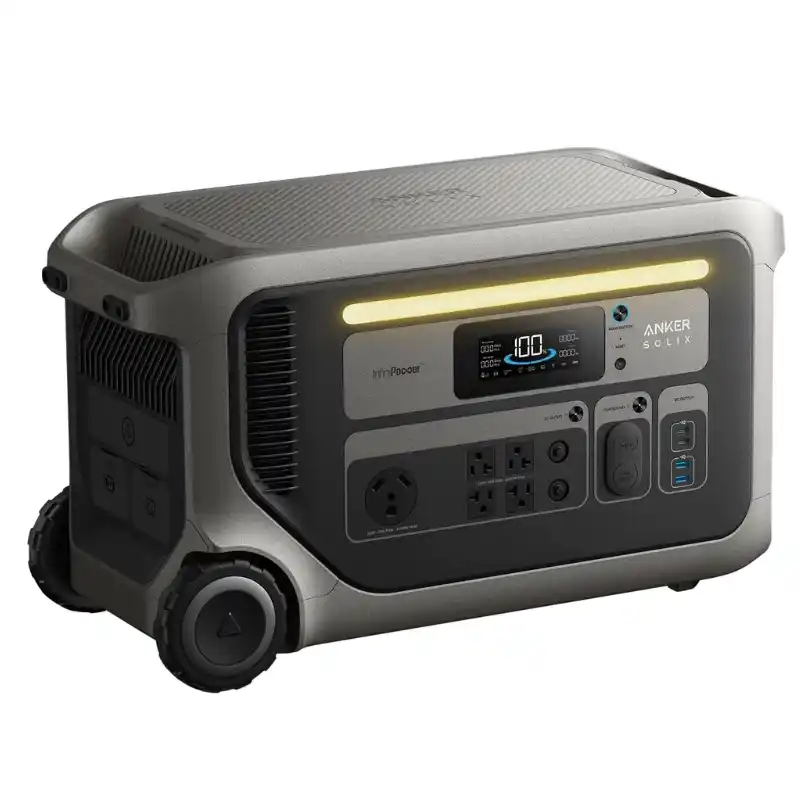
Anker SOLIX F3000 Review

The Anker SOLIX F3000 holds 3,072Wh behind a 3,600W inverter and accepts 2,400W of solar, including a path reaching 165 volts that permits a real series string. It returns 91% through DC, charges at 3,840W from the wall, and sits in the upper mid-range price tier at exceptional value.
My Quick Verdict
Solar input to this unit arrives via two separate paths, and the second accepts up to 165 volts. Very few machines in this dataset go that high, and none of the ones that do is priced at this level.
That ceiling changes what you can build. Stop at 60 volts, as the majority here do, and a string holds two rigid panels. Allow 165, and five or six fit, which drops the current for the same delivered power, thins the cable, and cuts what is lost warming it.
The rest of the specification holds up: 3,600 watts sustained, 91% delivered through DC, 4,000-cycle cells, and 3,840 watts of mains charging.
The omission is the familiar one. It hands over in 9.8 milliseconds, but requires someone to switch the inverter on first.
Best for: Off-grid installations with a large series array, and Emergency Home Resilience in a house that is rarely empty.
Not for unattended protection or for anyone who has to shift it regularly.
Key Stats
| Badge | Stats |
|---|---|
| Battery chemistry and longevity | LiFePO4 | 4,000 cycles |
| Continuous AC power output | 3,600W AC | 7,200W peak |
| Energy storage capacity | 3,072Wh | 2,760Wh usable |
| Rapid AC wall recharge | 3,840W input | Adjustable speed |
| Uninterrupted emergency backup | 9.8ms UPS | Manual arm |
| Maximum solar input and MPPT | 2,400W solar | 165V high path |
| Ultra-fast USB-C power delivery | 100W USB-C PD |
| Low-noise operational level | 53dB | Moderate under load |
| High-output DC | 440W, app-controlled |
| Modular capacity expansion | Expandable | Extra battery port |
Introduction
Anyone who has priced the cable for a solar array knows the arithmetic. Power is voltage times current, and it is the current that determines how thick the copper has to be and how much of the generated energy is lost as heat while it’s being carried.
Wiring panels in series raises voltage and lowers current for the same power, which is why every permanent installation is designed that way. Whether you can do it depends entirely on the maximum voltage your machine accepts.
This one takes 165, which puts a genuine string within reach. Its pack is rated for 4,000 lithium iron phosphate cycles and comes with a five-year warranty, which, at daily use, reaches the 80% threshold around year 11.
What It Can Actually Run
3,600 watts held continuously; 7,200 in a burst. That is at the top of the Heavy-Duty Household Class and is enough for several heavy loads simultaneously.
The pack is rated at 3,072 Wh, and the outlets returned 2,760 Wh. 89%, which is a solid result at this scale. Figures below use 2,760Wh.
- Refrigerator at 150W: better than eighteen hours.
- CPAP at 40W without the humidifier: sixty-nine hours, comfortably three nights.
- Starlink dish at 50W: fifty-five hours.
- Laptop at 70W: around thirty-nine charges.
Measured output was 121 volts, distortion 1.40%. Both pass, though the electrical noise reading climbed past 2,000 mV; noisy by the standards of this field.
Charging and Smart Features
The main input reaches 3,840 watts with stepped rate control, which refills three kilowatt-hours in well under an hour.
Solar totals 2,400 watts across two paths: 800 watts between 11 and 60 volts at 17 amps, and 1,600 watts between 11 and 165 volts at the same current.
Handover took 9.8 milliseconds, though the inverter must be armed by hand and left running.
Upper mid-range price tier and exceptional value tier; an unusual combination at three kilowatt-hours.
Charging Speed Benchmarks
Input figures for the Anker SOLIX F3000 compared with the full Over 3,000Wh capacity class, a bracket of 16 machines averaging 2,802W on mains and 2,681W on panels. Every rating is scored within the class, which is why the same wattage would read very differently on a 1kWh unit.
At 3,840W the F3000 charges well above the 2,802W class average and clears the 3,600W threshold for a High rating, second only to the 6,000W machine at the top of this bracket. Three kilowatt-hours therefore come back in around 0.8 hours from a socket. For a machine that weighs ninety-one pounds and gets installed once, that recovery speed is what makes it viable through a storm week rather than a single outage.
Panels reach 2,400W across two tracked paths, a little under the 2,681W class average and an Average rating in a bracket topping out at 6,400W. A full solar refill takes about 1.3 hours in good conditions. The distinguishing figure is the 165-volt ceiling rather than the wattage, since most of this field stops at 60 volts and a five or six panel series string changes what cable you need from a roof. Both channels cap at 17 amps, so the design deliberately favours voltage over current.
Need faster recovery and more panel headroom? The Anker SOLIX F3800 Plus steps mains charging up to 6,000W and solar to 3,200W on the same 165-volt architecture, filling a larger 3,840Wh pack in roughly 0.6 hours from the grid. It also adds pass-through charging and a self-arming inverter. The costs are 136 pounds in a sealed body and a full price tier above this machine.
Real Capacity: What You Actually Get
Both paths deliver well here, and the twelve-volt route is the stronger of the two.
Metered at the sockets, 2,760 Wh was recorded against a claimed 3,072 Wh, or 89%.
The DC side returned 2,796Wh, which is 91%. Two points ahead, so anything capable of running on twelve volts should, and the 440-watt app-controlled DC port makes that practical rather than theoretical.
Standby is strong. Awake with nothing drawing, the pack loses about 0.66% per hour, and the meter found no measurable loss on the DC side. Left it for a month, and it would still be close to full.
My takeaway: 2,760 Whh from the outlets, 2,796 Whh from DC. The gap is small, but the 440-watt DC port is large enough that routing real loads through it is worth doing.
Power Output and Surge: What It Can Turn On
A 3,600-watt sustained rating sits at the ceiling of the Heavy-Duty Household Class, and in practice it means you stop choosing between appliances.
A space heater, a refrigerator, lighting, and networking equipment run together without approaching the limit, and a 7,200-watt surge covers any domestic motor start with a wide margin.
The DC output deserves attention too. Four hundred and forty watts through an app-controlled port is among the higher figures in this data, and it is enough to run a compressor fridge and a heater, with the inverter entirely out of the circuit.
The one weak spot in the array is USB-C: a single 100-watt port, where several cheaper machines now fit two at 140 watts.
Real Appliance Runtimes
Two thousand seven hundred and sixty watt-hours, measured out in hours against this site’s unchanging appliance list.
| Appliance | Power Draw | Runtime | What That Means |
|---|---|---|---|
| Full-size refrigerator | 150W | About 18.4 hours | Most of a day before cycling is even counted. |
| CPAP machine (no humidifier) | 40W | About 69 hours | Sixty-nine hours of overnight running. |
| Starlink dish | 50W | About 55 hours | Fifty-five hours before the dish loses power. |
| Pellet grill or smoker | 100W | About 27.6 hours | Several sessions between charges. |
| Laptop (70W) | 70W | About 39 recharges | One port at 100W, so sequentially. |
Three kilowatt-hours at 89% puts an ordinary household’s essential loads out of reach of a single outage. What decides multi-day use from here is the solar, which is where this machine was clearly designed to win.
Recharging: Wall and Solar
From a Wall Outlet
Three thousand eight hundred and forty watts is among the fastest mains inputs recorded in this data, and it takes an empty three-kilowatt-hour pack to fill in under forty-five minutes.
The rate steps down for an unhurried overnight charge, which, over a decade of cycling,g is worth having.
Together, both inputs reach the same 3,840-watt ceiling, with solar prioritised, so panels displace mains draw rather than add to it.
From Solar Panels
This section justifies the machine.
Panels feed in through two independent inputs. One handles 800 watts from 11 to 60 volts at 17 amps, which is foldable and small-bank territory. The other stretches from 11 to 165 volts at the same current for the remaining 1,600 watts.
165 volts is high enough to drive five or six rigid panels in a single string. The practical consequences are lower current for the same delivered power, thinner and cheaper cable, and less energy lost as heat over a long run from a roof or a ground mount to wherever the unit sits.
Because the two inputs are tracked separately, an array in full sun and one under partial shade will not average each other down.
The array can remain permanently connected, and the machine runs loads throughout a charge cycle.
Blackout Backup: The Part I Care About Most
The hardware is capable, and the firmware stops one step short, which, by now, is the most common failure in this whole category.
Handover measured 9.8 milliseconds, beneath the eleven-millisecond mark where genuine protection begins. Nothing with a processor would register it.
But the inverter will not raise itself. Someone has to switch it on before an outage and leave it on afterwards.
At 0.66% per hour, the standby cost is among the lowest recorded, making it a genuinely sustainable habit rather than a slow bleed. That softens the problem considerably without solving it.
Why this matters to me: Of everything in this dataset that cannot self-arm, this is the machine that stings the least, because the drain while armed is so small you can leave it running. It is still a habit rather than a guarantee.
Noise and Living With It
Fifty-three decibels under load, a shade above the threshold for a room with a sleeper and unexceptional for a garage, plant room or workshop.
For a 3,600-watt inverter, that is a reasonable outcome, though quieter machines exist at lower output.
The weight is 91 pounds (41 kilograms), a two-person lift, and considerably heavier than the other three-kilowatt-hour unit reviewed alongside it.
The app connects over Wi-Fi at home and via Bluetooth in the field, and Anker staffs a support line.
Where It Falls Short
Three points to weigh, and only the first affects what the machine can be used for.
1. The Inverter Will Not Wake Itself
Nine point eight milliseconds count for nothing unless the inverter happened to be live at the moment the mains dropped, and here that means somebody set it that way on purpose.
The low 0.66% standby drain makes leaving it armed practical, so the fault is manageable. But a house left empty for a fortnight with the inverter off is a house with no protection at all.
2. Ninety-One Pounds
A two-person lift, and twenty-eight pounds heavier than the other three-kilowatt-hour machine reviewed here, despite identical capacity.
For an installation that is irrelevant. For anything involving loading it into a vehicle, it is not.
3. A Single 100-Watt USB-C Port
One 100-watt port on a machine of this capability, where units at a fraction of the price now fit two at 140.
It charges a laptop slowly, one at a time. Electrical noise above 22,000 mVis is also at the high end of this field, which is worth noting before running sensitive equipment.
How It Compares
The natural comparisons are the Pecron F3000, identical in capacity, and the EcoFlow Delta Pro 3, which is a tier above.
| Feature | Anker SOLIX F3000 | Pecron F3000 | EcoFlow DELTA Pro 3 |
|---|---|---|---|
| Price tier | Upper mid-range | Upper mid-range | Premium |
| Value tier | Exceptional | Exceptional | Good |
| Rated capacity | 3,072Wh | 3,072Wh | 4,096Wh |
| Usable through AC | 2,760Wh (89%) | 2,750Wh (89%) | 3,810Wh (93%) |
| Usable through DC | 2,796Wh (91%) | 2,823Wh (91%) | 3,660Wh (89%) |
| Sustained output | 3,600W | 3,000W | 4,000W |
| Solar input | 2,400W to 165V | 1,600W to 120V | 2,600W to 150V |
| Wall charging | 3,840W | 1,800W | 4,000W |
| Self-arming inverter | No | No | Yes |
| Battery cycles | 4,000 | 3,500 | 4,000 |
| Weight | 91 lbs | 63 lbs | 113 lbs |
Against the Pecron F3000, the two units share capacity, conversion,n and the same inability to self-arm. Where they separate is charging and mass: the Anker takes more than twice the mains input and 800 more watts of solar at a much higher voltage ceiling, and pays for it with twenty-eight extra pounds.
For a fixed installation with a large array, the Anker is clearly the better machine. For anyone moving t, or buying purely on cost, the Pecron is lighter and cheaper per watt-hour.
The Delta Pro 3 costs a price tier more and delivers split-phase 240-volt output, a self-arming inverter, and 1/3 more capacity. If a two-pole circuit is in your plans, this unit is not a substitute for it.
Who Should Buy It, and Who Should Skip It
Buy It If
- You are wiring a permanent array and want a series string rather than a parallel bank.
- You need to refill three kilowatt-hours from the wall in under an hour.
- Twelve-volt loads matter, where the 440-watt DC port and 91% delivery both help.
- The house is seldom empty, so arming the inverter by hand is not a burden.
Skip It If
- The house must be protected while empty.
- You will move the unit. Ninety-one pounds decide that.
- You need a 240-volt output for a two-pole circuit.
- USB-C throughput matters for your work equipment.
The Bottom Line
The F3000 is built for permanent solar installations and is unusually well suited to one. A 165-volt path, 2,400 watts of input across two tracked channels, and mains charging fast enough that the panels are a supplement rather than a necessity.
The numbers underneath support that reading. 89% at the sockets, ninety-one on the twelve-volt side, and a standby figure small enough that it can sit armed for months.
That last point is the frustration. It will hold a charge indefinitely while armed, and it still will not arm itself. For a machine this capable, that remains the one thing standing between it and the top of its class.


There are no reviews yet.