
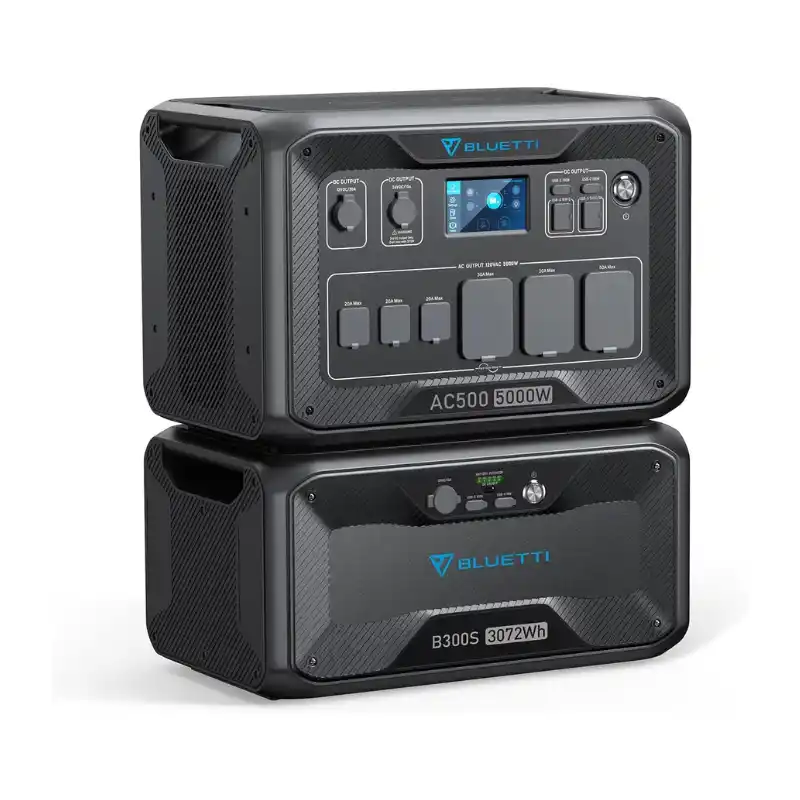
Bluetti AC500 + B300S Review

The Bluetti AC500 pairs a 5,000W inverter head, which holds no cells, with a B300S module, delivering 2,520Wh. Wall charging reaches 5,000W, and the combined input is 8,000W, both among the highest recorded, with 3,000W from solar across two 150-volt channels.
My Quick Verdict
This machine draws 5,000 watts from a wall socket and 8,000 watts when panels are running alongside. Both figures sit at the very top of everything measured for this site.
It also has the largest inverter of any single-phase machine reviewed here, at 5,000 watts continuous, and it draws 3,000 watts of solar power across two 150-volt channels.
Then you meter what comes out. 82% through the sockets and 77% through DC, both the weakest figures at this capacity.
You pay the highest price per watt-hour at three kilowatt-hours and receive the smallest share of the pack back.
Best for: Whole-property backup where a modular system will be expanded over time and refilled fast between outages.
Not for: anyone counting usable watt-hours per pound spent, or moving the system after installation.
Key Stats
| Badge | Stat |
|---|---|
| Battery chemistry and longevity | LiFePO4 | 3,500 cycles |
| Continuous AC power output | 5,000W AC | 10,000W peak |
| Energy storage capacity | 3,072Wh | 2,520Wh usable |
| Modular architecture | Head unit + battery modules |
| Rapid AC wall recharge | 5,000W input | 8,000W combined |
| Uninterrupted emergency backup | 16ms UPS | Manual arm |
| Maximum solar input and MPPT | 3,000W solar | Dual 150V channels |
| Inverter waveform quality | 0.70% THD | 985mv noise |
| Ultra-fast USB-C power delivery | 100W USB-C PD |
| High-output DC | 400W, app-controlled |
Introduction
Charging speed is usually the limiting factor in a large system. A machine that empties in half an hour and refills in three is not much use across a storm week, and several units at this capacity have exactly that problem.
This one does not. Five thousand watts from a domestic socket, eight thousand with panels feeding in alongside, and a 5,000-watt inverter to spend it through.
Like the smaller AC300, this is a two-part system: a head unit containing the electronics and no cells, and a battery module beneath it. The B300S modules carry a 3,500-cycle rating under five years of cover.
What It Can Actually Run
5,000 watts sustained, with 10,000 watts available in a burst, at 120 volts. That continuous rating is the largest of any single-phase machine reviewed on this site.
Fit a single B300S, and the rating reads 3,072 Wh. Metered output came to 2,520 Wh (82%), and the number that governs everything else here. All calculations below use 2,520Wh.
- Refrigerator at 150W: nearly seventeen hours.
- CPAP at 40W with the humidifier off: sixty-three hours.
- Starlink dish at 50W: fifty hours.
- Laptop at 70W: around thirty-six charges.
The waveform is a genuine strength: 120 volts, 0.70% distortion, and 985mv of electrical noise, all among the cleanest figures recorded at this capacity.
Charging and Smart Features
Wall input reaches 5,000 watts, and mains with panels together climb to 8,000 watts when solar is prioritised. Both are at the top of everything measured for this site.
Three thousand watts of panel capacity is delivered over a pair of channels, both spanning 12 to 150 volts at 15 amps, capable of carrying a proper series string.
Handover is listed at 16 milliseconds, within the safety threshold but among the slower readings here. The inverter must be armed manually.
Premium price tier and premium value tier: the most expensive energy at this capacity.
Charging Speed Benchmarks
Recharge times for the Bluetti AC500 paired with one B300S module, benchmarked against the 16 machines our database holds in the Over 3,000Wh capacity class. Wall input across that group averages 2,802W and solar averages 2,681W. Every band is a tercile drawn inside this class, so the ratings compare this system only with machines of similar size.
Mains charging of 5,000W is close to double the 2,802W class average, well past the 3,600W High threshold, rising to 8,000W once panels feed it as well. Against the 3,072Wh a head and one module hold, that is roughly 0.6 hours from flat. Only one machine in the bracket accepts more, at 6,000W. The headroom is the argument rather than the raw speed: stack a second or third module underneath and the charger still refills the whole system inside a sensible window.
Panels take 3,000W across two independently tracked 150-volt channels with a 12-volt floor, above the 2,681W class average and a High rating, though the 6,400W class ceiling is more than double it. A full module refills from the array in about 1.0 hour. The wide voltage span is the useful part here: a single foldable and a proper rigid series string both register, and the two channels are optimised separately so a shaded array does not drag down a sunlit one.
Planning an array rather than a fast grid recharge? The Pecron F5000LFP accepts 6,400W of solar, more than double this system, at 180 volts with 25 amps on each channel, and it fills a larger 5,120Wh pack from panels in around 0.8 hours. Mains charging drops to 3,600W and its waveform distortion measures 3.50%, so keep sensitive equipment off its AC side.
Real Capacity: What You Actually Get
This is where the system gives back everything it wins elsewhere.
Against a 3,072 Wh rating, the outlets yielded 2,520 Wh. That 82% is the lowest AC conversion at this size, trailing the strongest machines in its class.
The twelve-volt path was worse again, at 2,381 Wh (77%), which is among the lowest DC figures in the entire dataset. Unusually, there is no efficiency argument for routing loads to DC at all.
In absolute terms, a machine converting at 91% with the same rating would give you around 280 watt-hours more, about two additional hours of refrigerator runtime
While armed, it gives up roughly 1.3% an hour, or 0.8% through the twelve-volt side.
My takeaway: 2,520 Wh from a 3,072 Wh system, and 2,381 Whh if you use the DC side. Neither is good, and at this price tier, the gap against better-converting rivals is what the buying decision turns on.
Power Output and Surge: What It Can Turn On
The inverter is the reason to look at this system, and it is genuinely at the top of its field.
Five thousand watts continuous on a single phase covers a household’s heavy circuits simultaneously (heating, refrigeration, tools, cooking) with nothing needing to be shed. At 10,000 watts momentarily, inrush from any motor is no longer a consideration.
Waveform quality is the other standout. With distortion at 0.70% and noise at 985 mV, this machine is among the tidiest power supplies in its class, making it well-suited for delicate motors and switching supplies.
Output is single-phase 120 volts, leaving two-pole circuits out of reach, and the sockets are unremarkable: a lone 100-watt USB-C port beside a 400-watt DC port managed through the app.
Real Appliance Runtimes
One module’s worth (2,520Wh) expressed in hours against this site’s fixed appliance loads.
| Appliance | Power Draw | Runtime | What That Means |
|---|---|---|---|
| Full-size refrigerator | 150W | About 16.8 hours | Sixteen hours on the fridge, and this figure grows with each module. |
| CPAP machine (no humidifier) | 40W | About 63 hours | Two and a half days of overnight use. |
| Starlink dish | 50W | About 50.4 hours | Fifty hours of connection with no mains. |
| Pellet grill or smoker | 100W | About 25.2 hours | Twenty-five hours of cooking per module. |
| Laptop (70W) | 70W | About 36 recharges | Thirty-six of them, one after another. |
These are the shortest runtimes of any machine at this capacity, and the pack is not smaller; the conversion is. Adding modules raises every line, which is the argument for the architecture rather than for this configuration.
Recharging: Wall and Solar
From a Wall Outlet
Five thousand watts is the highest mains input figure recorded for any machine on this site, and it refills a single-module system in well under half an hour.
That changes what the system can do across a multi-day event. A machine that empties under heavy load and recovers in twenty-five minutes can be cycled repeatedly through a storm week, which is precisely where slower rivals fail.
Combining mains and solar lifts the ceiling to 8,000 watts, with panels taking priority, and that headroom becomes more useful as modules are added and the pack grows.
Charging is incremental, so a gentler overnight rate is available when time is not the constraint.
From Solar Panels
Panels arrive through two channels, each delivering 1,500 watts at 12-150 volts and 15 amps, for a total of 3,000 watts.
A 150-volt ceiling on both channels means each can carry four or five rigid panels in series, which is how a permanent array is properly designed; the same power arrives at lower current, through thinner cable, with less heating.
Tracking each channel separately keeps a shadowed bank from dragging a sunlit one down to a shared operating point.
The 12-volt floor keeps foldable panels usable too, which several machines at this capacity do not manage.
Panels may remain permanently connected while the system supplies loads.
Blackout Backup: The Part I Care About Most
Backup is the weakest part of an otherwise formidable system.
The listed handover is 16 milliseconds. That is within the twenty-millisecond safety line but leaves little margin, and it is roughly twice what the best machines at this capacity achieve. Bench testing did not record a figure of its own, so treat the manufacturer’s number with the usual caution.
Nor does the inverter come up on its own; a person must set it running before the mains go and leave it that way.
A standby drain of 1.3% per hour makes that affordable rather than free; a fortnight’s worth would cost roughly a third of a single module.
Why this matters to me: a 5,000-watt system built to be installed and relied on should not need a person to switch it on first. Combined with a sixteen-millisecond handover, this is the one area where a machine at this price is beaten by units costing a third as much.
Noise and Living With It
Fifty-five decibels under load, which excludes rooms where people sleep or work quietly, is unremarkable in a plant room or garage.
Given the size of the inverter involved, that is fair enough, although the family’s smaller AC300 holds 44.
Weight is the practical obstacle: 149 pounds for the head and one module together (68 kilograms), with each additional B300S adding more.
As with the AC300, it at least separates into liftable components rather than presenting as a single immovable object. It pairs over Wi-Fi and Bluetooth, and Bluetti keeps a telephone line staffed.
Where It Falls Short
Three limitations, and the first is the one that decides whether the rest is worth paying for.
1. The Weakest Conversion at This Capacity
82% through the sockets and 77% through DC. Both are the lowest figures at three kilowatt-hours, and the DC result is among the lowest in the entire dataset.
At an identical rating, a 91% machine returns around 280 watt-hours more, which is close to two extra hours of refrigerator runtime.
On a system in the premium value tier, paying the most per rated watt-hour while receiving the smallest share back is a difficult combination to justify.
2. Sixteen Milliseconds and No Self-Arming
The handover is slow by the standards for this capacity, and the inverter is waiting to be switched on.
For a 5,000-watt system intended as household infrastructure, requiring someone to be present to make it work is the wrong kind of flaw.
3. One Hundred and Forty-Nine Pounds and a Premium Value Tier
Head and one module together, before any expansion. It separates into parts, which helps, but this is a permanent installation.
And per watt-hour, it is the most expensive machine at this capacity, roughly double the cost of the best-value units holding the same energy.
How It Compares
The obvious comparisons are the smaller AC300 in the same modular family and the Anker SOLIX F3000 as the sealed alternative.
| Feature | Bluetti AC500 + B300S | Bluetti AC300 + B300K | Anker SOLIX F3000 |
|---|---|---|---|
| Price tier | Premium | Premium | Upper mid-range |
| Value tier | Premium | Good | Exceptional |
| Rated capacity | 3,072Wh | 2,764Wh | 3,072Wh |
| Usable through AC | 2,520Wh (82%) | 2,620Wh (85%) | 2,760Wh (89%) |
| Usable through DC | 2,381Wh (77%) | 2,361Wh (83%) | 2,796Wh (91%) |
| Sustained output | 5,000W | 3,000W | 3,600W |
| Wall charging | 5,000W | 3,000W | 3,840W |
| Combined charging | 8,000W | 5,400W | 3,840W |
| Solar input | 3,000W to 150V | 2,400W to 150V | 2,400W to 165V |
| Battery cycles | 3,500 | 6,000 | 4,000 |
| Fan noise | 55dB | 44dB | 53dB |
| Weight | 149 lbs | 127 lbs | 91 lbs |
Compared to its smaller sibling, this system adds 2,000 watts of inverter capacity, 2,000 watts of wall charging capacity, and 600 watts of solar capacity. It gives up three points of conversion, 2,500 cycles, 11 decibels, and 22 pounds at a worse value tier.
Unless you genuinely need 5,000 watts continuously, the AC300 is the better system in the same family, and it is not close.
The sealed Anker F3000 converts seven points better with AC and fourteen with DC, weighs fifty-eight pounds less,s and sits two value tiers higher. What it cannot do is grow beyond its own capacity or deliver 5,000 watts.
Who Should Buy It, and Who Should Skip It
Buy It If
- You need 5,000 watts continuously from a single-phase system.
- The installation has to recover fast and repeatedly across a multi-day event.
- You intend to add modules and want the electronics bought once.
- Clean output matters for sensitive equipment.
Skip It If
- Usable energy per pound spent is your test. This is the weakest converter at its capacity.
- Three thousand watts of inverter would do, where the AC300 is better in every other respect.
- You want automatic protection without having to arm anything.
- The system must be moved after installation.
The Bottom Line
The input and output specifications on this system are the largest in their categories anywhere on this site. Five thousand watts in, five thousand watts out, eight thousand with panels running.
What sits between them is the weakest conversion at this capacity, so the system delivers less usable energy than machines costing a third as much while charging the highest price per watt-hour recorded here.
If you genuinely need 5,000 watts continuously and a system that recovers in half an hour, nothing else here does it. If 3,000 watts would suffice, Bluetti’s own AC300 is better on almost every measure that follows.


There are no reviews yet.