
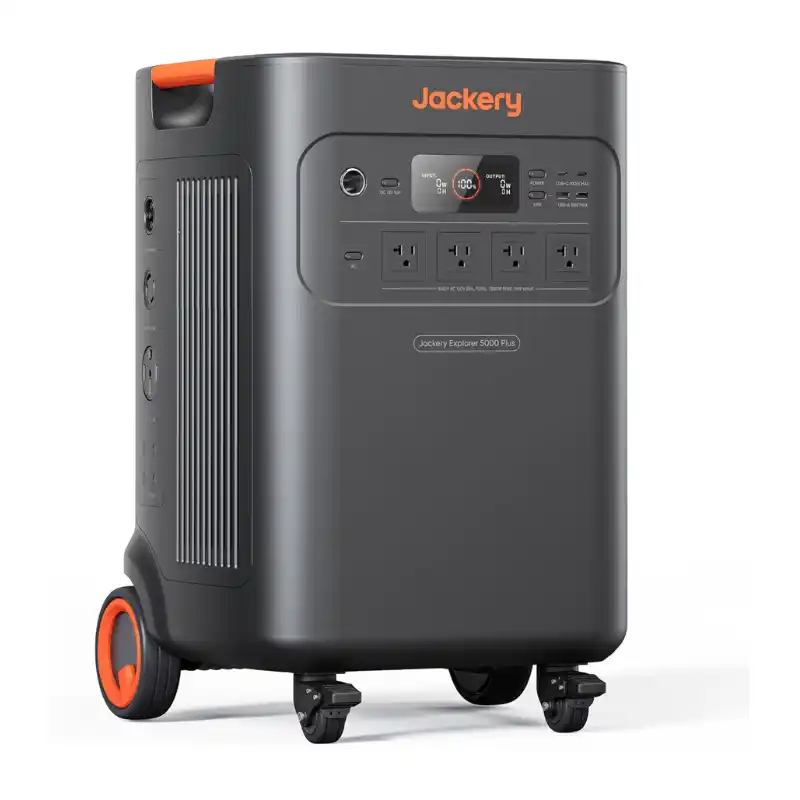
Jackery Explorer 5000 Plus Review

The Jackery Explorer 5000 Plus delivers 4,380Wh of its 5,040Wh rating, backed by a 7,200W split-phase inverter with 14,400W of surge, the largest peak rating measured here. Solar accepts 4,000W across a path reaching 450 volts.
My Quick Verdict
Fourteen thousand four hundred watts of surge is the largest peak rating in this entire database. No other machine tested here comes close to it, and no household motor will come close to stalling this one.
It also produces 7,200 watts continuously on split-phase power, accepts solar input up to 450 volts, and runs at 49 decibels.
Then you plug it into a wall socket. Eighteen hundred watts into a 5,040Wh pack is close to three hours from empty, and it is the worst charging-to-capacity ratio at this size.
It cannot supply load while charging, so recovery time counts as downtime.
Best for: Off-grid properties with a large rooftop array and whole-house backup, where recharging occurs during daylight hours.
Not for: grid-tied backup that has to recover quickly, or protecting an empty house.
Key Stats
| Badge | Stat |
|---|---|
| Battery chemistry and longevity | LiFePO4 | 4,000 cycles |
| Continuous AC power output | 7,200W AC | 14,400W peak |
| Split-phase output | 120V and 240V |
| Energy storage capacity | 5,040Wh | 4,380Wh usable |
| AC wall recharge | 1,800W input | 4,000W dual |
| Emergency backup switchover | 0ms measured | Manual arm |
| Maximum solar input and MPPT | 4,000W solar | 450V high path |
| Inverter waveform quality | 1.10% THD | 700mv noise |
| Low-noise operational level | 49dB | Quiet for its size |
Introduction
Surge ratings matter most at the moment a motor starts. A well pump, a compressor, a table saw; each demands a violent gulp of current for a fraction of a second, and an inverter either holds or drops the load.
This one holds 14,400 watts at that instant, the highest peak figure across all machines measured at this site. Behind it sits 7,200 watts of continuous output in split-phase, matching the highest sustained rating in this data.
Its pack claims 4,000 lithium iron phosphate cycles against five years of cover; call it eleven years if you drain and refill it daily.
What It Can Actually Run
Seven thousand two hundred watts held indefinitely, 14,400 available momentarily, across 120 and 240 volts. At that level, you are no longer choosing which circuits to protect.
The label reads 5,040Wh. Metered at the sockets, it returned 4,380 Whh, or 86%. Every figure below rests on 4,380Wh.
- Refrigerator at 150W: better than twenty-nine hours.
- CPAP at 40W without the humidifier: 109 hours, or four and a half nights.
- Starlink dish at 50W: eighty-seven hours.
- Laptop at 70W: around sixty-two charges.
The waveform is genuinely clean: 1.10% distortion alongside 700mv of electrical noise, both among the better readings in this dataset.
Charging and Smart Features:
Main charging caps at 1,800 watts, offering two speed settings rather than the finer stages offered by several rivals.
Two separate solar channels feed it. The lower one accepts 1,200 watts from 11 to 60 volts at 21 amps; the upper one ranges from 135 to 450 volts and takes 4,000 watts at 15 amps.
That 450-volt channel is string-inverter territory, the range at which a permanent rooftop array actually operates, and only one other machine here reaches it.
The switchover reads 0ms on one path and 15.5ms on another, and the inverter will not arm itself. Flagship price tier, premium value tier.
Charging Speed Benchmarks
How the Jackery Explorer 5000 Plus compares on recharging with the rest of the Over 3,000Wh capacity class, using all 16 machines in our charging database. Typical wall input in that bracket is 2,802W and typical solar is 2,681W. Ratings are internal to the class, which is why a Low figure here would still be a strong one on a smaller machine.
This is the least balanced input on any machine at this size. 1,800W is a thousand watts under the 2,802W class average and sits at the floor of the Average band, feeding a 5,040Wh pack that consequently needs roughly 2.8 hours from empty. Pass-through is absent too, so those hours are downtime rather than a background top-up. With the fastest machine in the bracket accepting 6,000W and only two wall speeds available here, mains recovery is simply not this machine's strength.
Panels are a different story entirely. 4,000W is half again the 2,681W class average and a firm High rating, arriving over a path that reaches 450 volts, which is the range a rooftop string array genuinely operates at rather than a figure that only suits portable panels. The array fills the whole pack in about 1.3 hours, less than half the time the wall socket needs. Feed this machine from a proper roof installation and the charging weakness above stops mattering.
Need to recover from the grid between outages? The Anker SOLIX F3800 Plus draws 6,000W from a wall socket, more than three times the Explorer 5000 Plus, and supports pass-through so loads keep running throughout. A 3,840Wh pack comes back in roughly 0.6 hours. Solar falls to 3,200W at 165 volts, so this is the trade: less array headroom in exchange for grid recovery that keeps pace across a storm week.
Real Capacity: What You Actually Get
Delivery is fair rather than exceptional, and the two paths diverge by four points.
The outlets produced 4,380 Wh out of a claimed 5,040 Wh (86%), comfortably above the class line without leading the class.
The 12-volt route returned 4,146 Wh (82%), so the AC side is the better path here. Bear that in mind alongside the 172-watt car outlet, which at least exceeds the 150-watt threshold that most sockets here fall below.
Idling armed costs roughly 1% per hour, falling to 0.08% at 12 volts. Acceptable, though a number of machines this size retain better.
My takeaway: Build every calculation on 4,380 Wh, and prefer the sockets on the twelve-volt side; they are four points ahead here, which reverses the usual advice.
Power Output and Surge: What It Can Turn On
This is the section the whole machine is built around.
With 7,200 watts available on both legs, you can run the pump, the range, the heating, and the workshop simultaneously without shedding any load.
Fourteen thousand four hundred watts of peak is why it exists. Nothing in a house draws inrush approaching that, so the question that stalls lesser inverters mid-job never comes up.
The power itself is tidy too. At 1.10% distortion and 700mv of noise, delicate equipment is well served, which is far from universal at this scale.
Real Appliance Runtimes
4,380 Wh laid out as running time, with appliance loads held constant across this site.
| Appliance | Power Draw | Runtime | What That Means |
|---|---|---|---|
| Full-size refrigerator | 150W | About 29.2 hours | More than a day on the fridge before cycling extends it. |
| CPAP machine (no humidifier) | 40W | About 109.5 hours | A hundred and nine hours of overnight use. |
| Starlink dish | 50W | About 87.6 hours | Three and a half days of off-grid connection. |
| Pellet grill or smoker | 100W | About 43.8 hours | Several full cooking days on one charge. |
| Laptop (70W) | 70W | About 62 recharges | Sixty-two, through a single 100W port. |
Capacity is not the constraint on a machine this size. Recovery is, and that is precisely where this one struggles.
Recharging: Wall and Solar
From a Wall Outlet
Eighteen hundred watts into a 5,040Wh pack yields the poorest charge-to-capacity ratio among machines at this size, which means close to three hours from empty.
Two speed settings, rather than four or five, also remove the gentle overnight option some rivals provide.
The bigger problem is pass-through. The grading data indicates that this machine cannot supply loads while it is charging, so every recovery period is time the system is unavailable. Only one other machine reviewed here shares that limitation.
Running mains and solar together lifts the ceiling to 4,000 watts, which helps considerably, but only when the sun is out.
From Solar Panels
Given how slow the socket is, solar is not a bonus on this machine. It is the way the thing is meant to be filled.
The lower channel draws 1,200 watts at 11-60 volts and 21 amps, which covers foldables and parallel banks.
That second channel spans 135 to 450 volts for 4,000 watts. Those are string-inverter numbers, so a house array already on the roof can feed the machine as-is: high voltage in, low current, thin cable.
Four thousand watts of solar against 1,800 watts of mains tells you exactly where the design intent sits.
The array never needs to be unplugged, and each channel finds its own operating point.
Blackout Backup: The Part I Care About Most
The switchover data here is unusual and worth reading carefully.
Two figures are recorded: 0ms and 15.5ms. That pattern normally indicates different behaviour across circuits or output modes, so plan around the slower number unless Jackery confirms otherwise.
More decisively, the inverter will not arm itself. Whichever figure applies, it only applies once somebody has switched the inverter on and left it running.
Losing a percent an hour keeps arming it cheap enough, but a fortnight untouched takes about a third of the pack, and replacing that means three hours on the socket.
Why this matters to me: hardware this large is meant to be part of the building, and part of the building does not wait to be switched on. Add the missing pass-through and the slow charger, and you own something that needs supervising.
Noise and Living With It
Forty-nine decibels under load, which for a 7,200-watt inverter is a genuinely good result and beneath the threshold for a room where anyone sleeps.
Several machines producing half this output run louder, so the acoustic engineering here is better than the class average.
Weight is 132 pounds (59.8 kilograms) in a single body. A two-person installation, and one that stays where it is put.
Jackery supports both Wi-Fi and Bluetooth here and keeps a telephone line staffed throughout the warranty.
Where It Falls Short
Three limitations, and the first two compound each other badly.
1. Eighteen Hundred Watts Into Five Kilowatt-Hours
The worst charging-to-capacity ratio at this size. From empty, that is close to three hours on the socket alone.
For an off-grid property, refilling by daylight hardly matters. For grid-tied backup expected to recover between outages across a storm week, it is the specification that will let you down.
2. No Pass-Through Charging
The machine cannot power loads while it refills, so charging and using are mutually exclusive.
Paired with a three-hour recharge, that means every recovery is three hours during which the system is doing nothing for you. Only one other machine reviewed on this site shares this limitation.
3. A Manually Armed Inverter and Conflicting Switchover Figures
The bench data records both 0ms and 15.5ms, suggesting different behaviour across modes rather than a single clean number.
Either way, the inverter waits to be switched on, so an empty house is not covered regardless of which figure applies.
How It Compares
The natural comparisons are the two other machines above five kilowatt-hours reviewed on this site.
Against the Pecron F5000LFP, this machine wins on surge headroom, noise, and waveform quality by a wide margin; 1.10% distortion against 3.50% is not a close comparison. It loses on charging speed, pass-through, self-arming, and value tier.
The Delta Pro Ultra beats it on nearly everything that involves moving energy: 5 points more conversion, 4 times the wall charging and pass-through, and an inverter that arms itself. It costs more and weighs fifty-six pounds more.
So the case for this machine is narrow but real. If your loads include something with brutal startup inrush, and your recharging happens by daylight from a rooftop array, the 14,400-watt surge and the 450-volt path are exactly what you want.
Who Should Buy It, and Who Should Skip It
Buy It If
- Something in your load list has a brutal startup inrush: a well pump, a large compressor, or heavy shop equipment.
- You have an existing rooftop array operating at string-inverter voltages.
- Recharging happens in daylight rather than from a socket.
- You want split-phase output with fans quiet enough for a room near the living space.
Skip It If
- The system is grid-tied and must recover quickly after outages.
- You need it to keep supplying loads while it charges.
- The house must be protected while empty.
- Cost per watt-hour matters, where one rival at this size sits two value tiers better.
The Bottom Line
Jackery built an inverter here that nothing else in this database can match on peak output, wrapped it in clean power and unusually quiet fans, and attached it to a rooftop-voltage solar input that few machines can accept.
Then it fitted a charger sized for a machine a third as large, removed the pass-through, and left the inverter unable to wake itself.
As an off-grid system powered by a large array, it is genuinely robust and features an unmatched surge rating. As a grid-tied backup expected to recover quickly and operate alone, it is one of the weaker choices at this size.


There are no reviews yet.