
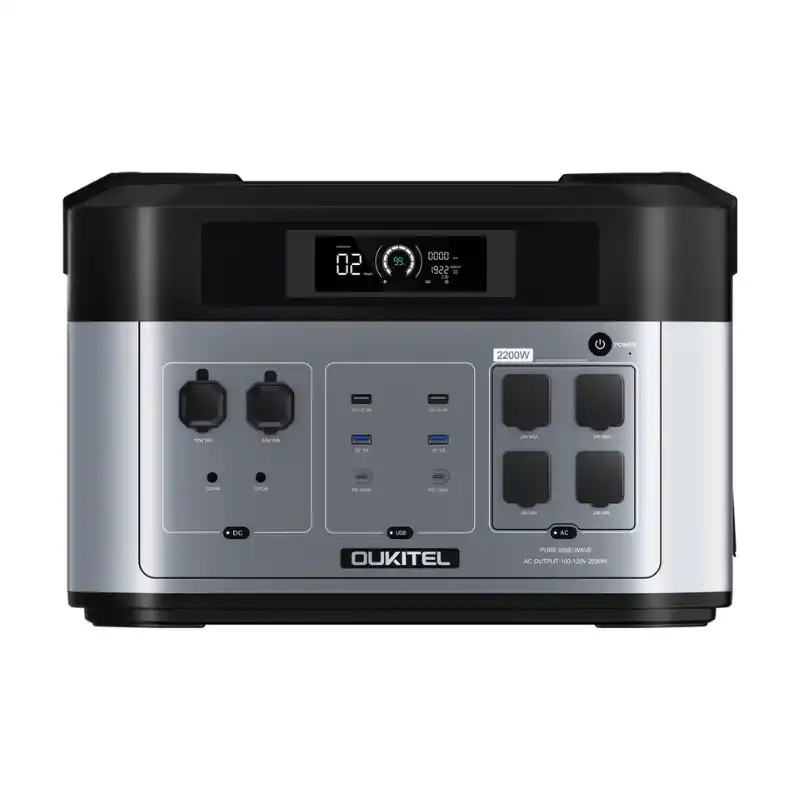
FFpower BP2000 Review

The FFpower BP2000 (marketed as Oukitel BP2000) transfers to battery in 6.2ms, the fastest measurable switchover we have recorded. It has a 2,048 Wh capacity, is powered by a 2,200W inverter, charges internally at 1,800W, and accepts an expansion battery.
My Quick Verdict
Setting aside the handful of machines that transfer with no measurable gap, this one is the quickest here. Six point two milliseconds ahead of every branded rival, including several costing considerably more.
It backs that with internal charging at 1,800 watts rather than an external brick, 2,500 watts from both inputs together, and a solar ceiling of 120 volts.
It also takes an expansion battery and returns 87% through the outlets, which puts it above the class line.
The gaps are real but narrow: no app at all, a 77% DC path, and fans at 59 decibels.
Best for: Budget-conscious household backup and off-grid installations that value a quick handover over phone connectivity.
Not for: twelve-volt-heavy builds, anywhere quiet, or anyone who wants remote monitoring.
Key Stats
Introduction
FFpower is not a name most buyers will recognise, and several of its machines share hardware with rebadged rivals elsewhere in this database. That makes it easy to dismiss the brand as anonymous budget stock.
This particular machine deserves better than that, because it does one thing better than anything else measured for this site.
When the grid fails, it hands over in 6.2 milliseconds. Every branded rival with a measurable transfer time is slower, including machines from manufacturers with a hundred times the marketing budget.
The cells are lithium iron phosphate, rated for 3,500 cycles and covered for 3 years.
What It Can Actually Run
2,200 watts sustained, with 4,400 in a burst, which comfortably covers a heating appliance alongside a second load.
Rated at 2,048 Wh, the sockets returned 1,800 Wh. That 87% clears the class line. Every figure below uses 1,800Wh.
- Refrigerator at 150W: twelve hours.
- CPAP at 40W without humidification: forty-five hours.
- Starlink dish at 50W: thirty-six hours.
- Laptop at 70W: about twenty-six charges, across two ports.
Output measured 120 volts with the inverter itself logged as silent. Electrical noise came in at over 2,000 mV, toward the messier end of what gets measured here.
Charging and Smart Features
Wall charging is internal rather than via a brick, and it delivers up to 1,800 watts, enough to refill the pack in a little over an hour.
Together, both inputs draw 2,500 watts, which is among the higher combined figures at this capacity.
Solar accepts 1,000 watts at 12 to 120 volts and 15 amps. That range covers both foldables and a rigid series string.
There is no app of any kind. Upper mid-range price tier; good value.
Charging Speed Benchmarks
Input speeds for the FFpower BP2000, sold in some markets as the Oukitel BP2000, plotted against the 26 machines in the 2,000Wh to 3,000Wh capacity class we hold charging data for. Typical wall input there is 1,641W and typical solar is 1,123W, with every band calculated inside the class rather than across the whole database.
The charging hardware is the strongest argument for this machine. 1,800W is internal rather than through an external brick, clears the 1,641W class average, and closes out the Average band, filling 2,048Wh in around 1.1 hours. Combined input reaches 2,500W. The comparison that matters is with the older machines it competes against on price, several of which still charge at 470W through a brick and take four hours and more to do the same job.
Solar tops out at 1,000W across a wide 12 to 120 volt window, a fraction under the 1,123W class mean which rates Average in a field whose highest figure is 2,400W. A full panel refill runs to about 2.0 hours. The width of that voltage window is the practical strength: a single small foldable and a proper rigid series string both register on the same input, which several machines at this capacity cannot manage without a second port.
Want solar to match the wall socket? The DJI Power 2000 carries the same 1,800W mains input but takes 1,800W of solar over a 43-amp path, the largest current allowance in our data. Panels then fill 2kWh in roughly 1.1 hours instead of 2.0, which puts array and grid on equal footing. Its fans measure 62dB, so where you can put it becomes the deciding question.
Real Capacity: What You Actually Get
The two output paths diverge by 10 points, which is a wide gap, and this runs counter to what most buyers hope for.
The sockets produced 1,800 Wh from a 2,048 Wh rating, 87%, ahead of several better-known machines at this capacity.
Twelve volts yielded just 1,586 Wh (77%), one of the poorer DC results recorded. Shifting loads that way saves nothing on this machine.
When sitting armed, it gives up roughly 1.6% per hour, or 0.91% at 12 volts. Middling rather than good, and something to bear in mind given how well the machine handles a transfer.
My takeaway: 1,800Wh from the outlets, and stay on the outlets. The DC path returns 10 points less, which is unusual for a machine with a 191-watt DC socket.
Power Output and Surge: What It Can Turn On
The inverter is generous for the price. Twenty-two hundred watts sustained runs a space heater with something beside it, and 4,400 watts of surge absorbs any household compressor start.
Two 100-watt USB-C ports are a genuine advantage in this cohort, where several rivals fit a single port, and one manages only 60 watts. Two laptops charge at full rate simultaneously.
At 191 watts,s the twelve-volt outlet passes the 150-watt bar that separates a useful socket from a token one, though the 77% return through it takes the shine off.
Electrical noise above 2,000mv is the one output figure worth checking against your own requirements, and no harmonic distortion measurement exists.
Real Appliance Runtimes
1,800Wh in hours, judged against the appliance figures held constant here.
Solid figures for capacity, achieved through good conversion rather than an unusually large pack. What distinguishes this machine is not how long it runs but how quickly it starts.
Recharging: Wall and Solar
From a Wall Outlet
Eighteen hundred watts, delivered internally, is the single biggest advantage this machine holds over the older units it competes with on price.
Three machines in this cohort charge at 470 or 520 watts through external bricks and take over four hours. This one refills in a little over sixty minutes with no separate charger to carry.
Use socket and panels together, and the total climbs to 2,500 watts, which is properly quick and among the stronger combined numbers at this size.
For anyone whose scenario is a storm warning with an hour or two of notice, that difference is the whole purchase.
From Solar Panels
The panel input draws 1,000 watts at 120 volts and 15 amps.
Both ends of that range are useful. The 12-volt floor means a single foldable panel registers immediately, and the 120-volt ceiling allows three or four rigid panels wired in series.
That combination is more flexible than several machines at this capacity manage, and it is well matched to the wattage on offer.
There is no need to unplug the array, and output continues while the pack fills.
Blackout Backup: The Part I Care About Most
This is why the machine is worth writing about.
The transfer measured 6.2 milliseconds. Setting aside the small group of machines that show no measurable gap at all, nothing else in this database is faster; not the best-selling brands, not the premium-tier systems.
At that speed, nothing with a processor registers the changeover. A desktop keeps running, a network drive stays mounted, a router holds its connection.
One caveat worth stating plainly: our data does not record whether the inverter arms itself. Given how much rides on that question across this category, confirm it with FFpower before relying on the machine to protect an empty house. A standby drain of 1.6% per hour means leaving it armed is workable, though not free.
Why this matters to me: I have spent this whole database criticising machines for slow transfers and manual inverters. This one solves the first problem better than anything with a measurable figure, which makes the unanswered second question genuinely worth chasing.
Noise and Living With It
Fifty-nine decibels under load, among the louder readings recorded here and beyond what an occupied indoor room will tolerate.
The inverter itself is logged as silent, so the fans are the sole source, which is better than in several machines in this cohort, where both contribute.
Weight is 52 pounds (23.5 kilograms), which is mid-field for two kilowatt-hours.
There is no app of any kind. Neither wireless standard is present, so nothing can be checked from another room, no rate is adjusted by phone, and no update will ever land. The cover extends for three years, and there is a number to call.
Where It Falls Short
Three limitations, and none of them touches the reason to buy it.
1. No App at All
No Bluetooth and no Wi-Fi, so nothing can be monitored or adjusted remotely, and no firmware update will ever arrive.
On a machine whose main strength is its behaviour during an outage, not being able to check its state from another room is a real inconvenience.
2. 77% Through DC
Ten points behind its own AC path and among the weaker twelve-volt figures in this database.
That is awkward given the 191-watt DC socket, which is otherwise well specified. Use it for what it can carry, not to save energy.
3. Fifty-Nine Decibels, and Self-Arming Unconfirmed
Loud enough to exclude bedrooms, tents and quiet offices entirely.
And our data does not record whether the inverter wakes on its own, which matters enormously given the transfer speed. Worth a direct question to FFpower before purchase.
How It Compares
Two comparisons matter: the fastest branded machine in this database and the older units this one competes with on price.
Against the Anker SOLIX C2000 Gen 2, this machine wins on transfer speed by a millisecond and on AC conversion by two points. It loses on DC conversion, on noise by 15 dB, on cycle life, on warranty, and on having an app at all.
The Anker is the better machine and the better value tier. What the FFpower offers is a faster transfer for less money, which is a narrow but genuine argument.
Against the older Bluetti units it competes with on price, the comparison is not close. Those machines have no transfer function whatsoever and charge at 470 watts through a brick. This one hands over in 6.2 milliseconds and refills in an hour.
Who Should Buy It, and Who Should Skip It
Buy It If
- Transfer speed is your priority, and you want the fastest measurable figure available.
- You are replacing an older machine that charges through an external brick.
- Your solar mixes foldables with rigid panels, which the 1-2 to 120-volt range handles.
- The machine will live somewhere where the fan noise doesn’t reach anyone.
Skip It If
- Twelve-volt loads are central, where 77% is a real penalty.
- You want to monitor or control the machine from a phone.
- It has to run within earshot of people.
- You need the self-arming question answered before committing, and you cannot get an answer.
The Bottom Line
This is the most interesting unbranded machine in the database. It transfers faster than anything with a measurable figure, charges internally at 1,800 watts, while its rivals use 470-watt bricks, and takes an expansion battery.
What it gives up is entirely on the periphery: no app, a weak DC path, and loud fans. None of those affects what it does when the grid fails.
The one thing I would settle before buying is whether the inverter arms itself, because a 6.2-millisecond transfer that requires a person to be present is only half a product. Ask FFpower directly, and if the answer is yes, this is quietly one of the better backup machines at this capacity.


There are no reviews yet.