
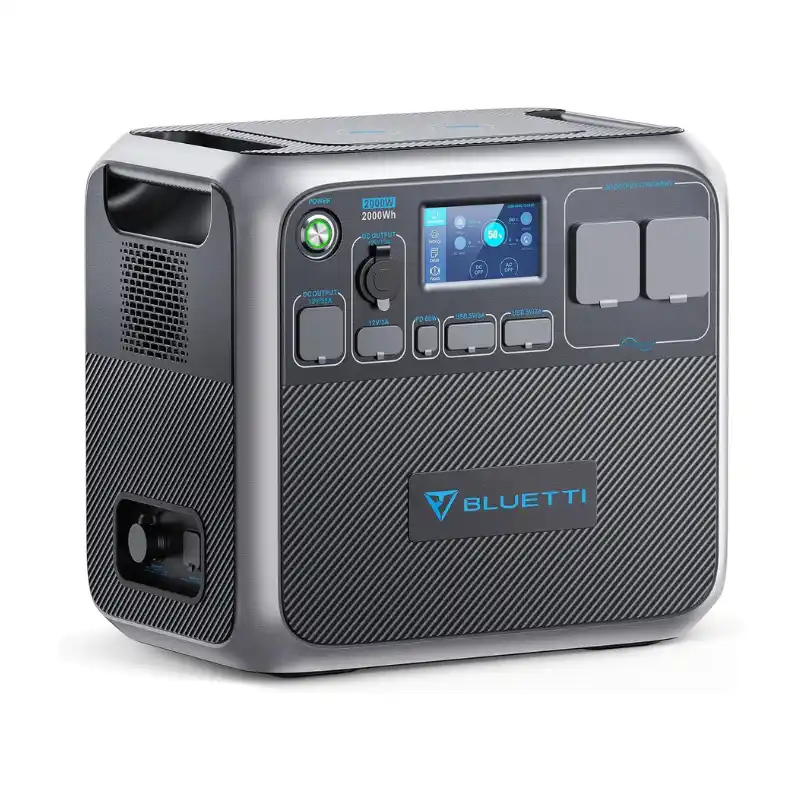
Bluetti AC200P Review

The Bluetti AC200P holds 2,000Wh behind a 2,000W inverter and returns 1,750Wh at the outlets. Solar reaches 700W at up to 150 volts, and the DC output is rated at 335 W, though there is no app, no expansion, and no transfer function.
My Quick Verdict
Three machines reviewed from Bluetti now sit in our database with no automatic transfer function. That is no longer an oddity; it is a generation of hardware that was never built to catch an outage.
The AC200P is the oldest of them, and it shows in ways the others do not. Its USB-C port supplies 60 watts, the second-lowest of anything measured here. Its solar input tops out at 700 watts and will not engage below 35 volts.
On top of that, 2% an hour disappears while it waits, mains charging runs at 470 watts from a separate brick, and nothing connects to a phone.
Two things it gets right: panels rated up to 150 volts and a 12-volt outlet rated at 335 watts.
Best for: Off-grid storage charged by a rigid series array, where nothing needs to be monitored or protected.
Not for: backup, laptop charging, or long periods sitting ready.
Key Stats
Introduction
Reviewing an older machine means separating what has aged from what was always a compromise, and on this one, the two are tangled together.
What has aged is the charging: 470 watts through an external brick, when current rivals take 1,800 internally. And the connectivity, which does not exist at all.
One compromise from the start was the USB-C port. Sixty watts will keep a phone or a tablet topped up. It will not charge most laptops at full speed, and only one machine in this entire database charges slower.
Chemistry is lithium iron phosphate, 3,500 cycles claimed, three years warranted.
What It Can Actually Run
2,000 watts sustained, with 4,000 in a burst, which is enough for a heating appliance on its own or a refrigerator with lighting.
Rated at 2,000Wh, the sockets returned 1,750Wh, an 88% result that is respectable. Everything below is calculated from 1,750Wh.
- Refrigerator at 150W: close to twelve hours.
- CPAP at 40W without humidification: nearly forty-four hours.
- Starlink dish at 50W: thirty-five hours.
- Laptop at 70W: about twenty-five charges, but slow ones through a 60-watt port.
The line held 120 volts, the inverter made no noise of its own, and electrical noise came to 1,665mv — nothing to remark on.
Charging and Smart Features
Wall input is 470 watts via an external charging brick. From flat, that is well over four hours.
Panel input handles 700 watts, 15 to 35 volts, 0-12 amps. Superb at the top end; the wattage itself is the smallest at this size.
There is no UPS mode, no app, and no expansion port.
Both inputs together reach 1,200 watts. Premium price tier, premium value tier.
Real Capacity: What You Actually Get
Conversion is the strongest part of the machine and the only category where it clearly beats current rivals at this capacity.
Against a 2,000 Wh label, the sockets returned 1,750 Wh. Eighty-eight percent is above the class line and ahead of several newer machines.
The twelve-volt route returned 1,710Wh, or 85%, three points behind. Given the 335-watt DC output, that port is worth using for its capacity rather than for efficiency.
Standby is the weak half. Awake, it gives up around 2% per hour, or 1.2% per 12 volts. Two weeks’ worth of ammo would account for most of what is stored.
My takeaway: Work from 1,750Wh; the conversion producing it is sound. Losing 2% an hour, though, means filling it near the day you need it.
Power Output and Surge: What It Can Turn On
The inverter is modest but sufficient: 2,000 watts sustained handles ordinary household loads one at a time, and 4,000 watts of surge covers a compressor start.
The DC side is better than the AC side in one respect. Three hundred and thirty-five watts is about two and a half times the power of a standard car outlet, enough to run a compressor fridge and a modest heater at once.
USB-C is where the machine falls down hardest. Sixty watts is half what nearly every rival provides and a fraction of the 140 watts the best now deliver. Current laptops will take a charge, unhurriedly, and a few will refuse to draw their full rate.
One reassurance regarding output quality is that the grading entry records no audible noise from the inverter itself, although harmonic distortion was not measured.
Real Appliance Runtimes
1,750Wh expressed in hours, on the unchanging appliance set used throughout.
Read the laptop line carefully. Every other machine at this capacity charges a laptop at 100 or 140 watts. Here, it goes through a 60-watt port or through the inverter, and neither is efficient.
Recharging: Wall and Solar
From a Wall Outlet
Four hundred and seventy watts into a 2,000Wh pack takes well over four hours, and it comes through an external brick rather than a built-in charger.
That brick is a separate object to carry, store, and eventually replace, and its loss disables the machine’s mains charging entirely.
Both sources, at once, reach 1,200 watts, cutting the wait time roughly in half on a bright day, yet still short of what current machines can draw from the socket on their own.
From Solar Panels
The solar arrangement is the machine’s best feature and its most awkward, in the same specification.
Panel input reaches 700 watts at 12 amps between 35 and 150 volts. A 150-volt limit ranks among the best at this size and lets four or five rigid panels share a string, so current stays modest and the cable can be slim across distance.
But the wattage ceiling is the lowest among machines at this capacity, so even a well-designed array cannot deliver much.
And the 35-volt floor means small foldable panels are simply invisible to it. Reaching the floor takes two rigid panels in series at minimum.
In short, this machine wants a proper array and then limits how much that array can give it.
Blackout Backup: The Part I Care About Most
There is no automatic transfer function.
Its grading row lists the UPS mode as not applicable. Equipment plugged into the outlets during a blackout loses power in the same instant the grid does.
This is now the third machine from this manufacturer reviewed on this site with the same gap, alongside the AC200Max and the EB200P. All three share a generation of hardware that predates the switchover arms race.
The 2% hourly standby drain compounds it. When handled manually, it still needs to be filled shortly beforehand rather than stored at the ready.
Why this matters to me: with nothing to catch the load and a pack that drains itself inside two weeks, neither half of readiness survives. Pack it for a trip you have planned, not for weather you have not.
Noise and Living With It
Fifty-four decibels under load, past the point where a room with a sleeper is comfortable and unremarkable in a garage.
The inverter itself is recorded as running silently, so the fans are the only source of noise, which is better than what several machines in this cohort manage.
It reads 59 pounds, 27 kilograms, substantial for two kilowatt-hours when the leanest machines this size sit around forty.
There is no app at all, and the warranty runs for three years with telephone support, two years short of the current class standard.
Where It Falls Short
There are five limitations, and the first two will actually affect you.
1. A 60-Watt USB-C Port
Half what nearly every machine at this capacity provides, and only one unit in this entire database offers less.
A modern laptop charges slowly, and some will not draw at the full rate at all. Anyone charging work equipment should treat this as a disqualifying specification rather than a minor one.
2. No UPS Mode
No automatic transfer function of any kind, so a blackout takes connected equipment down.
Combined with a 2% hourly standby drain, this machine is neither ready nor reactive.
3. Seven Hundred Watts of Solar, With a 35-Volt Floor
The lowest solar wattage ceiling at this capacity, on an input that ignores anything below 35 volts.
The 150-volt upper limit is genuinely good, which makes the low wattage more frustrating: you can build the right array, and it still will not deliver much.
4. No App and No Expansion
Neither Bluetooth nor Wi-Fi is present, so nothing can be watched, adjusted,d or updated.
No expansion battery support either, so 2,000Wh is a permanent ceiling.
5. Four Hundred and Seventy Watts Through a Brick
Better than four hours from flat, using a charger that lives outside the machine and can go missing.
A three-year warranty also sits two years short of what the class now offers.
How It Compares
The clearest comparisons are its own newer sibling and the strongest value machine at this capacity.
Bluetti’s own AC200L is the machine that replaced this one, and it beats it on every line: a working transfer function, five times the wall charging, nearly twice the solar wattage, a quarter of the standby drain, Wi-Fi, an extra two years of warranty, and a lower price tier.
The AFERIY P280 makes the point even harder, offering three improvements, dual 140-watt USB-C ports, and a seven-year warranty, at two value tiers below.
Who Should Buy It, and Who Should Skip It
Buy It If
- The machine stores planned trips and is charged shortly beforehand.
- Your array is a series of rigid panels, comfortably above 35 volts.
- Twelve-volt equipment is the main load, where the 335-watt DC output helps.
- You have no use for an app, an expansion port, or fast laptop charging.
Skip It If
- You charge a laptop with it. Sixty watts is not enough.
- Blackout protection is part of the plan.
- The machine will sit charged for weeks between uses.
- Bluetti’s own AC200L is available, which beats it on every line.
The Bottom Line
There is a competent battery here with genuinely good conversion, a high solar voltage ceiling, and a useful DC output.
Everything around it belongs to an earlier generation: a 60-watt USB-C port, no transfer function, no app, no expansion, 470 watts through an external brick, and a pack that loses 2% an hour while it waits.
Its own replacement is better on every measurable specification and costs a tier less. That comparison is not close, and it is the only comparison that matters.


There are no reviews yet.