
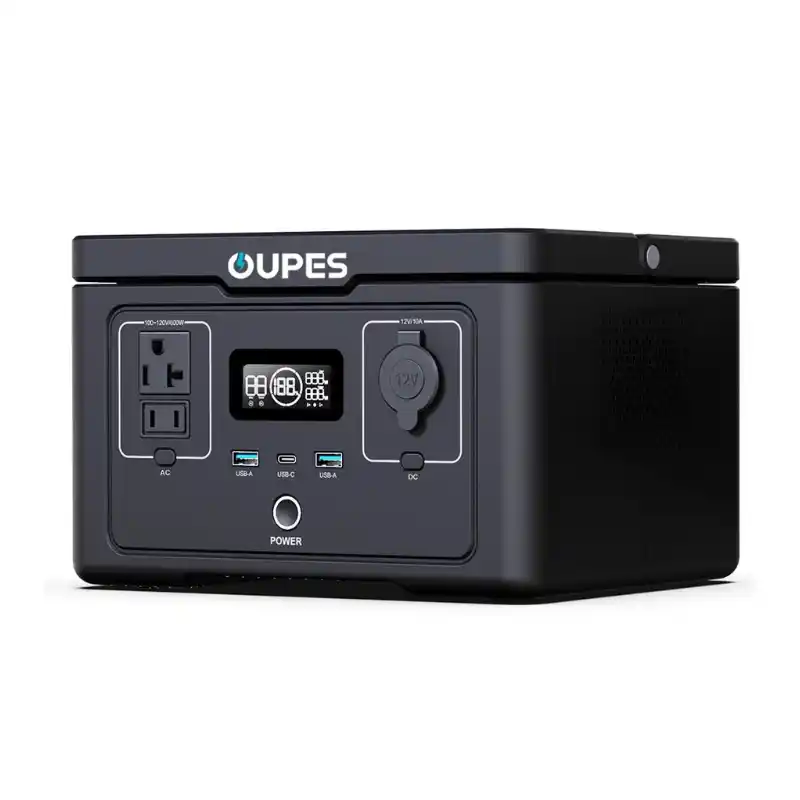
Oupes 600 Review

The Oupes 600 delivers 470Wh of its 595Wh rating, is powered by a 600W inverter, weighs 14.9 pounds, and charges at 97W via an external brick. Output measures 110 volts, and there is no transfer function or app.
My Quick Verdict
We have reviewed and tested several Oupes power stations. All charge through an external brick; none has a transfer function or an app, and every one caps its solar input at around 30 volts.
The Oupes 600 is the smallest and repeats the set exactly. It charges at 97 watts, which is more than enough to charge from empty in six hours.
It returns 78% through the AC sockets, below the class line, on an output measuring 110 volts.
In its favour: nothing this size weighs less, and none of the four Oupes machines costs less per watt-hour.
Best for: Light camping and device charging on a cheap machine filled the night before.
Not for: backup, solar-led charging, motors, or anything needing monitoring.
Key Stats
Introduction
This is the fourth Oupes machine we have measured, and by now the specification sheet writes itself.
Across the Oupes 600, 1100, 1800, and Mega series, the same four gaps appear every time: mains charging through an external brick, no automatic transfer function, no app of any kind, and a solar input that cuts off around 30 volts.
The smallest machine in that range repeats all four, and adds a 110-volt output and conversion below the class line.
Cells are lithium iron phosphate rated at 2,000 cycles under a two-year warranty.
What It Can Actually Run
Six hundred watts sustained with 1,200 in a burst. That covers a television, lighting, a router and devices, and stops short of refrigerator compressors and every heating appliance.
Rated at 595Wh, the sockets returned 470Wh (78%), seven points below the class line. Everything below uses 470Wh.
- Television at 150W: three hours.
- CPAP without humidification at 40W: close to twelve hours.
- Starlink dish at 50W: 9.5 hours.
- A 45W twelve-volt camp fridge on DC: past eleven hours, using the better 504Wh route.
Output measured 110 volts, below the accepted working band, with electrical noise of 1,765 mV and an audible whine from the inverter itself.
Charging and Smart Features
Wall input is 97 watts through an external charging brick at a single fixed rate. From empty, that is more than six hours.
Solar requires 115 watts at 12-30 volts, which excludes most rigid panels.
Dual charging is supported, raising the combined charging ceiling to 160 watts, a shared input feature of the larger Oupes machines.
There is no UPS mode and no app. Mid-range price tier, exceptional value tier.
Charging Speed Benchmarks
Wall and array charging on the Oupes 600, set against the 300Wh to 999Wh capacity class our database covers. Twenty-eight machines make up that group, with a 279W mains mean and a 192W solar mean. Each rating is scored inside the class, so it measures this unit against comparable capacities.
Charging at 97W through an external brick falls under the 99W line for a Low rating and is roughly a third of the 279W class average. A 595Wh pack therefore needs about 6.1 hours from a socket, which is most of a working day. There is no transfer function either, so this machine cannot cover an outage while it fills, and the brick is a separate item that has to travel with it.
Panels are the quicker of the two, which is unusual at this size. 115W still sits below the 192W class average but clears the Low threshold for an Average rating, and it refills the pack in roughly 5.2 hours, close to an hour faster than mains. Neither is quick, but the practical advice follows from it: if you are taking this machine away from a socket, bring panels rather than assuming the wall will be the faster route back.
Want the same size pack in under two hours? The Pecron E600LFP holds a comparable 614Wh and accepts 400W of solar, three and a half times the Oupes 600, filling it from the array in around 1.5 hours. Mains charging is internal at 270W, so the brick disappears and a wall recharge drops from six hours to a little over two.
Real Capacity: What You Actually Get
Both paths fall short, though the twelve-volt side is the better of the two by six points.
A meter on the sockets measured 470 Wh against a claimed 5595 Wh. At 78%, some 125 watt-hours remain locked inside.
The DC route returned 504 Wh (84%), which clears the line the AC side misses. Route what you can that way.
Neither idle drain figure is recorded in our data, leaving storage behaviour an open question.
For context, the Pecron E600LFP at a similar capacity returns 91% on both paths, thirteen points better through AC from a comparable pack.
My takeaway: Plan on 470 Wh at the outlets, 504 Wh at 12 volts. Neither figure is strong, and the twelve-volt path is preferable where your kit allows.
Power Output and Surge: What It Can Turn On
Six hundred watts continuous suits the capacity and constrains it in familiar ways. A television, lighting, a router, a laptop, and devices all run; a kettle, a heater,r or a hair dryer does not.
Twelve hundred watts of surge sits right at the edge of what a domestic refrigerator demands at startup, so a fridge is a marginal load rather than a reliable one.
The voltage compounds that. One hundred and ten volts sits below the accepted band, so any motor draws extra current and runs hotter, which matters most on a machine whose surge margin is already thin.
At 160 watts, the twelve-volt outlet passes the 150-watt bar, making it the power source, especially with six more points arriving that way.
USB-C is 60 watts and bidirectional, so it charges phones and tablets at full speed and can also recharge the machine itself from a compatible source.
Real Appliance Runtimes
Main figures are based on 470 Wh; the DC line uses the higher 504 Wh.
No refrigerator line appears here. With 1,200 watts of surge delivered at 110 volts, a domestic fridge is a load I would test before relying on it rather than assume.
Recharging: Wall and Solar
From a Wall Outlet
Charging a 595Wh pack at 97 W takes more than 6 hours from empty, which is among the slowest charging arrangements in our database.
Power comes from a brick in the cable, one more thing to pack and eventually renew, and its loss ends mains charging.
There is no adjustable rate, so slow is the only speed.
Dual charging is at least supported here, lifting the combined ceiling to 160 watts. That still leaves close to four hours on a bright day, but it is better than the socket alone.
From Solar Panels
The panel input draws 115 watts at 12-30 volts.
Both figures are low. Thirty volts excludes most rigid panels, leaving low-voltage foldables wired in parallel as the practical option.
The sheet confirms what the arithmetic implies: 115 watts will not fill this pack inside the standard window.
The 12-volt floor does mean a single small foldable engages immediately, which suits casual camp charging.
The array can stay permanently connected, and pass-through charging is supported.
Blackout Backup: The Part I Care About Most
There is no automatic transfer function on this machine.
The grading entry records the UPS mode as not applicable, so anything plugged into the outlets loses power the instant the grid does.
At 595 Wh, that is entirely normal; almost nothing under 800 Wh offers a transfer function, but it is now consistent across all four Oupes machines we have tested, regardless of size.
On the larger units, that omission costs real points. Here it costs almost nothing, because nobody buys a 595Wh machine for blackout protection.
Why this matters to me: the missing transfer function matters far less at this size than it does on the 1,800 and Mega machines. What it does show is that the omission is a brand decision rather than a capacity limitation.
Noise and Living With It
Fifty-one decibels under load, which sits at the upper edge of what a room with a sleeper will tolerate and is fair for this capacity.
Beyond the fans, the sheet logs the inverter humming on its own account.
Weight is the machine’s clearest strength: 14.9 pounds (6.7 kilograms), the lightest of any unit we have weighed at this capacity, and a genuine one-handed carry-over distance.
There is no app of any kind, and the warranty runs for two years, backed by a 24-hour customer service response commitment.
Where It Falls Short
Four limitations, and all four appear on every Oupes machine we have tested.
1. Ninety-Seven Watts Through an External Brick
Six hours or more from flat, unchangeable, dependent on a part that can go missing.
Dual charging lifts it to 160 watts combined, which still leaves close to four hours on a good day.
2. 78% Through AC at 110 Volts
Seven points adrift of the standard, leaving 125 watt-hours of the label unreachable.
The 110-volt reading also falls under the band, adding strain to motors on a machine whose burst margin is already narrow.
3. A 30-Volt Solar Ceiling at 115 Watts
Rigid panels typically recognise 30 volts and go unrecognised, leaving small foldables.
At 115 watts, panels cannot refill the pack within the usual window either.
4. No UPS Mode and No App
Neither a handover nor any wireless is in place, so nothing can be monitored, altered, or improved.
Both are consistent across every Oupes machine in our database, at every capacity.
How It Compares
Two comparisons at a similar capacity, one of which is decisively better.
The Pecron E600LFP is the machine to buy at this capacity. Thirteen points more AC conversion, double the inverter, more than three times the solar at three times the voltage ceiling, correct output voltage,e and 1,500 more cycles.
The Pecron is cheaper per watt-hour and five pounds heavier, mass being the only column this machine takes.
Compared to the Bibene, the Oupes is the better AC machine and the worse DC machine, while also offering dual charging. Between those two, it is close; against the Pecron, it is not.
Who Should Buy It, and Who Should Skip It
Buy It If
- Weight is your priority, and 14.9 pounds is worth paying for.
- Your loads are devices and lighting, not motor-driven appliances.
- It gets charged overnight before planned use.
- You already own small foldable panels that fit under 30 volts.
Skip It If
- You need it full in under six hours.
- A fridge features in your plans, and 1,200 watts at 110 is a thin margin.
- Solar is your charging route.
- The Pecron E600LFP is available, which beats it on nearly every measure.
The Bottom Line
At 14.9 pounds, this is the lightest machine we have weighed at capacity, and for a walk-in campsite or a day trip, that counts for something.
The rest is the familiar Oupes recipe (brick charging, nothing to catch a failure, no connectivity, a panel ceiling too low for rigid arrays) with 78% conversion at 110 volts on top.
The Pecron E600LFP costs less per watt-hour and does nearly everything better. Buy this one for the weight, or do not buy it.


There are no reviews yet.