
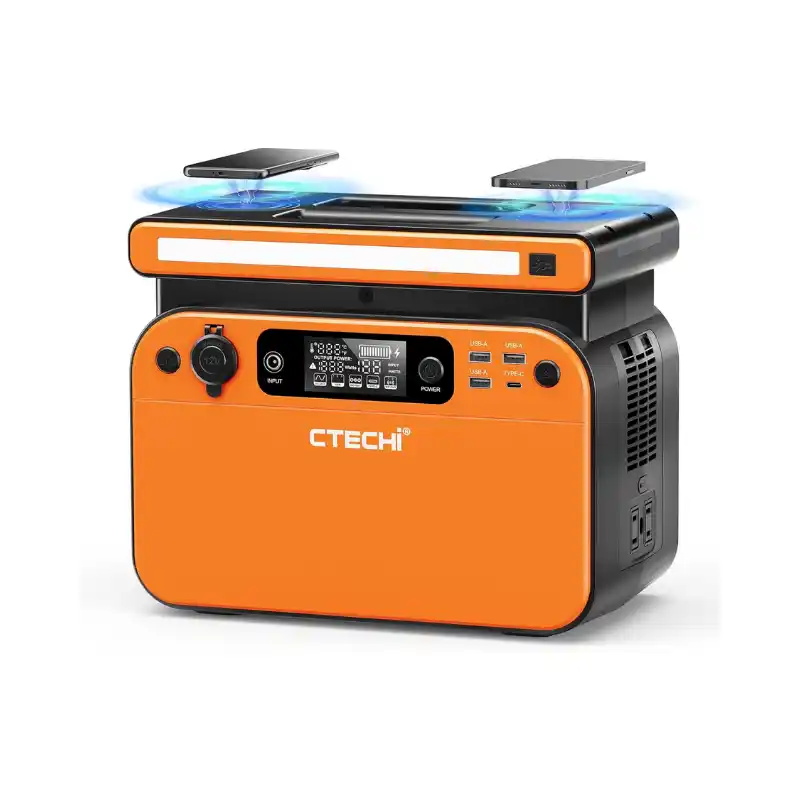
CTechi 500wh Review

The CTechi 500Wh runs at 45dB and outputs a correct 115 volts, returning 420 Wh of its 518 Wh rating. It has no pass-through charging and carries a one-year warranty, the shortest in our database.
My Quick Verdict
Forty-five decibels puts this among the quietest power stations we have reviewed and tested, and at 15.4 pounds, it is genuinely portable.
It also delivers 115 volts, which is within the accepted range, something some compact machines we have tested fail to maintain.
But it is one of the few machines we have tested with no pass-through charging at all. It cannot power anything while it refills.
That, plus a one-year warranty (the shortest we have recorded), describes a machine built to a price.
Best for: Quiet camping and device charging where the machine is filled and used in separate sessions.
Not for: running loads while charging, long-term ownership, or anything with a motor.
Key Stats
Introduction
Compact machines are bought for tents and vehicles, where quiet matters more than almost any specification on the box.
This one measures 45 decibels under load, placing it among the quietest units in our database and comfortably below the threshold for a room where someone is sleeping.
It also delivers 115 volts, within the accepted range, which four compact machines we have tested do not achieve.
Its pack claims 2,000 lithium iron phosphate cycles, yet CTechi stands behind it for a single year, briefer than anything else on record here.
What It Can Actually Run
Five hundred watts sustained with 1,000 in a burst. That covers a television, lighting, a router and devices, and excludes refrigerator compressors and heating appliances.
Rated at 518 Wh, the sockets returned 420 Wh (81%), four points below the class line. Everything below uses 420Wh.
- Television at 150W: two and three-quarter hours.
- CPAP at 40W with the humidifier off: 10.5 hours.
- Starlink dish at 50W: 8.5 hours.
- A 45W twelve-volt camp fridge on DC: ten hours, drawing on the better 454Wh route.
The line read 115 volts (inside the band, if near its floor), and the sheet logs the inverter as silent.
Charging and Smart Features
Wall input is 120 watts through an external charging brick at a single fixed rate. From empty, that is around 4.5 hours.
Panels contribute roughly 101 watts, rising to 175 watts when both inputs are combined.
There is no pass-through at all, and no other line on the sheet changes daily use as much.
There is no UPS mode and no app. Mid-range price tier, premium value tier.
Charging Speed Benchmarks
Where the CTechi 500Wh sits on recharging against the 300Wh to 999Wh capacity class, using the 28 units in our charging database. The bracket averages 279W of wall input and 192W of solar. Because bands are set inside each class, a Low rating here still describes an input a smaller machine could not accept.
Mains input of 120W is well under half the 279W class average, holding Average by the narrow banding at this size, and it fills 518Wh in roughly 4.3 hours. The absence of pass-through compounds it: the machine cannot supply loads while it charges, so those four hours are downtime rather than a background top-up, and in a class where the leader accepts 950W that is a long time to have it out of service.
Panels stop at 101W, which falls below the 104W line and takes a Low rating, roughly half the 192W class average and a sixth of the 600W ceiling. A solar refill runs to about 5.1 hours of flawless light, longer than the socket and beyond what a single usable daylight window reliably delivers. A 100W folding panel saturates the input on its own, so there is nothing to gain from building an array around this machine.
Want a machine that charges while it works? The EcoFlow River 2 Pro takes 940W from a wall socket and supports pass-through, so it keeps supplying loads throughout, bringing 768Wh back in around 0.8 hours. Solar more than doubles to 220W. Its five-year warranty against the CTechi's single year is the other gap worth weighing.
Real Capacity: What You Actually Get
The twelve-volt path is the stronger of the two by nearly seven points.
A meter on the sockets recorded 420 Wh, compared with a claimed 518 Wh. Four points under what this class is held to.
Twelve volts gave back 454 Wh (87.6%), comfortably over the bar. Route what you can that way.
Neither idle drain figure is recorded in our data, leaving storage behaviour unmeasured.
The AC shortfall is roughly 20 watt-hours compared to a machine converting at 85% from the same pack, small in absolute terms and consistent with the price.
My takeaway: Plan on 420 Wh at the outlets, 454 Wh at 12 volts. Prefer the twelve-volt path, and remember the machine cannot supply either while it charges.
Power Output and Surge: What It Can Turn On
Five hundred watts continuous is standard for the class. A television, lighting, a router, a laptop, and devices are running; heating appliances and refrigerator compressors are not.
One thousand watts of surge is below what a domestic fridge demands at startup, so that is not a load to plan around.
The 167-watt twelve-volt socket is genuinely good. It clears the 150-watt threshold comfortably and, paired with 87.6% DC efficiency, makes camp fridges and vehicle accessories efficient to run.
The USB-C outlet supports bidirectional power at 60 watts: full speed for phones and tablets, sluggish for a current laptop, and capable of refilling the unit from a compatible supply.
Output quality is decent: 115 volts is within the band, and the inverter itself produces no audible noise.
Real Appliance Runtimes
Main figures are based on 420 Wh; the DC line uses the higher 454 Wh.
None of these can happen while the machine is charging. With no pass-through, filling and using are entirely separate activities on this unit.
Recharging: Wall and Solar
From a Wall Outlet
One hundred and twenty watts into a 518Wh pack takes around four and a half hours from empty, which is slow.
It arrives through an external brick, so there is a separate component to carry and eventually replace.
Dual charging is at least supported, lifting the combined ceiling to 175 watts and bringing a full charge inside about three hours on a bright day.
The larger issue is what you cannot do during those hours, which the next section covers.
From Solar Panels
The panel input is around 101 W, which is modest for a 518 Wh pack.
Our data does not include a voltage window for this machine, a gap worth closing with CTechi before buying panels for it.
A 101-watt ceiling explains the sheet’s note that panels alone do not meet the standard refill window.
Dual charging helps, since the panels and mains together reach 175 watts.
The array can stay permanently connected, which is useful, though with no pass-through, a permanently connected array means the machine is unavailable whenever the sun is out and it is charging.
Blackout Backup: The Part I Care About Most
There is no automatic transfer function, which is standard at this capacity.
The specification that matters more here is the absence of pass-through charging. Similar to the Anker SOLIX F3800, at seven times the capacity, it shares that limitation.
It means charging and using are mutually exclusive. You cannot run a light while the machine refills, or keep a fridge going while panels top it up.
For a camp machine, this is a real constraint because charging usually happens during the day, when you also need power.
Why this matters to me: no pass-through is unusual enough to be worth stating plainly. Every recharge is time the machine is doing nothing for you, which on a four-and-a-half-hour wall charge is most of an afternoon.
Noise and Living With It
Forty-five decibels under load, which is among the quietest readings anywhere in our database and well below the threshold for a room where someone sleeps.
The inverter is logged as making no sound of its own, leaving airflow alone as the sole cause, something several competitors cannot claim.
For a tent, that pairing is the strongest argument this machine makes.
Fifteen point four pounds, 6.9 kilograms, lean for what it holds. Nothing connects to a phone, and the cover extends for 12 months with a same-day response promise.
Where It Falls Short
Four limitations, the first of which is shared with only one other machine in our data.
1. No Pass-Through Charging
Only one other machine in our entire database cannot supply loads while charging, and it holds seven times the capacity.
Charging and using are mutually exclusive here. On a four-and-a-half-hour wall charge, that is most of an afternoon during which the machine does nothing for you.
For camp use, where solar charging happens during the day, it is a genuine constraint rather than a footnote.
2. A One-Year Warranty
The shortest cover of any machine in our database, on cells rated for 2,000 cycles.
That is a mismatch: the pack is built to last five and a half years with daily use, and the maker stands behind it for one year.
3. Eighty-One Per cent Through AC and 101 Watts of Solar
Four points adrift of the standard, leaving 98 watt-hours of the label unreachable.
The 101-watt panel limit also falls short of the standard window, and no voltage range appears in our records.
4. A 60-Watt USB-C Port, No App
Sixty watts charges phones and tablets well but slows any modern laptop.
Wireless is absent too, so nothing can be checked or improved.
How It Compares
Two comparisons at almost identical capacity.
The CTechi wins on the two things a camper notices first: 45 decibels, for which neither rival has a recorded figure, and correct-band output voltage, which both rivals miss.
It also has the best DC socket of the three at 167 watts and the only dual charging.
It loses on pass-through, which both rivals support, and on the one-year warranty. The Vinnic’s 4,000-cycle rating is the stronger long-term argument, and the GoLabs is beaten by both.
Who Should Buy It, and Who Should Skip It
Buy It If
- Quiet operation is your priority, and the machine shares a tent with you.
- Twelve-volt equipment matters, and the 167-watt socket is the best of its class.
- You charge and use the machine in separate sessions anyway.
- The correct output voltage matters more to you than the warranty length.
Skip It If
- You need to run anything while the machine charges. It cannot.
- Warranty length matters: one year versus two or more elsewhere.
- Laptops often charge from it, and you want the full 100 watts.
- Solar is your main route, at around 101 watts with no recorded voltage window.
The Bottom Line
For a tent, this machine gets the two things right that matter most: 45 decibels with a silent inverter and output voltage within the accepted band.
Its twelve-volt outlet is the strongest at this size, and it is the only one of the three that combines both inputs.
What it cannot do is work while it charges, and it is covered for a single year. Those are the two facts to weigh, and for anyone charging from panels during the day, they carry significant weight.


There are no reviews yet.