
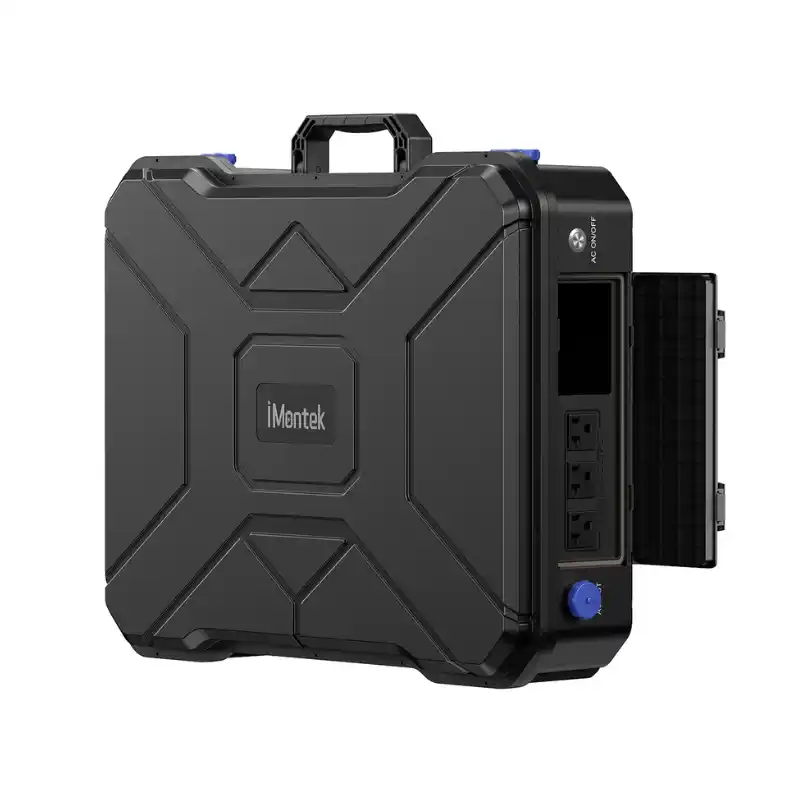
Montek X1200 Review

The Montek X1200 answers one question better than anything at its size: will it start the tool? A 7,000W surge ceiling swallows motor inrush that trips lesser inverters, 1,280Wh returns a class-leading 92% at the outlets, and solar accepts panels up to 150 volts.
My Quick Verdict
The Montek X1200 is the odd one out in this size range. In terms of capacity, it looks like a Mid-Size All-in-One unit, but its 2,000W inverter puts it in the Heavy-Duty Household Class, the 2,000W to 3,600W band.
Then there is the surge rating. Seven thousand watts. That is roughly double what most units this size offer, and it is the number that makes this unit interesting.
It also posted the best efficiency of anything I have looked at in this range. Independent testing pulled 92% of the rated capacity from the AC outlets, whereas most units land at 85%.
The trade-offs are real, though. It is loud and heavy, and its cells are rated for fewer cycles than its rivals’.
Best for: Remote Work and DIY Tools, plus Emergency Home Resilience, where high-inrush motor loads are the concern.
Not for: bedside or tent use. It is one of the louder units in this class.
Key Stats
| BadgeStat | Stats |
| Battery Chemistry and Longevity | LiFePO4 | 2,500 Cycles |
| Continuous AC Power Output | 2,000W AC | 7,000W Peak |
| Energy Storage Capacity | 1,280Wh | 1,190Wh Usable |
| Rapid AC Wall Recharge | 1,200W Input | Adjustable Speed |
| Uninterrupted Emergency Backup | 9.6ms UPS | Auto-failover |
| Maximum Solar Input and MPPT | 1,200W Solar | 12–150V MPPT |
| Ultra-fast USB-C Power Delivery | 100W USB-C PD |
| Low-noise Operational Level | 57dB | Audible Under Load |
| Modular Capacity Expansion | Expandable | Extra Battery Port |
| Smart App Remote Control | Wi-Fi + Bluetooth App |
Introduction
Batteries have always lost one argument to gasoline: starting things. A circular saw or a well pump takes a violent gulp of current in its first instant, and modest inverters fold.
The X1200 was built to win that argument. Its 7,000W ceiling is the highest surge figure I have on record at this capacity, and it exists for precisely that instant.
The pack is lithium iron phosphate, rated to 2,500 cycles. Genuine longevity, though noticeably short of the 4,000-cycle packs it competes against. Cycled daily, call it seven years before it settles at 80%.
What It Can Actually Run
Hold 2,000W all day. Spike to 7,000W for an instant. Those are the two figures, and the second one is why this unit exists.
The label reads 1,280Wh. Testing drew 1,190 Wh back out through the outlets, yielding a 92% result and the strongest conversion figure in this bracket. All the arithmetic below is based on 1,190 Wh.
- Full-size refrigerator drawing 150W: just under eight hours.
- CPAP with the humidifier switched off, 40W: close to 29 hours, so nearly three nights.
- Starlink dish at 50W: a shade under 24 hours.
- Laptop at 70W: about 17 complete refills.
Measured output sat at 121 volts, squarely in the middle of the safe band.
Charging and Smart Features
Mains charging peaks at 1,200W with stepped rate control, so you can throttle it back when time is not pressing.
Solar is the second reason to want this unit. It draws 1,200W at 12- 150 V, 20 A. That 150-volt ceiling is rare, and it means you can string a proper series array of cheap rigid panels rather than making do with a pair of foldables.
Failover occurred in 9.6 milliseconds, and the inverter self-arms, so no human needs to be present. An expansion port accepts a second battery when you want more, and the app connects to it over Wi-Fi or Bluetooth.
It occupies the mid-range price tier and the good value tier. Fair footing for what it does, though it never undercuts the entry-tier bargains.
Charging Speed Benchmarks
Where the Montek X1200 lands on wall and solar recharging within the 1,000Wh to 1,999Wh capacity class. Thirty units make up that comparison in our charging database, averaging 1,085W on mains and 641W on panels. All ratings are set inside the class, never against the database as a whole.
From a socket the X1200 takes 1,200W, marginally ahead of the 1,085W bracket average and holding an Average rating, since High begins at 1,300W. Its 1,280Wh pack therefore fills in about 1.1 hours at the top setting, with adjustable rates below that. Inputs in this bracket reach as high as 2,400W, so mains charging is the one specification on this machine that is genuinely mid-field rather than exceptional.
Panels tell a different story. 1,200W is nearly double the 641W bracket average, a solid High rating, and only 200W off the 1,400W class ceiling. That refills 1,280Wh in roughly 1.1 hours of good sun, matching the wall socket exactly. The number that makes it usable is the 150-volt input window, which is two and a half times what most machines at this capacity allow and lets you wire a genuine series string of cheap third-party rigid panels rather than a few branded foldables.
Need to refill from the grid in a hurry? The Bluetti AC240 doubles the mains figure to 2,400W, the highest wall input in this bracket, and empties-to-full on a bigger 1,536Wh pack takes about 0.6 hours. Panel input falls to 900W with a 60-volt ceiling, so it is a straight trade of solar flexibility for grid speed and extra capacity.
Real Capacity: What You Actually Get
Conversion always takes its cut. In this bracket, 85% is the going rate, and nobody thinks twice about it.
The X1200 is the outlier. Put a meter on it; at a rate of 1,190 Wh, 1,280 Wh comes back through the AC outlets. That 92% beats everything else I have measured at this capacity.
DC came back at 1,144Wh, or 89%. Strong too, though here the AC side is unusually the better performer of the pair.
Leave the inverter switched on with nothing connected, and it bleeds about 1.3% an hour, well inside the 2% line.
My takeaway: 92% is not a rounding difference. It means this 1,280 Wh unit delivers more usable energy to you than some 1,500 Wh units do.
Power Output and Surge: What It Can Turn On
Surge is the headline on this unit, so start there. Seven thousand watts, against the three to four thousand most units at this size offer.
That gap decides real outcomes. A fridge compressor might demand 1,200W for a heartbeat. A circular saw or a shop vacuum asks for far more, and units with 3,000W of headroom sometimes fold. This one has margin to spare.
The steady rating is 2,000W, and that number carries it across the line into the Heavy-Duty Household Class. That opens the door to resistive heating loads, and a 1,800 W unit cannot hold without shedding everything else.
One gap in the data worth naming: distortion was never measured. For tools and laptops, that is immaterial. Before running medical equipment, ask the manufacturer.
Real Appliance Runtimes
Below is 1,190Wh converted into hours. Appliance draws stay fixed across every review here, so these numbers travel.
| Appliance | Power Draw | Runtime | What That Means |
| Full-size refrigerator | 150W | About 7.9 hours | Clears a night comfortably, and further once cycling is counted. |
| CPAP machine (no humidifier) | 40W | About 29 hours | Three nights of sleep between charges. |
| Starlink dish | 50W | About 23.8 hours | A day and a night of connectivity with no grid. |
| Pellet grill or smoker | 100W | About 11.9 hours | An all-day cook with hours in reserve. |
| Laptop (70W) | 70W | About 17 recharges | USB-C at 100W handles it. |
That 92% conversion is doing visible work. These figures run further ahead of the 1,024Wh units than the raw capacity gap alone would explain.
Recharging: Wall and Solar
From a Wall Outlet
A household socket supplies it with up to 1,200W, with the rate adjustable in steps rather than fixed at two presets.
Middling for the class. Useful when a storm warning lands, but several rivals refill considerably faster.
From Solar Panels
Panels feed in at 1,200W anywhere between 12 and 150 volts at 20 amps. That high-voltage figure is the standout spec of the whole unit, and it changes what you can build.
Most rivals stop at 60 volts, which caps you at two rigid panels in series. At 150 volts, you can wire a genuine array of inexpensive third-party panels without an adapter or a separate charge controller. For anyone planning a permanent off-grid setup, that alone may decide the purchase.
A clear sky refills it in roughly two and a half hours.
Panels can remain wired permanently, and the unit can run a load while charging. Mains and sun together draw up to 1,800W, panels first.
Blackout Backup: The Part I Care About Most
Milliseconds decide whether a blackout is a shrug or a lost afternoon of unsaved work.
The X1200 crossed over in 9.6 milliseconds. Twenty is the usual safety line for a PC or router, eleven is the mark of a good one, and this clears both.
The inveallowsms ato s well, which is what lets it work when the house is empty.
Why this matters to me: speed counts for nothing if the inverter was switched off when the lights went out. Self-arming is what turns a fast unit into a dependable one.
Noise and Living With It
The fans are the price of admission. Under load, they read 57dB, among the loudest figures in this class and well beyond the 51dB line I draw for anything running near a sleeper.
Picture a normal conversation happening in the same room. A workshop drowns it out entirely. A tent does not.
It weighs 37 pounds (17 kilograms), which is heavy compared to the lighter kilowatt-hour unit next to it. Two hands, and you will feel it.
One more thing worth knowing in advance: this brand runs no telephone support. Problems get handled by email or a web form.
Where It Falls Short
This unit trades hard in both directions. Four of those trades deserve attention before you commit.
1. It Is One of the Louder Units in This Class
At 57 dB, the fans are clearly audible under load. That rules out bedside use for most people, and it makes tent camping unpleasant.
This is the clearest case for buying something else. If the unit needs to run in a bedroom, this is not the one.
2. Fewer Charge Cycles Than Its Rivals
The cells are rated for 2,500 cycles, whereas competing units in this class are rated for 3,500 or 4,000.
In practice, that is still seven years of daily cycling, and most people never cycle to a power station daily. But over a ten-year horizon, it is a real difference, and it is the strongest argument against this unit as a long-term home fixture.
3. No Phone Support, and No Distortion Figure
The brand does not offer phone customer support. For a purchase at this level, that is worth knowing in advance.
Inverter distortion was also not measured in the bench data I have. For laptops and tools, it is unlikely to matter, but I would confirm it before running medical equipment.
4. Heavy for Its Capacity
At 37 pounds, it is noticeably heavier than 1-kWh units, which weigh in the mid-twenties. The extra weight buys you the bigger inverter and the higher surge, but it makes this a vehicle-and-cart unit rather than a carry-anywhere one.
How It Compares
Two natural comparisons sit below. The Bluetti AC240 is the other Heavy-Duty Household Class contender at roughly this size; the Bluetti Elite 100 V2 is the value yardstick one power class down.
| Feature | Montek X1200 | Bluetti AC240 | Bluetti Elite 100 V2 |
| Price Tier | Mid-range | Upper mid-range | Entry |
| Value Tier | Good | Premium | Exceptional |
| Rated Capacity | 1,280Wh | 1,536Wh | 1,024Wh |
| Usable (Tested) | 1,190Wh (92%) | 1,310Wh (87%) | 890Wh (86%) |
| Continuous Output | 2,000W | 2,400W | 1,800W |
| Surge Output | 7,000W | 4,800W | 3,600W |
| UPS Switchover | 9.6ms | 19.2ms | 8.7ms |
| Fan Noise | 57dB | 47dB | 51dB |
| Battery Cycles | 2,500 | 3,500 | 4,000 |
| Expansion Battery | Yes | Yes | No |
Against the Bluetti AC240, the X1200 gives up capacity and quiet operation in exchange for a much larger surge, faster switchover, and a full price-tier of savings. The AC240 is the better home fixture. The X1200 is the better tool.
Against the Bluetti Elite 100 V2, this is a different question entirely. The Elite is quieter, cheaper, and lasts more cycles, but its inverter is a full power class smaller.
The way I would put it: if your worry is keeping a fridge and a router running during an outage, the Elite 100 V2 does that for less. If your worry is whether the thing will start when you pull the trigger on a saw, the X1200 is built for that, and the Elite is not.
Who Should Buy It, and Who Should Skip It
Buy It If
- You run power tools and need surge headroom that will not trip on motor startup.
- You want to build a real solar array from cheap third-party panels rather than foldables.
- You need a 2,000W inverter for a space heater or portable air conditioner.
- The unit will live in a garage, workshop, or vehicle rather than a bedroom.
Skip It If
- It needs to run quietly near where someone is sleeping. Look at the Bluetti AC240 instead.
- You want the longest possible cycle life. Competing units offer 3,500 to 4,000.
- Phone support matters to you.
- You need to carry it any real distance by hand.
The Bottom Line
The Montek X1200 is a specialist wearing a generalist’s shape. On paper, it looks like another mid-size unit, but the 2,000W inverter and 7,000W surge put it in a different power class than its capacity suggests.
The 92% efficiency is the quiet bonus. It hands back more usable energy than anything else I have measured at this size.
You pay for that in noise, weight, and cycle life. If the unit is going in a garage or a truck, that is a fair trade. If it is going in a bedroom, buy something else.


There are no reviews yet.