
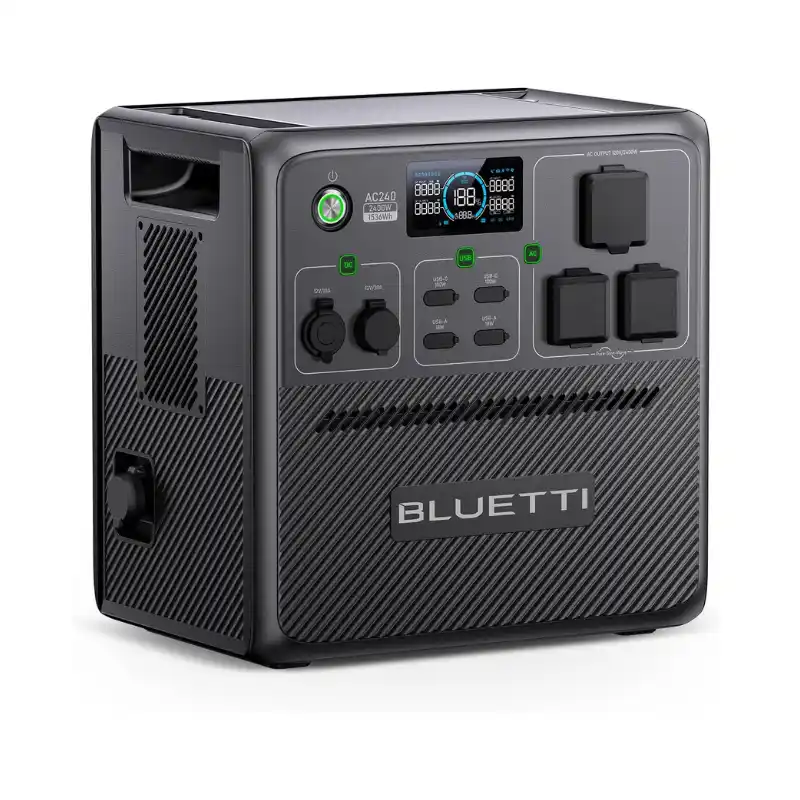
Bluetti AC240 Review

The BLUETTI Pioneer 150 (AC240) portable power station behaves less like gear and more like an appliance: 1,536Wh behind a 2,400W inverter, humming at 47dB, refilling from the wall at 2,400W. Six years of warranty and expanded battery support make it a fixture in the upper-mid-range home backup market.
My Quick Verdict
The BLUETTI Pioneer 150 (AC240) portable power station is a High-Capacity, heavy-duty unit that falls into the Heavy-Duty Household Class, the 2,000W to 3,600W band. It is built to be a fixture, not a companion.
Two things stand out. It is quiet, at 47dB under load. And it charges from a wall outlet faster than anything else in this size class, pulling up to 2,400W.
It also comes with a six-year warranty, a year longer than almost everything else in this class.
The problem is the switchover. Independent testing measured it at 19.2 milliseconds, and there is no auto-on inverter setting. As a backup system, that is the weak link.
Best for: Emergency Home Resilience, where the unit stays in one place and quiet operation is important.
Not for: unattended backup for a PC or NAS drive. The switchover is slow and does not self-arm.
Key Stats
| BadgeStat | Stats |
| Battery Chemistry and Longevity | LiFePO4 | 3,500 Cycles |
| Continuous AC Power Output | 2,400W AC | 4,800W Peak |
| Energy Storage Capacity | 1,536Wh | 1,310Wh Usable |
| Rapid AC Wall Recharge | 2,400W Input | Fastest in Class |
| Uninterrupted Emergency Backup | 19.2ms UPS | Manual Arm |
| Maximum Solar Input and MPPT | 1,200W Solar | Built-in MPPT |
| Ultra-fast USB-C Power Delivery | 100W USB-C PD |
| Low-noise Operational Level | 47dB | Whisper Quiet |
| Modular Capacity Expansion | Expandable | Extra Battery Port |
| Smart App Remote Control | Wi-Fi + Bluetooth App |
Introduction
Some power stations are gear. This one is closer to an appliance, a box you position once and very likely never lift again.
That is not a complaint. At 47dB under load, it can be installed in a utility room against a bedroom wall and forgotten about, which is more than most units at this capacity can claim.
Behind the panel sits a lithium iron phosphate pack rated for 3,500 cycles and covered by a six-year warranty. Twelve months beyond the class norm, and manufacturers do not extend coverage they expect to pay out on.
What It Can Actually Run
The steady output is 2,400 W, and the surge is 4,800W, but the steady figure is the interesting one here.
Fifteen hundred watts leaves headroom to spare, and that is the threshold where resistive heating appliances live. A smaller inverter runs one of them and must shed everything else to do it.
The label claims 1,536Wh. Put a meter on the outlets, and 1,310 Wh comes back, or 87%. Every runtime below is built from that figure.
- Full-size refrigerator drawing 150W: nearly nine hours.
- CPAP with the humidifier off, 40W: around 32 hours, covering three nights.
- Starlink dish at 50W: about 26 hours.
- Laptop at 70W: about 18 complete refills.
The measured output was 122 volts, comfortably within the safe household range.
Charging and Smart Features
Main charging is the headline feature. It accepts 2,400W, roughly double the intake of most units this size, with the rate adjustable in steps.
Panels contribute around 1,000W in practice, at 12 to 60 volts and 21 amps, refilling the pack in about two and a half hours under a clear sky.
Failover wtook19.2 milliseconds, and the inverter has no self-arming mode. Panels may remain attached indefinitely, loads can run while charging, and mains and sun together exceed 2,400W.
It occupies the upper mid-range and premium value tiers, meaning you pay above the class average per watt-hour. Whether the quietness and charging speed justify it is the focus of the rest of this review.
Charging Speed Benchmarks
Grid and solar recharge times for the Bluetti AC240, set against every machine in the 1,000Wh to 1,999Wh capacity class we hold charging data for. Thirty units sit in that bracket, with a mean mains input of 1,085W and a mean solar input of 641W. The banding is internal to the class, so these ratings describe the machine among comparable capacities only.
Nothing in this bracket charges faster from a wall socket. 2,400W is more than double the 1,085W bracket average and matches the class maximum outright, which puts a 1,536Wh pack back to full in around 0.6 hours. That is the specification that makes this machine an appliance rather than gear: a storm warning at lunchtime means a full battery by mid-afternoon, with the charging rate adjustable down when there is no rush. Against a class floor of 200W, the spread here is twelvefold.
Panels reach about 900W, which still clears the 641W bracket average and the 750W High threshold, so it rates High even though several 1kWh units in the same class accept more. A full solar refill runs to roughly 1.7 hours, nearly three times its mains figure. The 60-volt input ceiling is the real limit rather than the wattage, capping the series string at two rigid panels and pushing anything larger into parallel wiring.
Building an array rather than relying on the grid? The Montek X1200 accepts 1,200W of solar through a 150-volt window, a third more wattage than the AC240 and two and a half times the voltage headroom, which is what actually lets you wire five or six cheap rigid panels in one series string. Mains charging halves to 1,200W, so take this route when the panels are doing the work and the socket is the backup.
Real Capacity: What You Actually Get
Nobody ever receives the number printed on the box. Conversion sees to that.
The AC240 is sold as 1,536Wh. Metered at the AC outlets, it returned 1,310 Wh, which works out to 87% and sits comfortably above the 85% mark.
DC measured 1,306 Wh (8(5%)), nearly identical to the AC figure. So there is no efficiency argument for running 12V gear from the car socket rather than the outlets.
Left idling with the inverter awake and no load attached, it sheds roughly 1.5% an hour. Inside the 2% line, though several rivals hold a better charge.
My takeaway: 1,310Wh is the working figure. Set against the kilowatt-hour units, that buys you roughly three more hours of refrigerator time; the gap between covering an evening and covering a whole night.
Power Output and Surge: What It Can Turn On
Steady and surge answer different questions, and in this unit, the story centres on the steady figure.
That 2,400W rating is what carries it into the Heavy-Duty Household Class. A space heater or a compact air conditioner becomes something it holds all day, not a load it grudgingly tolerates while the rest of the house stays dark.
The 4,800W surge handles fridge compressors and most hand tools without drama, though it has less reserve than a few rivals at this size.
Distortion never appears in the bench data I have. Household gear will not care. For medical equipment, it’s worth calling the manufacturer first.
Real Appliance Runtimes
What follows is 1,310 Wh expressed in hours, based on the fixed appliance draws used throughout this site.
| Appliance | Power Draw | Runtime | What That Means |
| Full-size refrigerator | 150W | About 8.7 hours | A whole night, stretching well past that, with cycling. |
| CPAP machine (no humidifier) | 40W | About 32 hours | Three nights on a single charge. |
| Starlink dish | 50W | About 26 hours | More than a day of uninterrupted connection. |
| Pellet grill or smoker | 100W | About 13 hours | Sunrise to sunset on the smoker. |
| Laptop (70W) | 70W | About 18 recharges | Handled by the 100W USB-C port. |
Focus on the refrigerator line. Nearly nine hours of continuous operation, and realistically past twelve once the compressor rests between cycles, determine whether a freezer full of food survives an overnight outage.
Recharging: Wall and Solar
From a Wall Outlet
Nothing else on this unit impresses me as much. A household socket delivers 2,400W into it, roughly twice what comparable units accept.
Empty to full lands well inside an hour. When a weather warning gives you two hours of notice, that single specification is worth more than any other on the page.
The rate steps down as well, so an unhurried overnight charge is gentler on the cells.
From Solar Panels
The paper rating overstates it. In practice, panels contribute around 1,000W, at 12-60 V and up to 21 A.
Sixty volts is the constraint worth noting. Two rigid panels in series are your ceiling, which rules out a serious array and matters if a permanent off-grid setup was the plan.
Clear sky, empty to full: roughly two and a half hours.
Panels can remain wired permanently, and the unit runs loads while charging. The mains and sun together draw more than 2,400W.
Blackout Backup: The Part I Care About Most
Here, the AC240 gives ground, and it gives quite a lot of it.
Testing clocked the crossover at 19.2 milliseconds. That scrapes under the 20-millisecond safety threshold, but only just, and the manufacturer’s own claim of 15 milliseconds is faster than the meter found.
The larger issue is that the inverter will not arm itself. Someone has to switch it on. Sitting on standby with the inverter dormant, it catches nothing at all when the power cuts out.
For a lamp or a refrigerator, this is academic. For a desktop, a NAS, or a router that has to survive unattended, it is the whole question.
Why this matters to me: unattended backup means exactly that. Without self-arming,g this is a manual system wearing a UPS badge, and I would not stake a NAS drive on it.
Noise and Living With It
Under load,ad, the fans read 47dB, which, for a 2,400W inverter, is genuinely impressive. Comfortably beneath the threshold I use for anything sharing a room with a sleeper.
Roughly, the sound of a quiet kitchen with the refrigerator humming. People sleep through that every night.
Weight is the counterweight to all this. Seventy-two pounds, 32 kilograms. You do not carry this unit; you position it, and you want a second person or a cart to do it.
The app connects via Wi-Fi and Bluetooth, and Bluetti staffs a telephone support line, which is far from universal in this category.
Where It Falls Short
One weakness here is serious, and three others are worth weighing. The first explains the score.
1. The Switchover Is Slow and Does Not Self-Arm
At 19.2 milliseconds, the switchover barely clears the 20-millisecond safety line, and the manufacturer’s claimed 15 milliseconds does not match the test results.
The bigger issue is the missing auto-on setting. The inverter must be armed manually, so if the unit is idle during an outage, it won’t pick up the load at all.
If unattended UPS protection is your main reason for buying, this is the wrong unit, and I would not recommend it to anyone.
2. It Is Heavy Enough to Be Furniture
Seventy-two pounds is a two-person lift or a cart. This is a unit that goes in a utility room and stays there.
That is fine if you are buying home backup. It is a dealbreaker if you imagine taking it camping.
3. It Sits in the Premium Value Tier
Per watt-hour, this costs more than most of its class. The Montek X1200 and the Bluetti Elite 100 V2 both sit a full value tier below it.
You are paying for quiet operation, fast wall charging, and the six-year warranty. Whether that is worth a tier depends entirely on where the unit will live.
4. Solar Input Caps at 60 Volts
The voltage ceiling limits you to a couple of rigid panels in series. For occasional foldable-panel charging, that is fine. For a permanent array, it is a real constraint.
How It Compares
Two comparisons sit below. The Montek X1200 is the nearest Heavy-Duty Household Class rival; the EcoFlow Delta 3 Plus is the quiet-backup benchmark one power class down.
| Feature | Bluetti AC240 | Montek X1200 | EcoFlow Delta 3 Plus |
| Price Tier | Upper mid-range | Mid-range | Mid-range |
| Value Tier | Premium | Good | Premium |
| Rated Capacity | 1,536Wh | 1,280Wh | 1,024Wh |
| Usable (Tested) | 1,310Wh (87%) | 1,190Wh (92%) | 880Wh (85%) |
| Continuous Output | 2,400W | 2,000W | 1,800W |
| UPS Switchover | 19.2ms | 9.6ms | 10.2ms |
| Auto-on Inverter | No | Yes | Yes |
| Fan Noise | 47dB | 57dB | 41dB |
| Wall Charging | 2,400W | 1,200W | 1,500W |
| Battery Cycles | 3,500 | 2,500 | 4,000 |
Against the Montek X1200, the AC240 buys you more capacity, ten decibels of quiet, double the wall charging speed, and a thousand more cycles. You give up the auto-on inverter, half the switchover speed, and a full-value tier.
The AC240n is harder to compare against the EcoFlow Delta 3 Plus. The Delta 3 Plus is quieter, switches over twice as fast, self-arms, and carries more cycles, all at a lower price tier. The AC240 offers 50% more capacity and much faster wall charging.
So the case for the AC240 comes down to one question: do you need more than 1kWh, and will the unit sit in one place? If yes to both, the quiet and the charging speed make it worth the tier. If you need real unattended UPS protection, the Delta 3 Plus does that job better for less.
Who Should Buy It, and Who Should Skip It
Buy It If
- The unit will live in one place, and quiet operation matters.
- You want to run a space heater or a portable air conditioner as a steady load.
- You need to recharge quickly when a storm warning gives you only an hour’s notice.
- You want more than 1kWh with room to add expansion batteries later.
Skip It If
- You need unattended UPS protection for a PC or NAS. The EcoFlow Delta 3 Plus does that far better.
- You want to move the unit regularly. At 72 pounds, it is a two-person lift.
- You are building a permanent solar array. The 60-volt input ceiling will limit you.
- Value per watt-hour is your main test.
The Bottom Line
The Bluetti AC240 is a good home fixture and a mediocre backup system, and which of those matters more depends entirely on what you are protecting.
As a fixture, it is excellent. Quiet at 47dB, fast to refill at 2,400W, backed by a six-year warranty, and expandable when you need more.
As a UPS, it is the weakest unit I have looked at in this class. A 19.2-millisecond switchover with no auto-on setting means it will not protect a PC that nobody is standing next to. Buy it knowing that it earns its place.


There are no reviews yet.