
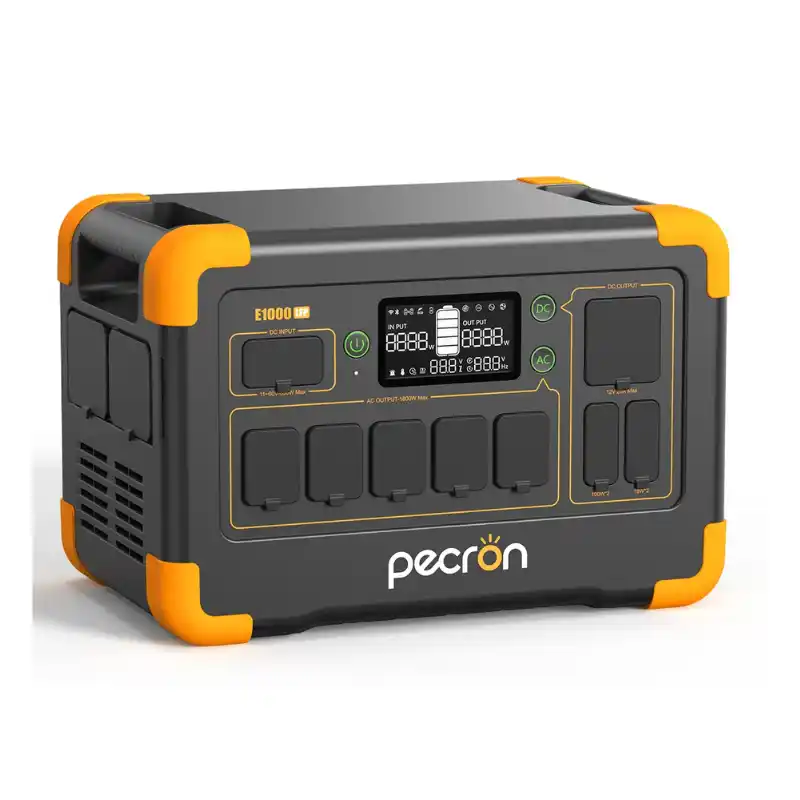
Pecron E1000LFP Review

The Pecron E1000LFP delivers 1,024Wh through an 1,800W inverter and returns 90% of its rated capacity on the DC side, with a 300W XT60 output that dwarfs the usual car socket. Four-stage charging, 600W of solar, and expansion support put it in the entry-price tier at exceptional value.
My Quick Verdict
Nearly every unit in this class treats the twelve-volt side as an afterthought. A car socket rated near 130 watts, tucked under the AC outlets, is adequate for a tire pump and little else.
The E1000LFP goes the other way. It delivers a 300-watt XT60 DC output and returns 90% of its rated capacity via the DC side, compared with 85% via the outlets.
For anyone running a twelve-volt fridge, a diesel heater, or vehicle electrics, that combination is worth more than another few hundred watt-hours.
The compromises are a 2,000-watt surge ceiling, the lowest in this class, and a three-year warranty, where its rivals offer five.
Best for: Overland, RV, and Remote Dry Camping, and Emergency Home Resilience where twelve-volt gear is part of the plan.
Not for: heavy simultaneous AC loads, or anyone who weighs warranty length heavily.
Key Stats
| Badge | Stat |
| Battery Chemistry and Longevity | LiFePO4 | 3,500 Cycles |
| Continuous AC Power Output | 1,800W AC | 2,000W Peak |
| Energy Storage Capacity | 1,024Wh | 880Wh Usable |
| Rapid AC Wall Recharge | 1,100W Input | Four-stage |
| Uninterrupted Emergency Backup | 13.5ms UPS | Manual Arm |
| Maximum Solar Input and MPPT | 600W Solar | 20A MPPT |
| Ultra-fast USB-C Power Delivery | 100W USB-C PD |
| Low-noise Operational Level | 53dB | Moderate Under Load |
| Modular Capacity Expansion | Expandable | Extra Battery Port |
| High-output DC | 300W XT60 | 90% DC Yield |
Introduction
Running a twelve-volt fridge from a power station through the AC outlets is a small act of waste that happens millions of times a year. The battery is DC. The fridge is DC. In between, an inverter converts to AC, and the fridge’s own supply converts it back, and each step takes a cut.
The E1000LFP is one of the few units at this size that takes the alternative seriously. A 300-watt XT60 output, and a DC path that hands back 90% of rated capacity against 85% through the sockets.
The cell chemistry is lithium iron phosphate, with a 3,500-cycle rating. Used daily – that is a decade of service. The warranty, oddly, covers three years, whereas rivals cover five.
What It Can Actually Run
The inverter sustains 1,800W with a peak of 2,000W. That surge figure is the lowest in this class, and you should check the specifications against your own appliance list before buying.
Rated capacity is 1,024Wh. The outlets returned 880 Wh ( 8%)t, while the DC side returned 923 Wh (90%). AC figures below use 880Wh.
- Full-size refrigerator at 150W: close to six hours.
- CPAP with the humidifier off, 40W: about 22 hours, covering two nights.
- Starlink dish at 50W: near 18 hours.
- Twelve-volt camp fridge at 45W, running on DC: roughly 20 hours, using the better 923Wh DC yield.
Waveform measured 120 volts with 1.8% distortion, inside safe limits, though not the cleanest here.
Charging and Smart Features
Mains charging peaks at 1,100W across four selectable stages rather than a simple fast-or-slow switch.
Panels feed in at 600W between 11 and 60 volts at 20 amps. Twenty amps is a generous ceiling that opens the door to rigid panels, not just foldables. Good sun takes it from empty to full in about two and a half hours.
The crossover measured 13.5 milliseconds, and the inverter does not self-arm. Solar can be permanently attached; loads run during charging; and both inputs together reach 1,150W, with the panels first in line.
Entry-price tier, exceptional-value tier. For a unit carrying expansion support and DC hardware of this quality, that is a hard combination to argue with.
Real Capacity: What You Actually Get
Most units in this class hand back a similar share through AC and DC, so the choice of port rarely matters. This one is different, and the difference is the reason to buy it.
Through the AC outlets, it returned 880 Wh of the rated 1,024 Wh, an 85% result that clears the threshold without distinction.
Through DC, it returned 923 Wh, or 90%. That is a 43Wh advantage, roughly 5% more energy, simply for choosing the right socket.
Standby loss runs at about 1.5% per hour on AC with the inverter awake and 0.75% on the DC side. Both are within the acceptable range; neither is exceptional.
My takeaway: run 12-volt gear on 12 volts here, and you gain 5% more energy than you would through the inverter. Over a multi-day trip with a camp fridge that is measured in hours, not minutes.
Power Output and Surge: What It Can Turn On
Sustained output covers what runs continuously. Peak covers the instant a motor engages. On this unit, the gap between them is unusually narrow.
At 1,800W sustained and 2,000W peak, the E1000LFP has only 200 watts of headroom. Most units at this capacity carry 1,800W or more of reserve above their continuous rating.
A refrigerator compressor demanding roughly 1,200W at startup fits, provided nothing substantial is already running. Add a microwave or a kettle to the same circuit,t and you are at the ceiling.
The DC side is where the output story turns. A 300-watt XT60 output is more than double the typical car socket in this class, enough to power a diesel heater, a compressor fridge, and vehicle accessories together, without an inverter in the path.
Real Appliance Runtimes
Below is 880 Wh through the outlets, plus one DC figure calculated from the stronger 923 Wh yield, using this site’s standard appliance draws.
| Appliance | Power Draw | Runtime | What That Means |
| Full-size refrigerator | 150W | About 5.9 hours | An evening covered, extending as the compressor cycles off. |
| CPAP machine (no humidifier) | 40W | About 22 hours | Two nights between charges. |
| Starlink dish | 50W | About 17.6 hours | A working day plus the evening. |
| 12V camp fridge, runs on DC | 45W | About 20.5 hours | Uses the 923Wh DC yield, not the 880Wh AC figure. |
| Laptop (70W) | 70W | About 12.6 recharges | Through the 100W USB-C port. |
Notice the camp fridge line uses a different starting figure. That is the whole argument for this unit: the same battery delivers more when the load stays on the DC side.
Recharging: Wall and Solar
From a Wall Outlet
A household socket delivers up to 1,100W, which is the slowest mains charging among the units in this comparison. An empty pack takes a little over an hour.
What partly offsets this is the four-stage rate control, which provides finer control than the two-speed switches common at this price. Overnight, when time is irrelevant, drop it to the gentlest setting and treat the cells kindly.
From Solar Panels
Panels feed in up to 600W at 11- 60 V and 20 A. The wattage ceiling is ordinary, but the current ceiling is not.
Twenty amps is generous for this class, and it widens what you can actually connect. Units limited to 10 or 12 amps restrict you to small foldable panels; this one accepts rigid panels without hitting a current wall.
Give it a clear sky, and it comes back from empty in about two and a half hours.
Leave the panels attached permanently if you like; the unit powers loads while it charges. Run both inputs simultaneously; it accepts a total of 1,150W, prioritizing the panels.
Blackout Backup: The Part I Care About Most
Backup performance here is middling, and it is the one area where the unit is simply average.
Crossover took 13.5 milliseconds. That is inside the 20-millisecond safety line with a reasonable margin, though short of the sub-11 figures posted by the best units in this class.
The inverter has no self-arming mode, so it must be switched on and left on for the crossover to protect anything.
For a fridge, lighting, or a router, this is entirely serviceable. For a desktop or a NAS drive, I would not choose the combination of thirteen milliseconds and a manual arm.
Why this matters to me: this unit’s strengths are on the DC and solar side, not the backup side. Buying it primarily as a UPS means paying for hardware you won’t use and accepting middling performance where it counts.
Noise and Living With It
Under load, the fans measure 53dB. That sits just above the line I use for anything running near a sleeper, though only barely.
In practice,e it is a steady mechanical presence rather than a whine. Tolerable in a living room, borderline in a small bedroom, and noticeably better behaved than the loudest units in this class.
The weight is 29 pounds (13.5 kilograms), which is within capacity and manageable to carry one-handed over short distances.
The app runs on both Wi-Fi and Bluetooth, so remote monitoring works at home, and control still works even without a network.
Where It Falls Short
Three things hold this unit back, and one of them is a hard ceiling you cannot work around.
1. The Surge Ceiling Is the Lowest in the Class
Two thousand watts of peak against an 1,800W sustained rating leaves just 200 watts of headroom, where rivals carry 1,800W or more.
A single refrigerator starting on an otherwise quiet unit is fine. A fridge compressor engaging while a microwave is already drawing power is not, and that is an ordinary evening in a household outage. Write out what will run simultaneously before choosing this one.
2. Three-Year Warranty Where Rivals Offer Five
The cells are rated for 3,500 cycles, which is genuinely good and better than several competitors. The warranty covering them runs for three years.
That gap between what the hardware claims and what the manufacturer will stand behind is worth weighing, particularly on a purchase meant to last a decade.
3. Slowest Mains Charging Here
Eleven hundred watts is the lowest wall charging figure among the units compared on this page. An empty pack takes a little over an hour, whereas rivals manage forty minutes.
For storm preparation, a day’s notice is irrelevant. With an hour’s notice, it is the difference between a full pack and a partial one.
How It Compares
Two comparisons frame it. The Anker SOLIX C1000 is the closest rival on price and capacity, and the Bluetti Elite 100 V2 is the strongest all-round unit at this size.
| Feature | Pecron E1000LFP | Anker SOLIX C1000 | Bluetti Elite 100 V2 |
| Price Tier | Entry | Entry | Entry |
| Value Tier | Exceptional | Exceptional | Exceptional |
| Usable Through AC | 880Wh (85%) | 910Wh (86%) | 890Wh (86%) |
| Usable Through DC | 923Wh (90%) | 946Wh (89.5%) | 879Wh (85%) |
| High-output DC Port | 300W XT60 | 138W Socket | 146W Socket |
| Surge Output | 2,000W | 2,600W | 3,600W |
| UPS Switchover | 13.5ms | 16.1ms | 8.7ms |
| Solar Current Ceiling | 20A | 12.5A | 20A |
| Fan Noise | 53dB | 59dB | 51dB |
| Warranty | 3 years | 5 years | 5 years |
| Expansion Battery | Yes | Yes | No |
Against the SOLIX C1000, this is close. The Anker holds its charge better in storage and produces a cleaner waveform; the Pecron is six decibels quieter, moves significantly more power through its DC port, and takes 20 amps of solar current against 12.5.
For a vehicle build or a camp setup, the Pecron wins that exchange decisively. For a unit stored in a cupboard, waiting for a blackout, Anker’s standby behavior matters more.
The Elite 100 V2 beats both on backup performance, with a crossover under nine milliseconds and an inverter that arms itself. What it cannot do is take an expansion battery, and its DC output is an ordinary car socket. The E1000LFP is the better choice the moment twelve-volt loads or system growth come into play.
Who Should Buy It, and Who Should Skip It
Buy It If
- You run twelve-volt gear: a camp fridge, a diesel heater, vehicle electrics.
- You want to connect rigid solar panels, not just small, foldable ones.
- You expect to add an expansion battery without moving up a price tier.
- Your appliance list is one heavy load at a time rather than several at once.
Skip It If
- A fridge and a microwave will run together. The 2,000W surge ceiling is too tight.
- Warranty length carries real weight in your decision.
- You need the fastest possible mains recharge before a storm.
- The unit’s main job is to protect a computer during outages.
The Bottom Line
The E1000LFP is built around a decision most manufacturers in this class never make: to treat the twelve-volt side as a first-class output rather than a convenience port.
The payoff is real. A 300-watt XT60 with a 90% DC yield and 20 amps of solar current makes this the strongest unit here for a vehicle build, a camp setup, or anyone running DC loads.
The cost is a 2,000-watt surge ceiling that will not tolerate two heavy appliances at once, and a warranty two years shorter than its rivals. Know your load list before buying, and this is a lot of capability for an entry-tier price.


There are no reviews yet.