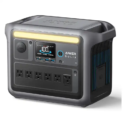

We measured both. Compare tested usable capacity, charging speed, blackout switchover, fan noise, and solar input for the Delta 2 and the SOLIX C1000.
Summary
-
- Overview
- Review
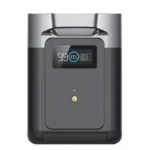
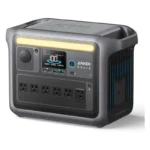
The Marquee 1kWh Matchup
These two units are cross-shopped more than any other pair in the category, and on paper they look almost identical: same 1,800W continuous output, same lithium iron phosphate chemistry, same 3,000-cycle rating, same five-year warranty, roughly the same weight.
On the bench,h they separate quickly. The Anker returns more of its battery, runs a cleaner waveform, charges faster from the wall, and accepts more solar. The EcoFlow answers with more surge headroom and a quieter, more mature app.
One thing to settle first, because it affects both: a rated 1,024Wh battery does not deliver 1,024Wh of usable power. AC inverter conversion efficiency losses take a cut on the way out, typically 14 to 17% on machines of this class, and everything below is calculated from what actually reached the outlets.
Tested Specifications Side by Side
| Measurement | EcoFlow Delta 2 | Anker SOLIX C1000 |
| Rated Capacity | 1,024Wh | 1,056Wh |
| Usable Through AC (Tested) | 850Wh – 83% | 910Wh – 86.1% |
| Usable Through DC (Tested) | 870Wh – 85% | 946Wh – 89.5% |
| Continuous AC Output | 1,800W | 1,800W |
| Surge Output | 2,700W | 2,600W |
| Pure Sine Wave Distortion (THD) | 1.70% | 0.80% |
| Measured Output Voltage | 120V | 121V |
| Blackout Switchover | 19.2ms measured | 16.1ms measured |
| Self-arming Inverter | No | No |
| Standby Drain Per Hour | 0.8% | 0.7% |
| Max Wall Charging | 1,200W | 1,350W |
| Dual Charging (AC + Solar) | Not supported | Not supported |
| Maximum Solar Input | 500W, 11–60V, 15A | 600W, 11–60V, 12.5A |
| Pass-through Charging | Supported | Supported |
| USB-C Output | 100W | 100W |
| 12V Car Socket | 135W | 138W |
| Expansion Battery | Supported | Supported |
| Cell Chemistry and Cycles | LiFePO4, 3,000 | LiFePO4, 3,000 |
| Fan Noise Under Load | 62dB | 59dB |
| Weight | 27 lbs | 28 lbs |
Charging Speed: X-Stream vs HyperFlash
Both makers market their own rapid charging system, and both are genuinely quick by the standards of a few years ago. The measured difference is smaller than the marketing suggests, and it runs in Anker’s favor.
- Wall input: the Anker accepts 1,350W, the EcoFlow 1,200W. On packs of this size, that is roughly the difference between fifty and sixty minutes from empty.
- Both offer incremental charging speeds, so you can dial the rate down overnight and be gentler on the cells rather than choosing between fast and off.
- Neither supports dual charging. Running mains and panels together is not an option on either machine, which is worth knowing if you expected the socket to top up what a cloudy morning is not delivering.
- Both support pass-through charging capabilities, so either will run a load while it refills.
If wall-charging speed is the deciding factor between these two, the Anker wins – though a third machine in this class, the Bluetti AC180, beats them both at 1,440W.
Solar Input and VOC Limits
This is where the two diverge most on paper, and where buyers most often get the direction wrong.
- Maximum solar input wattage is 600W on the Anker, compared to 500W on the EcoFlow. The Anker takes more.
- Both accept an 11 to 60 volt window, so the VOC limits are identical, and the same panels will work on either. Neither will take a long series string.
- The EcoFlow allows 15 amps, compared to the Anker’s 12.5, so it is the more current-tolerant of the two – useful if you are wiring a parallel bank of low-voltage panels.
In short: the Anker accepts more total solar power, and the EcoFlow accepts more current. For most buyers using two or three foldable panels, Anker’s extra 100W is the more useful advantage.
Real Usable Capacity and Efficiency Losses
The Anker is rated at 32 Wh higher than the EcoFlow. After AC inverter conversion losses, it delivers 60 Wh more because it wastes less getting there.
- Through the AC outlets: 910Wh from the Anker, 850Wh from the EcoFlow.
- Through DC: 946Wh from the Anker, 870Wh from the EcoFlow – a 76Wh gap, and the Anker’s 89.5% is one of the stronger DC figures at this capacity.
- On a 150W refrigerator that is roughly six hours from the Anker against five hours forty from the EcoFlow.
Waveform quality follows the same pattern. The Anker’s pure sine wave inverter has a continuous output distortion of 0.80%, compared to the EcoFlow’s 1.70%. Both are inside safe limits; the Anker is less than half as distorted, which matters for a CPAP motor or a workstation.
Apps, Ports and Smart Energy Management
Both machines run a smart app energy management system over Wi-Fi and Bluetooth, and both receive firmware updates.
- EcoFlow’s app software is the more mature of the two, with a longer track record and more granular control.
- Port hardware is nearly identical: a 100W USB-C output on each, and a 12V car socket rated at 135W on the EcoFlow, versus 138W on the Anker. Neither clears the 150W mark that makes a twelve-volt socket genuinely useful for larger DC gear.
- Both accept an expansion battery, so either can be grown later.
Blackout Performance
Neither of these is the machine to buy for off-grid emergency backup power if you are protecting a computer, and the reason is the same for both.
Our bench testing measured the EcoFlow Delta 2 at 19.2 milliseconds and the Anker SOLIX C1000 at 16.1 milliseconds. Both clear the 20ms line, but neither by much, and at those speeds, whether a desktop rides through the gap depends on its internal power supply.
More decisive: neither machine arms its own inverter. Both have to be switched on in advance and left running, so an outage that occurs while the house is empty is not caught by either of them.
Standby drain is low on both “0.8% an hour on the EcoFlow, 0.7% on the Anker,” so leaving either armed is at least affordable.
Noise and Portability
- Weight is effectively a tie: 27 pounds for the EcoFlow, 28 for the Anker.
- Fan noise is not. The EcoFlow measures 62dB under load, which is the loudest reading in our entire test database. The Anker’s 59dB is quieter and still too loud for a bedroom.
- Neither belongs in a room where someone is sleeping. If quiet matters, the Bluetti AC180 at 54dB is the one to look at in this class.
Which One Should You Buy?
| If Your Priority Is… | Choose |
| The Most Usable Energy for the Money | Anker SOLIX C1000 – 60Wh more at the outlets from a lower price tier |
| Clean Power for Medical or Sensitive Gear | Anker SOLIX C1000 – 0.80% distortion against 1.70% |
| Faster Wall Charging | Anker SOLIX C1000 – 1,350W against 1,200W |
| More Solar Input | Anker SOLIX C1000 – 600W against 500W |
| Maximum Surge Headroom for Motor Startup | EcoFlow Delta 2 – 2,700W against 2,600W |
| The Most Developed App Ecosystem | EcoFlow Delta 2 |
| Higher Solar Current for a Parallel Panel Bank | EcoFlow Delta 2 – 15 amps against 12.5 |
Based on the measured evidence, the Anker SOLIX C1000 is the better buy for most people, scoring 7.9 versus 7.2 across our ten categories. The EcoFlow’s advantages are real but narrow, and its 62dB fan noise limits where it can live.