
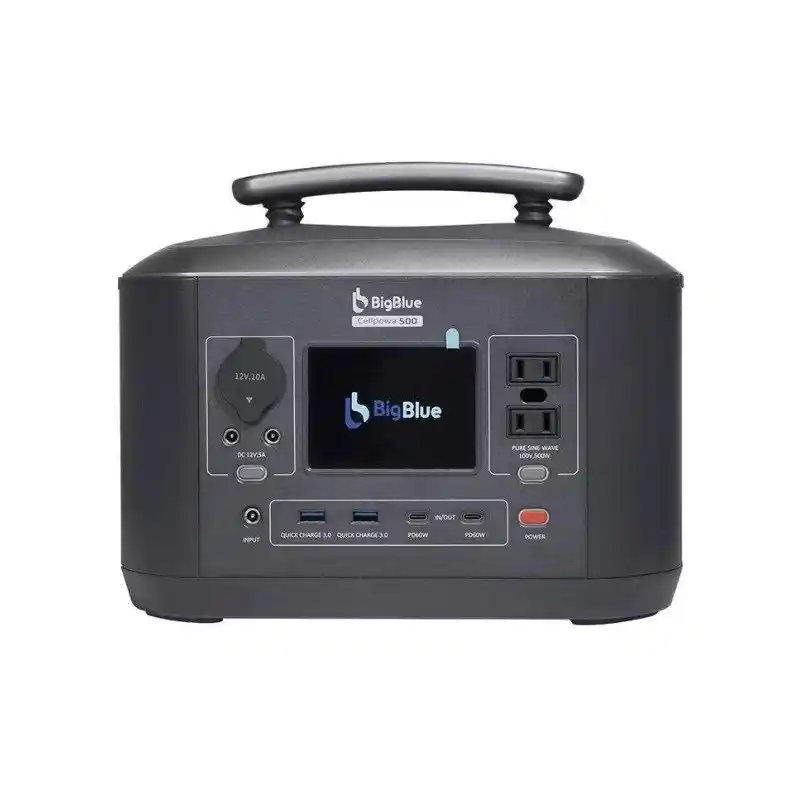
BigBlue CellPowa 500 Review

The BigBlue CellPowa 500 delivers 460Wh of its 537Wh rating at the correct 120 volts, converts at 88% efficiency via DC, and supports dual charging at 213W. Its solar input caps at 85W, the lowest we have measured.
My Quick Verdict
Among compact power stations, delivering a correct 120 volts is less common than it should be. Few of the machines we have tested at this size output 110 volts or below; this one does not.
It also converts respectably at 85% through the sockets and 88% through DC, and supports dual charging at 213 watts.
Its solar ceiling is 85 watts, the lowest maximum input we have recorded for any machine in our database.
Two 60-watt USB-C ports, rather than one 100-watt port, also mean a modern laptop charges slowly.
Best for: Light camping and device charging, where correct output voltage matters more than solar power.
Not for: solar-led charging, laptop work, backup, or anything with a motor.
Key Stats
Introduction
Output voltage is the specification that separates a machine that treats appliances well from one that quietly wears them out, and at this capacity it is surprisingly often wrong.
Four compact machines in our database deliver 110 volts or less, which makes any motor draw extra current and run hotter. This one delivers a correct 120.
It also converts sensibly (85% through the AC sockets, 88% through DC) and supports dual charging, which several rivals at this size lack.
Cells are lithium iron phosphate rated at 2,000 cycles under a two-year warranty.
What It Can Actually Run
Five hundred watts sustained with 1,000 in a burst. That runs a television, lighting, a router, and devices, and excludes refrigerator compressors and every heating appliance.
Rated at 537 Wh, the sockets returned 460 Wh (85%), exactly on the class line. Everything below uses 460Wh.
- Television at 150W: just over three hours.
- CPAP at 40W with the humidifier off: 11.5 hours.
- Starlink dish at 50W: nine hours.
- Twelve-volt camp fridge at 45W on DC: over 10.5 hours, based on the 477 Wh DC figure.
Output measured a correct 120 volts. No electrical noise figure was recorded for this machine.
Charging and Smart Features
Wall input is 92 watts through an external charging brick at a single fixed rate. From empty, that is close to six hours.
Solar takes 85 watts between 12 and 30 volts at 4 amps. That maximum is the lowest among all machines in our database.
Feeding both inputs at once reaches 213 watts, better than double what the wall manages alone.
There is no UPS mode and no app. Mid-range price tier, premium value tier.
Charging Speed Benchmarks
What the BigBlue CellPowa 500 accepts from wall and panels, measured against the 300Wh to 999Wh capacity class, using the 28 machines our charging database holds. Wall input in that group averages 279W and panel input averages 192W. Low, Average and High are terciles inside this class, not scores against the site as a whole.
Mains charging of 92W is a third of the 279W class average and a Low rating, filling 537Wh in roughly 5.8 hours. The redeeming figure is dual charging at 213W: run panels and the brick together and the effective input more than doubles, cutting the wait substantially. That is worth setting up deliberately rather than treating as a bonus, because neither channel alone gets this machine turned around inside a working day.
Panels cap at 85W, well under the 192W class average and a firm Low rating against a 600W ceiling, taking about 6.3 hours of clear sun to refill the pack. No other unit we have covered at this capacity accepts less from an array, though the class floor sits lower still at 65W. A single 100W folding panel already exceeds what this input will accept, so there is no array to build here.
Want a machine that fills in an hour rather than six? The VigorPool Captain 700 charges internally at 600W and takes 240W of solar with dual charging, so a 672Wh pack, a quarter larger than the CellPowa's, comes back in about 1.1 hours. It also runs at 47dB and supports an expansion battery, neither of which this machine offers.
Real Capacity: What You Actually Get
Both paths lead to where machines of this capacity are expected to, which is more than several rivals manage.
A meter on the sockets recorded 460 Wh, again claimed as a 5 claim. 85% sits exactly on the class line.
Twelve volts gave back 477Wh, 88%, three points up. Route what you can that way, though the gap is small enough not to dictate your setup.
Neither idle drain figure is recorded in our data, leaving storage behaviour unmeasured.
For context, the GoLabs R500 at a similar capacity returns 71% through AC. That fourteen-point gap is worth roughly 90 watt-hours per charge.
My takeaway: Plan on 460 Wh at the outlets or 477 Wh at 12 volts, arriving at a proper 120. Sound figures that several rivals at this capacity do not match.
Power Output and Surge: What It Can Turn On
Five hundred watts continuous is standard for the class. A television, lighting, a router, a laptop, and devices are running; heating appliances and refrigerator compressors are not.
One thousand watts of surge sits below what a domestic fridge demands at startup, so that is not a load to plan around.
The voltage is the machine’s quiet strength. A correct 120 volts means anything you do run is being treated properly, which is something few compact power stations can’t claim.
USB-C is the weak point. A pair of 60-watt outlets keeps phones and tablets charging at full speed, whereas a single 100-watt port would not. Both are bi-directional, so either can also refill the machine from a compatible source.
No harmonic distortion or electrical noise figure exists for this machine, so output quality beyond voltage is unmeasured.
Real Appliance Runtimes
Main figures are base460 Wh460Wh; the DC line uses the hi477 Wh477Wh.
Respectable figures for the capacity, and delivered at the correct voltage, which matters more over years of ownership than any single runtime does.
Recharging: Wall and Solar
From a Wall Outlet
A 537 Wh pack at 92 W takes close to six hours to charge from empty, which is among the slower charging rates in our database.
It arrives with an external brick, so there is a separate component to carry and eventually replace.
There is no adjustable rate, so slow is the only speed.
Dual charging is the redeeming feature. Socket and sun combined reach 213 watts, more than twice the wall alone, allowing a full charge in roughly two and a half hours in good weather.
From Solar Panels
The solar input is the weakest specification on the machine, and it holds a record at the wrong end.
Eighty-five watts is the lowest maximum solar input among all machines in our database.
The 12- to 30-volt window excludes most rigid panels, and the 4-amp current limit is among the lowest we have recorded.
Eighty-five watts against 537Wh explains the sheet’s note that sunshine alone misses the standard window.
Dual charging helps here, since the panels and mains together reach 213 watts. The array can also stay permanently connected, with pass-through charging supported.
Blackout Backup: The Part I Care About Most
There is no automatic transfer function on this machine.
The grading entry records the UPS mode as not applicable, so anything plugged into the outlets loses power the instant the grid does.
Standard at this size, with handover rare below 800Wh.
That settles it as a campsite and desktop kit, which the capacity already suggested.
Why this matters to me: no one buys 537Wh to guard a property; the cost of the absent fan is nothing. The solar ceiling is where this machine actually limits you.
Noise and Living With It
No fan noise measurements exist in our data for this machine, which is a genuine gap for a compact unit likely to be used in a tent.
Weight is 17.1 pounds (7.7 kilograms), the heaviest of the three machines at this capacity we have tested, about 3 pounds more than the GoLabs R500.
There is no app of any kind, so nothing can be monitored, adjusted, or updated.
The warranty runs for two years and is backed by a 24-hour customer service response commitment.
Where It Falls Short
Three limitations, and the first is a database record at the wrong end.
1. Eighty-Five Watts of Solar
The lowest maximum solar input of any machine in our entire database, across every capacity and brand.
The 30-volt ceiling excludes most rigid panels, and the 4-amp limit is among the lowest recorded, so you are confined to small foldables.
Dual charging at 213 watts mitigates it, but only when a socket is available, which defeats the point of solar.
2. Ninety-Two Watts Through an External Brick
Near six hours from flat, one speed only, dependent on a part that lives outside the machine.
Dual charging is the only way to meaningfully shorten it.
3. Two 60-Watt USB-C Ports and No App
Two 60-watt ports charge phones and tablets well, but are too slow for any modern laptop; a single 100-watt port would be more useful.
Wireless was also absent, and neither fan nor electrical noise was measured.
How It Compares
Two comparisons at almost identical capacity.
Compared to the Bluetti EB55, this machine converts 2 points worse and gives up 200 watts of powerinverter, 70 watts of solar power, and half the dual-charging headroom. What it gains is correct output voltage, which the Bluetti does not deliver, and a considerably lower price per watt-hour.
Against the GoLabs R500, it is decisively better: 14 points higher AC conversion, correct voltage, dual charging support, and a wider solar window.
So the choice at this capacity comes down to whether correct voltage and value matter more than inverter size and charging speed. For appliances with motors, they do.
Who Should Buy It, and Who Should Skip It
Buy It If
- Correct output voltage matters, which it should if anything with a motor is involved.
- Value per watt-hour is your metric at this capacity.
- You charge from a socket and use dual charging to speed up the process.
- Your USB kit is for phones and tablets, not laptops.
Skip It If
- Solar is any part of your charging plan. Eighty-five watts is the lowest we have measured.
- You charge a laptop frequently and want a full 100-watt port.
- You need to fill the machine in under six hours from a single socket.
- You want an app or any way to monitor the machine.
The Bottom Line
The CellPowa 500 gets the fundamentals right, unlike several rivals. Correct 120-volt output, conversion at or above the class line on both paths, dual charging support, and a sensible price per watt-hour.
What it gives up is solar. Eighty-five watts is the lowest ceiling in our database, and with a 30-volt limit and 4 amps of current, it is a token input rather than a working one.
Charge it from a socket, use the dual-charging headroom, and it is honest value. Plan to fill it from panels,s and it will disappoint.


There are no reviews yet.