
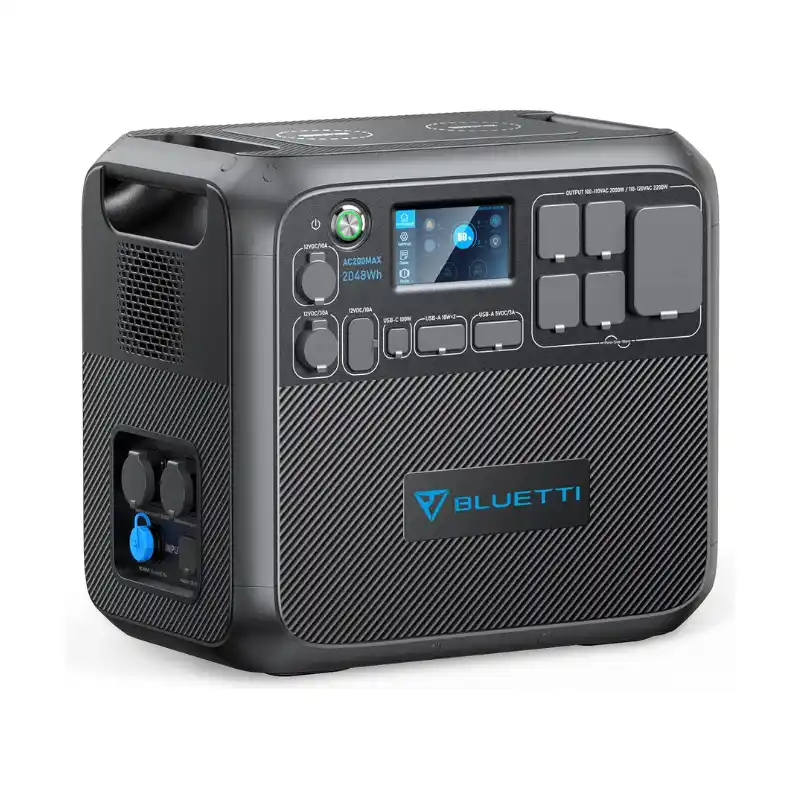
Bluetti AC200Max Review

The Bluetti AC200Max has 2,048Wh of capacity, a 2,200W inverter, and delivers 1,840Wh at the outlets. Solar reaches 900W at up to 145 volts; the DC output is rated at 400W, and the cells carry a 3,500-cycle rating with four years of coverage.
My Quick Verdict
Most machines in this category are judged on how fast they hand over when the grid fails. This one has no handover to measure.
The grading data records its UPS mode as not applicable. Not slow, not marginal, absent. Plug a computer into this, and a blackout will take it down, as it would with any extension lead.
That is a different kind of gap from the slow-switchover machines elsewhere on this site, and it changes what the unit can honestly be sold as.
What it does well is store and deliver energy: 89% conversion, 0.6% standby loss per hour, a 400-watt DC output, and a 145-volt solar ceiling.
Best for: Off-grid storage, workshops, and camping, where the machine serves as a battery rather than a backup system.
Not for: blackout protection of any kind, or anyone in a hurry to recharge.
Key Stats
| Badge | Stats |
|---|---|
| Battery chemistry and longevity | LiFePO4 | 3,500 cycles |
| Continuous AC power output | 2,200W AC | 4,800W peak |
| Energy storage capacity | 2,048Wh | 1,840Wh usable |
| AC wall recharge | 470W via external brick |
| Emergency backup switchover | No UPS mode fitted |
| Maximum solar input and MPPT | 900W solar | 10–145V |
| High-output DC | 400W output |
| Ultra-fast USB-C power delivery | 100W USB-C PD |
| Low-noise operational level | 54dB | Audible under load |
| Smart app control | Bluetooth only |
Introduction
There is a category of flaw worse than a bad measurement: a missing function. The AC200Max has one.
Across everything tested for this site, machines have handed over to battery in anywhere from zero to 20.1 milliseconds. This unit does not hand over. Its grading entry records no UPS mode at all, which means connected equipment loses power exactly as it would if it were plugged into the wall.
That does not make it a bad battery. It makes it a battery rather than a backup system; they are different products sold under the same name.
Its pack claims 3,500 lithium iron phosphate cycles and comes with a four-year warranty, a year longer than what this class normally offers.
What It Can Actually Run
2,200 watts continuous; 4,800 watts in a burst; sufficient for a heating appliance or a refrigerator with lighting.
Rated at 2,048 Wh, the sockets returned 1,840 Wh. 89% is a strong figure at this capacity. Everything below uses 1,840Wh.
- Refrigerator at 150W: better than twelve hours.
- CPAP without humidification at 40W: forty-six hours.
- Starlink dish at 50W: nearly thirty-seven hours.
- Laptop at 70W: around twenty-six charges.
Voltage read 120, with the inverter itself recorded as silent and electrical noise at 1,650 mV, squarely mid-pack.
Charging and Smart Features
The wall input is 470 watts, delivered through an external charging brick rather than an internal charger. From empty,y that is well over four hours.
There is no adjustable charging speed either, so the slow rate is the only rate.
Panels feed it 900 watts, 1 to 1 volt, and at 15 amps. That upper figure is a genuine strength and opens the door to a real series string.
Running both inputs together lifts the ceiling to 1,300 watts. Premium price tier, luxury value tier.
Charging Speed Benchmarks
Charging figures for the Bluetti AC200Max against the 2,000Wh to 3,000Wh capacity class, drawn from all 26 units in our charging database rather than only the ones reviewed so far. Mains input across the bracket averages 1,641W and solar 1,123W, and the rating bands are set inside that bracket alone.
Wall charging is where this machine dates itself. 470W through an external brick at one fixed rate is the slowest mains input in the entire class and less than a third of the 1,641W class average, which puts 2,048Wh at roughly 4.4 hours from flat. The fastest machine in the same bracket accepts 5,000W and does the same job in well under an hour. The brick is also a component that can be left behind, which turns a slow charge into no charge at all.
Panels are the better route here by a wide margin. 900W sits under the 1,123W class mean but still holds an Average rating, and it refills the pack in about 2.3 hours, roughly half the time the wall socket needs. The reason it works is the 145-volt ceiling, more than double what most machines at this capacity permit, so four or five rigid panels go into a single series string. Treat this as a solar-charged battery and the worst figure on the sheet stops mattering.
Want both channels brought up to date? The Bluetti AC200L replaced this machine and charges at 2,400W internally, over five times the AC200Max, with solar rising to 1,200W on the same generous 145-volt window. Empty to full drops from 4.4 hours to around 0.9 hours. It also fits a working transfer function, which this one lacks entirely, and sits a price tier lower.
Real Capacity: What You Actually Get
Delivery is the strongest part of this machine, and the AC side in particular holds up well.
Against a 2,048 Wh label, the sockets delivered 1,840 Wh. 89% puts it ahead of most machines this size.
The twelve-volt route returned 1,703 Wh, or 83%, six points behind, so the sockets are the more efficient path here despite the generous 400-watt DC output.
Retention is a highlight: 0.6% per hour while armed, and nothing the meter could find at 12 volts. Fill it, put it away, and it stays that way.
My takeaway: Plan on 1,840Wh. Standby losses are small enough that the pack sits full on a shelf for months; it simply will not react when the lights go out.
Power Output and Surge: What It Can Turn On
The inverter is adequate for the capacity, though not generous. 2,200 watts sustained is 200 watts short of the class norm, and 4,800 watts of surge covers any household compressor start.
The DC side is the more interesting half. Four hundred watts is roughly triple the power of a standard car socket, enough to run a compressor fridge and a heater side by side without taxing the inverter.
Given the 83% DC return, that port is about capability rather than efficiency here.
At 1,650 mV, the electrical noise reading is middling. Harmonic distortion was never measured, though the grading sheet does note the inverter itself runs silently, reassurance of a sort, but not a number.
Real Appliance Runtimes
One thousand eight hundred and forty watt-hours, expressed as hours on the standard appliance set.
| Appliance | Power Draw | Runtime | What That Means |
|---|---|---|---|
| Full-size refrigerator | 150W | About 12.3 hours | Half a day of refrigeration, longer as the compressor rests. |
| CPAP machine (no humidifier) | 40W | About 46 hours | Forty-six hours of overnight running. |
| Starlink dish | 50W | About 36.8 hours | Thirty-six hours before the dish drops. |
| Pellet grill or smoker | 100W | About 18.4 hours | Eighteen hours of cooking on one fill. |
| Laptop (70W) | 70W | About 26 recharges | Twenty-six, through a single 100W port. |
These are good figures, and they arrive from a strong 89% conversion rather than an unusually large pack. The problem with this machine is never how long it runs.
Recharging: Wall and Solar
From a Wall Outlet
470 watts into a 2,048 Wh pack is among the slowest charging rates in this data, and it takes well over 4 hours to charge from empty.
The power comes from an external brick rather than an onboard charger, a separate component that can be transported, misplaced, or replaced independently.
There is also no adjustable charging speed. Several rivals offer four or five selectable rates; this offers one.
Both inputs together reach 1,300 watts. Better, certainly, and still under what most machines this size draw from the socket by itself.
From Solar Panels
This is the area where the AC200Max genuinely competes, and given how slow the socket is, it is also how the machine is meant to be filled.
Panels feed in at 900 watts between 10 and 145 volts at 15 amps. A 145-volt ceiling leaves the 60-volt caps common at this size far behind.
That permits a string of four or five rigid panels, so current stays down, cable stays thin, and less of the generation is spent warming it on the way in.
A floor of 10 volts means foldables register too, so nothing in the range is excluded.
Panels need never be unplugged, and output carries on throughout a charge.
Blackout Backup: The Part I Care About Most
There is nothing to measure here, and that is the finding.
The grading data records this machine’s UPS mode as not applicable. It does not switch over quickly, slowly, or otherwise; it has no automatic transfer function at all.
Anything plugged into AC outlets loses power when the grid fails. A desktop restarts, a network drive shuts down uncleanly, a router drops its connection.
For a machine at this capacity, sold in a category defined by blackout backup, that is the single most consequential specification on the page.
Why this matters to me: elsewhere on this site, I have criticised machines for handing over in fifteen or twenty milliseconds. Those units at least hand over. This one asks you to plug things in again afterwards, which is a different product entirely.
Noise and Living With It
Fifty-four decibels under load is past what a room with a sleeper will tolerate and is unremarkable in a garage or utility space.
The scale reads 60 pounds, 27.2 kilograms, substantial for two kilowatt-hours when the leanest machines this size sit near forty.
The app connects over Bluetooth only. Without Wi-Fi, you have to be in range to see anything, although Bluetooth is the link that keeps working when there is no network. The warranty runs for four years and includes telephone support, which is a year short of the class standard.
Where It Falls Short
Four limitations, and the first is not a matter of degree.
1. There Is No UPS Mode
Not a slow switchover, but the absence of the function. Connected equipment loses power when the grid does.
Every other machine at this capacity reviewed on this site transfers to battery in some measurable time. This one does not transfer at all.
If blackout protection is any part of why you are shopping, this machine cannot provide it.
2. Four Hundred and Seventy Watts, Through a Brick, at One Speed
Over four hours from empty, delivered by an external charger, with no rate adjustment available.
Machines at this capacity routinely accept 1,800 watts internally and refill in a little over an hour.
3. Luxury Value Tier
Per watt-hour, this is among the most expensive machines at two kilowatt-hours in our data.
Paying at the top of the range for a machine with no UPS functionality and a 470-watt charger is difficult to justify compared with current rivals.
4. Bluetooth Only, and a Four-Year Warranty
No Wi-Fi means no remote monitoring from another room or building.
Four years of coverage is a year short of the class standard and two years short of what Bluetti offers on some of its newer machines.
How It Compares
The natural comparisons are Bluetti’s own newer machine at this capacity and the strongest all-rounder here.
| Feature | Bluetti AC200Max | Bluetti AC200L | Anker SOLIX C2000 Gen 2 |
|---|---|---|---|
| Price tier | Premium | Upper mid-range | Upper mid-range |
| Value tier | Luxury | Exceptional | Exceptional |
| Rated capacity | 2,048Wh | 2,048Wh | 2,048Wh |
| Usable through AC | 1,840Wh (89%) | 1,830Wh (89%) | 1,760Wh (85%) |
| UPS switchover | None fitted | 13.8ms | 7.2ms |
| Wall charging | 470W via brick | 2,400W internal | 1,800W internal |
| Solar input | 900W to 145V | 1,200W to 145V | 800W to 60V |
| App connectivity | Bluetooth only | Wi-Fi + Bluetooth | Wi-Fi + Bluetooth |
| Battery cycles | 3,500 | 3,000 | 4,000 |
| Warranty | 4 years | 5 years | 5 years |
| Weight | 60 lbs | 61 lbs | 41 lbs |
Bluetti’s own AC200L is the uncomfortable comparison. Same capacity, same conversion, same 145-volt solar ceiling, plus a working UPS mode, five times the wall-charging speed, Wi-Fi, an extra year of warranty, and 300 more watts of solar, at a lower price tier.
There is no specification on which the AC200Max leads, except for a 500-cycle advantage on the cells.
The Anker SOLIX C2000 Gen 2 converts four points worse and beats it on everything else that matters: a 7.2-millisecond self-arming switchover, 4,000 cycles, nineteen fewer pounds, and a far better value tier.
Who Should Buy It, and Who Should Skip It
Buy It If
- The machine is for storing tools, camping, or off-grid use rather than for backup.
- You are building a rigid series array and want the 145-volt ceiling.
- Twelve-volt equipment matters, where the 400-watt DC port is genuinely useful.
- Long standby storage is the job, where 0.6% per hour is excellent.
Skip It If
- Blackout protection is part of the reason you are shopping.
- You need to fill out the form within four hours.
- Remote monitoring over Wi-Fi matters to you.
- Bluetti’s own AC200L is available, which it almost certainly is.
The Bottom Line
As a battery, this is a decent machine. 89% conversion, 0.6% standby drain, a 145-volt solar ceiling,g and a 400-watt DC output are all genuinely good.
With anything else, it falls apart. There is no UPS function; the charger is an external brick delivering 470 watts at a single speed, and the price sits in the luxury value tier.
Bluetti’s own AC200L has the same capacity, converts identically, adds a working switchover, offers five times the charging speed, and costs a tier less. That comparison is the whole review.


There are no reviews yet.