
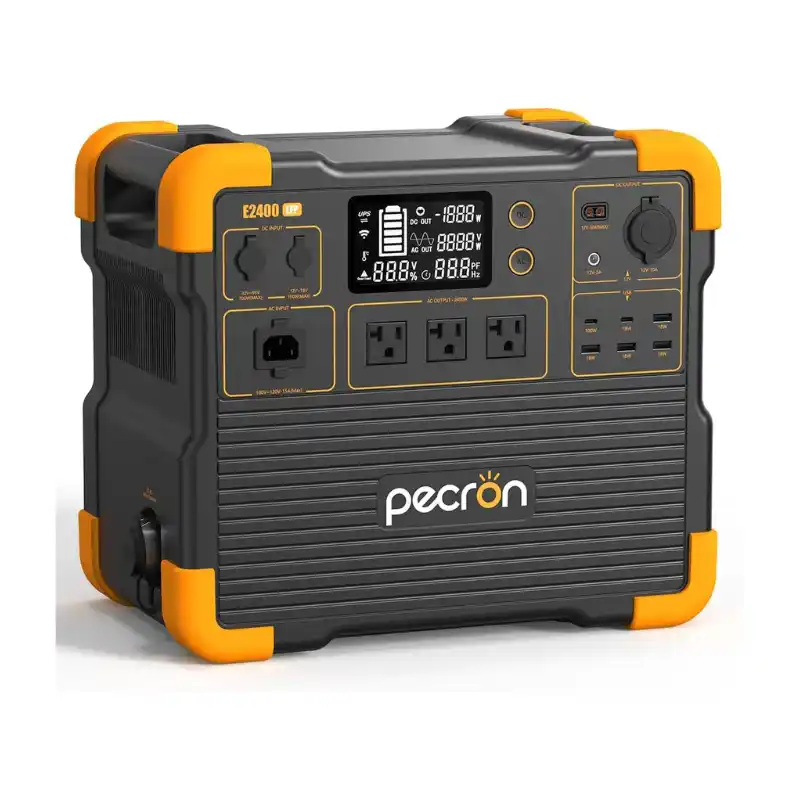
Pecron E2400LFP Review

The Pecron E2400LFP crosses over in 9.8ms with a self-arming inverter, a feat few units at any price can manage, and delivers 90% of its rated capacity through a 400W XT60 DC output. It holds 2,048Wh behind a 2,400W inverter and sits in the mid-range price tier at exceptional value.
My Quick Verdict
Across all power stations reviewed on this site, a clear pattern has emerged: most power stations sold as backups will not arm their own inverter. The inverter must be turned on and kept on by hand, so the cover lasts only as long as someone is around to do it.
Fewer than a third of the units here wake by themselves, and until now, every one of them sat in the upper mid-range price tier or above.
The E2400LFP is in the mid-range tier, with a 9.8-millisecond crossover, and it is the lowest-cost option at this capacity.
It pays for that with the weakest AC conversion at this size, a three-year warranty where rivals give five, and distortion sitting right on the threshold.
Best for: Emergency Home Resilience on a budget, and Overland or RV work where the 400-watt DC output does the heavy lifting.
Not for: medical equipment sensitive to waveform quality or anyone who weighs warranty length heavily.
Key Stats
| Badge | Stats |
|---|---|
| Battery chemistry and longevity | LiFePO4 | 3,500 cycles |
| Continuous AC power output | 2,400W AC | 4,300W peak |
| Energy storage capacity | 2,048Wh | 1,700Wh usable |
| Rapid AC wall recharge | 1,800W input | Four-stage |
| Uninterrupted emergency backup | 9.8ms UPS | Self-arming |
| Maximum solar input and MPPT | 800W solar | 32–95V MPPT |
| Ultra-fast USB-C power delivery | 100W USB-C PD |
| Low-noise operational level | 54dB | Audible under load |
| High-output DC | 400W XT60 | 90% DC yield |
| Modular capacity expansion | Expandable | Extra battery port |
Introduction
There is a question worth asking of any power station bought for blackouts: what happens if the grid fails while the house is empty?
For most of the machines reviewed here, the answer is nothing. Their inverters have to be switched on beforehand and left running, so an outage that arrives while everyone is out passes them by. It is the single most common gap in this category,y and almost no one advertises it.
This unit wakes up on its own, and it is the least expensive machine in the dataset to do so. The pack claims 3,500 lithium iron phosphate cycles. Unusually, the cover behind it stops at three years instead of the customary five.
What It Can Actually Run
The inverter sustains 2,400W, with 4a at 4,300W peak, which covers a heating appliance with something running alongside it.
Rated storage is 2,048Wh. The outlets yielded 1,700 Wh (83%), the poorest AC conversion at this size. The DC side did far better at 1,854Wh, or 90%. AC figures below use 1,700Wh.
- Refrigerator at 150W: a shade over eleven hours.
- CPAP at 40W without humidifier: around forty-two hours.
- Starlink dish at 50W: about thirty-four hours.
- Twelve-volt camp fridge at 45W on DC: over 41 hours, based on the higher 1,854 Wh figure.
The measured output was 119 volts with 2.00% distortion, which sits exactly on the threshold I treat as the limit for sensitive equipment, rather than comfortably inside it.
Charging and Smart Features
Wall input reaches 1,800W across four selectable stages, offering finer control than most rivals, and both sources together draw 2,000W.
Solar arrives as 800W total: a 100W low-voltage path for small panels, and a 32 to 95 volt path at 15 amps for the rest. That upper ceiling permits a genuine series string.
Handover took 9.8 milliseconds, and since the inverter raises itself, the cover holds with the house empty.
Mid-range price tier and exceptional value tier. In terms of stored energy per pound spent, only one unit in this data undercuts it.
Charging Speed Benchmarks
Recharge speed for the Pecron E2400LFP plotted next to the slowest, typical and quickest inputs across the 2,000Wh to 3,000Wh capacity class, where its 2,048Wh pack places it. Twenty-six units make up that class, averaging 1,641W on AC and 1,123W on solar, and every rating is scored inside the class rather than site-wide.
The mains charger tops out at 1,800W across four selectable stages, ahead of the 1,641W bracket average and closing the Average band, with 2,000W available when mains and panels run together. That fills 2,048Wh in roughly 1.1 hours at the top rate. Four selectable stages is the part worth using: most machines in this bracket offer two, and the slowest setting is the sensible choice for an overnight charge on a unit that will sit armed for weeks afterwards.
Panel input is the shortfall. 800W is nearly 300W below the 1,123W class average and a Low rating, against a 2,400W class maximum, which puts a full solar refill at about 2.6 hours in perfect light and well outside the two-and-a-half-hour window we treat as the practical benchmark. The 95-volt ceiling is generous enough for a real series string, but the 32-volt floor on the main path means a single small panel will not register at all and has to go to the secondary port.
Want the panels to keep pace with the charger? The DJI Power 2000 matches the E2400LFP's 1,800W mains input while accepting 1,800W of solar, more than double, over a 43-amp path with no high-voltage floor to trip over. Panels fill the same 2kWh of capacity in around 1.1 hours instead of 2.6, and small foldables register immediately rather than needing a separate port.
Real Capacity: What You Actually Get
The two output paths diverge by seven points, and the direction favours anyone running twelve-volt equipment.
The AC outlets returned 1,700 Wh, compared to a claimed 2,048 Wh. 83% is the lowest conversion rate at this capacity, and it costs roughly an hour of refrigerator time compared to the leaders.
The 12-volt route produced 1,854 Wh, or 90%. That is a 154 Wh advantage simply for choosing the right socket, and it is the largest such gap among units of this size.
Standby loss runs at nearly 1.0% per hour with the inverter awake and 0.16% while in DC. Low enough that leaving it armed is a realistic habit rather than a slow bleed.
My takeaway: 1,700 Wh from the outlets, 1,854 Wh from DC. On this machine, the 12-volt side has 154 Wh more capacity, so anything capable of running on DC should.
Power Output and Surge: What It Can Turn On
Sustained and peak ratings are conventional at this capacity and need little argument. At 2,400 watts continuous, a heating appliance leaves room to spare, and 4,300 watts of burst power easily handles compressors.
The DC side is where the port array distinguishes itself. Four hundred watts through an XT60 is about triple what a car socket can handle here, sufficient to run a diesel heater and a fridge simultaneously, with the inverter out of the picture entirely.
The one number to watch is distortion, at 2.00%. That is not over the line so much as on it, and the units at this capacity producing 0.30% or 0.60% are in a different category for anything with a sensitive motor or a switching supply.
Electrical noise measured at 1,900 mV, also at the higher end of this field.
Real Appliance Runtimes
1,700 Wh from the AC outlets converted into hours, plus one DC line drawn from the stronger 1,854 Wh figure.
| Appliance | Power Draw | Runtime | What That Means |
|---|---|---|---|
| Full-size refrigerator | 150W | About 11.3 hours | A night covered, and further as the compressor rests. |
| CPAP machine (no humidifier) | 40W | About 42.5 hours | Four nights, though on a supply at the distortion limit. |
| Starlink dish | 50W | About 34 hours | Thirty-four hours before the dish drops out. |
| 12V camp fridge, runs on DC | 45W | About 41 hours | Uses the 1,854Wh DC path, not the 1,700Wh AC figure. |
| Laptop (70W) | 70W | About 24 recharges | One 100W USB-C port. |
The AC lines here are the shortest at this capacity, and the DC line is among the longest. That contradiction is the whole character of this machine.
Recharging: Wall and Solar
From a Wall Outlet
Mains charging takes 1,800W with four selectable stages, filling the pack in a little over an hour.
Having four rates rather than two earns its keep across a decade. Pick the slowest overnight,t and the cells will thank you; pick the fastest when the forecast turns.
Feeding it from both at once caps out at 2,000W; neither impressive nor poor for this size.
From Solar Panels
Solar totals 800W and arrives through two distinct paths, which is worth understanding before you buy panels.
A low-voltage input handles 100W at 12-18 volts and is intended for small foldables. The main input runs 32 to 95 volts at 15 amps for the remaining 700W.
That 32-volt lower bound on the main path is unusual and matters: panels producing below 32 volts will not engage it, so a single small panel must go to the low-voltage port instead. Wire two or three rigid panels in series, and the main path works properly.
Ninety-five volts at the top is roomy for this class, but the grading sheet notes that panels alone will not refill the pack inside the customary two-and-a-half-hour window.
Panels may remain attached, and loads may run during charging.
Blackout Backup: The Part I Care About Most
This is the reason to buy the unit and the reason it scores where it does.
Handover landed at 9.8 milliseconds, beneath the eleven-millisecond mark where real protection starts. No processor should notice the mains vanishing.
The inverter arms itself. Most machines reviewed here cannot, and every other self-arming unit in this dataset sits in a higher price tier.
A 1% hourly loss keeps permanent arming affordable. A fortnight untouched costs roughly a third of the pack, which is a habit worth managing rather than a fault.
Why this matters to me: For months, I have been writing that most units in this category cannot protect an empty house, and that the ones which can are expensive. This is the first machine to break that second half, and at a mid-range price,e it changes what a budget backup plan can look like.
Noise and Living With It
Fifty-four decibels under load, past the point I would tolerate in a room with a sleeper and unremarkable in a garage, basement, or utility space.
It is a steady working noise rather than a whine, though a small bedroom would notice it plainly.
It reads 45 pounds (20.4 kilograms) on the scale. Sensible for two kilowatt-hours and lighter than many competitors, though you will want both hands.
Both Wi-Fi and Bluetooth are supported, and there is a phone number to call for the warranty.
Where It Falls Short
Three things hold it back, and the first is the one that costs it a place at the top of the class.
1. The Weakest AC Conversion at This Capacity
83% through the outlets, where the leaders return 90 or 9,1 and one reaches 95. From the same nominal pack, that is roughly an hour less refrigerator time.
The 90% DC path makes it suitable for anyone running 12-volt equipment. For a household on AC loads, it does not.
2. A Three-Year Warranty and Distortion at the Limit
The cells claim 3,500 cycles,es and the manufacturer will stand behind them for three years, whereas their rivals at this capacity offer five, and one offers seven.
Separately, 2.00% distortion sits exactly on the threshold rather than inside it. For tools and lighting, that is immaterial; for a CPAP motor, there are better options here.
3. Solar Cannot Fully Recharge It in the Usual Window
Eight hundred watts through a path that will not engage below 32 volts, and the grading data records that a complete solar recharge falls outside the two and a half hour benchmark most rivals meet.
It is a capable solar implementation rather than a fast one, and worth understanding before planning multi-day off-grid use around it.
How It Compares
The closest comparisons are the Anker SOLIX C2000 Gen 2, the strongest self-arming unit at this capacity, and the AFERIY P280, the conversion leader.
| Feature | Pecron E2400LFP | Anker SOLIX C2000 Gen 2 | AFERIY P280 |
|---|---|---|---|
| Price tier | Mid-range | Upper mid-range | Mid-range |
| Value tier | Exceptional | Exceptional | Exceptional |
| Usable through AC | 1,700Wh (83%) | 1,760Wh (85%) | 1,880Wh (91%) |
| Usable through DC | 1,854Wh (90%) | 1,875Wh (91%) | 1,831Wh (89%) |
| Self-arming inverter | Yes | Yes | No |
| UPS switchover | 9.8ms | 7.2ms | 8ms |
| High-output DC | 400W XT60 | 137W socket | 340W XT60 |
| Distortion (THD) | 2.00% | 0.60% | 1.60% |
| Warranty | 3 years | 5 years | 7 years |
| Solar input | 800W | 800W | 1,200W |
| Fan noise | 54dB | 44dB | 57dB |
The Anker SOLIX C2000 Gen 2 is the better machine on almost every measure: faster crossover, 2 points more conversion, 10 fewer decibels, a 5-year warranty, and 4,000 cycles. It also costs a price tier more.
What the Pecron offers is the same self-arming behaviour for less money, plus a 400-watt DC output that dwarfs the Anker’s 137-watt car socket. For a vehicle build, that port alone settles it.
The AFERIY P280 converts 8 points better and comes with a seven-year warranty at the same price tier, which, on paper, looks decisive. It also cannot bring its own inverter up, and that one gap divides a machine watching over a house from one watching over a house with somebody in it.
Who Should Buy It, and Who Should Skip It
Buy It If
- You want automatic blackout protection without paying a higher price tier
- Your loads are 12-volt, and this machine delivers 154 Wh more than through the outlets.
- You are wiring rigid panels in series and want a 95-volt ceiling.
- It will live in a garage, basement, or vehicle.
Skip It If
- Warranty length matters. Three years is the shortest at this capacity.
- You run a CPAP machine or sensitive audio, where 2.00% distortion is at the limit.
- Every watt-hour counts through the AC outlets.
- It has to run somewhere quiet.
The Bottom Line
The recurring finding across this dataset is that most power stations sold as backup will not start on their own and therefore provide no protection while a house is empty. Until now, every machine that solved that problem cost more.
The E2400LFP solves it at the mid-range tier, with a fast crossover and a 400-watt DC output that few units at any price can match.
What it asks in return is the weakest AC conversion at this capacity, a three-year warranty, and distortion right on the limit. For a garage, a vehicle, or a household on a budget that wants genuine automatic protection, that is a trade worth making.


There are no reviews yet.