
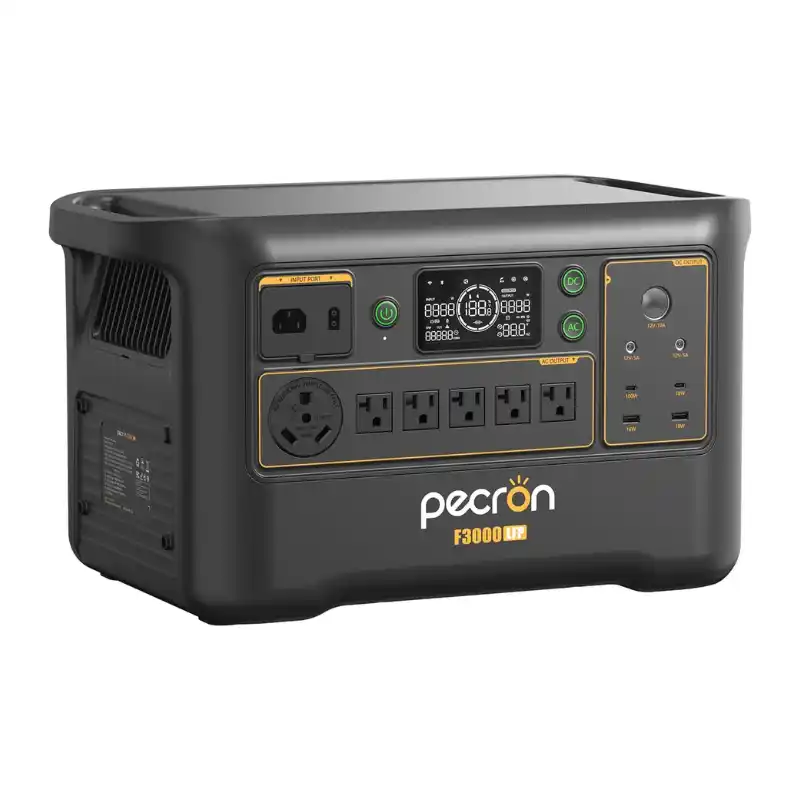
Pecron F3000 Review

The Pecron F3000 holds 3,072 Wh behind a 3,000W inverter and delivers 2,750 Wh at the outlets, 89% of its rating. At 63 pounds, it is far lighter than rivals of this capacity and offers the lowest cost per watt-hour among units measured at this site.
My Quick Verdict
Across every machine measured for this site, at every capacity and from every brand, this one costs less per watt-hour than any other. Not marginally: it undercuts the next cheapest by a comfortable margin and the field average by more than half.
It is also unusually light. Sixty-three pounds for three kilowatt-hours, where its closest rival at identical capacity weighs ninety-one.
It converts well (89% at the sockets, 91% at twelve volts), and the handover ranks among the faster figures on this site.
The money was taken from the charge. Wall input is 1,800 watts, less than half what its rival accepts, and the solar path will not engage below 25 volts.
Best for: Off-grid and workshop use where cost per watt-hour is the deciding metric, and any installation where the unit gets moved occasionally.
Not for: fast top-ups before a storm, unattended protection, or small-panel solar setups.
Key Stats
| Badge | Stats |
|---|---|
| Battery chemistry and longevity | LiFePO4 | 3,500 cycles |
| Continuous AC power output | 3,000W AC | 6,000W peak |
| Energy storage capacity | 3,072Wh | 2,750Wh usable |
| Rapid AC wall recharge | 1,800W input | Four-stage |
| Uninterrupted emergency backup | 8.6ms UPS | Manual arm |
| Maximum solar input and MPPT | 1,600W solar | 25–120V, 25A |
| Ultra-fast USB-C power delivery | 100W USB-C PD |
| Low-noise operational level | 56dB | Loud under load |
| Weight for capacity | 63 lbs | Light at 3kWh |
| Modular capacity expansion | Expandable | Extra battery port |
Introduction
Cost per watt-hour is the metric this site consistently returns because it strips away capacity differences and asks a single question: how much energy does each pound buy?
Across every machine measured here, the answer has ranged from about twenty-six cents to well over a dollar. This unit sits at the bottom of that range, and nothing else comes within about 15% of it.
Cheap and large usually means heavy as well. Not here: sixty-three pounds against the ninety-one of its nearest equivalent. Its cells are rated for 3,500 lithium iron phosphate cycles and come with a five-year warranty, putting a decade of daily cycling within reach.
What It Can Actually Run
Three thousand watts continuous, six thousand in a burst. That covers heating appliances, a refrigerator, and lighting without difficulty.
The label reads 3,072 Wh, and the outlets returned 2,750 Wh. 89%, matching machines costing considerably more. Everything below works from 2,750Wh.
- Refrigerator at 150W: eighteen hours and a quarter.
- CPAP at 40W, humidifier off: nearly sixty-nine hours.
- Starlink dish at 50W: fifty-five hours.
- Laptop at 70W: around thirty-nine charges.
The waveform came in at 121 volts with 1.30% distortion, within limits, though electrical noise exceeded 2,000 mV.
Charging and Smart Features:
Main input peaks at 1,800 watts across four selectable stages. Fine control, a modest ceiling, and a three-kilowatt-hour pack, which means the better part of two hours from empty.
Panels take 1,600 watts at 25- 120 volts at 25 amps. That current allowance is generous, and the voltage ceiling is respectable, but note the 25-volt floor.
Handover was recorded at 8.6 milliseconds in testing, though the grading sheet lists 8. Either way, it is quick, and either way, the inverter has to be armed by hand.
Upper mid-range price tier and exceptional value tier.
Charging Speed Benchmarks
Input speeds for the Pecron F3000 within the Over 3,000Wh capacity class, a group of 16 machines whose mains charging averages 2,802W and whose solar averages 2,681W. Because bands are drawn inside each class, a Low rating here still describes an input most smaller machines could not accept.
This is where the low cost per watt-hour comes from. Mains charging of 1,800W is 1,000W under the 2,802W class average and rests on the floor of the Average band, needing about 1.7 hours to refill 3,072Wh. Dual charging lifts the combined ceiling to 2,800W when panels are producing. The direct comparison is unavoidable: the machine at the top of this bracket accepts 6,000W, and Pecron's own dearer three-kilowatt-hour model takes twice what this one does.
Panels cap at 1,600W, well below the 2,681W class average and a Low rating in a bracket reaching 6,400W, which puts a full solar refill at roughly 1.9 hours. The 25-amp current allowance is generous for the price, but the input will not engage below 25 volts at all, so a single small foldable panel is invisible to the controller. Plan on a properly wired array in the 25 to 120 volt window or the solar side of this machine simply will not start.
Want the faster charging half of the same design? The Pecron E3600LFP uses the same cells and conversion but doubles mains input to 3,600W and raises solar to 2,400W across two channels, one of which engages from 12 volts so small foldables work. Three kilowatt-hours refill in about 0.9 hours instead of 1.7. It costs sixteen pounds more in weight, which pushes it firmly into two-person territory.
Real Capacity: What You Actually Get
The delivery figures here are why this machine is more than a cheap pack-in-a-box.
Metered at the sockets, it delivered 2,750 Wh out of a 3,072 Wh label: 89%. That matches units at a considerably higher price and beats most of the field.
Twelve volts fared better again, returning 2,823Wh or 91%, which is reason enough to route DC-capable loads that way. The car socket is rated at 182 watts, which clears the 150-watt mark that most sockets in this data fall short of.
Standby costs about 1.25% per hour with the inverter awake, and there is nothing measurable on the DC side. That is ordinary rather than good, and a week-old armed would take roughly a fifth of the pack.
My takeaway: Reckon on 22,750 Wh for the sockets and 22,823 Wh on the twelve-volt side, bought at the lowest price per watt-hour, and this data. In terms of pure energy value, nothing else here comes close.
Power Output and Surge: What It Can Turn On
Three thousand watts sustained is a genuine whole-circuit figure, eliminating the need to choose between appliances during an outage.
Six thousand watts of surge covers any domestic compressor start with room to spare.
The 12-volt socket is worth noting. One hundred and eighty-two watts is above the 150-watt threshold I use, and enough that ordinary vehicle accessories and small fridges will not hit a ceiling.
USB-C is the weak point at one 100-watt port. And electrical noise above 2,000mv is at the noisy end of this field, which is worth confirming against your own requirements before running anything sensitive.
Real Appliance Runtimes
2,750 Wh translated into hours, measured against the appliance list applied to every review on this site.
| Appliance | Power Draw | Runtime | What That Means |
|---|---|---|---|
| Full-size refrigerator | 150W | About 18.3 hours | The best part of a day is the day before compressor cycling extends it. |
| CPAP machine (no humidifier) | 40W | About 68.8 hours | Nearly sixty-nine hours of overnight use. |
| Starlink dish | 50W | About 55 hours | Two full days connected off-grid. |
| Pellet grill or smoker | 100W | About 27.5 hours | Multiple cooks between charges. |
| Laptop (70W) | 70W | About 39 recharges | Sequentially, through a single port. |
These runtimes are indistinguishable from the machine costing half again as much at the same capacity, which is the entire argument for this unit. The difference between them is in how quickly you can put the energy back.
Recharging: Wall and Solar
From a Wall Outlet
Eighteen hundred watts is where the savings show. It is less than half of what the closest rival at this capacity accepts, and with a three-kilowatt-hour pack, it means close to two hours from empty rather than forty-five minutes.
Four selectable stages give finer control than most machines offer, which is genuinely useful over years of cycling, but fine control over a modest ceiling is still a modest ceiling.
Mains and panels together reach 2,800 watts, with solar power prioritised to help offset the deficit when the sun is out.
From Solar Panels
Panel input runs to 1,600 watts at 25 amps between 25 and 120 volts, and both ends of that range warrant comment.
Twenty-five amps is a generous current allowance, more than most machines here permit, so a parallel bank of panels can deliver everything it generates without being clipped.
One hundred and twenty volts at the top is comfortable for a series string of three or four rigid panels.
The 25-volt floor is the catch. Panels producing less than that will not engage the input at all, which rules out single small foldables and any low-voltage arrangement. This machine expects real panels, wired properly, and offers no low-voltage fallback path for anything smaller.
The array can stay connected indefinitely, and the unit powers loads while charging.
Blackout Backup: The Part I Care About Most
The handover is quick, and the inverter is passive, which is by now the most familiar combination in this category.
Testing recorded 8.6 milliseconds, a figure that sits comfortably under the eleven-millisecond mark, so a computer or a network drive would ride through it.
The inverter won’t turn on by itself, so someone has to switch it on beforehand and leave it running.
At 1.25% an hour, that is a more expensive habit than on the best machines here. A fortnight left armed and unattended would cost around 40% of the pack.
Why this matters to me: the crossover speed is sufficient to protect a workstation, and the standby drain is high enough that keeping it ready to do so has a real cost. That tension is what keeps this machine out of the automatic-backup role its speed would otherwise earn.
Noise and Living With It
Fifty-six decibels under load, which is among the louder readings recorded here and clearly beyond what a bedroom or a tent can absorb.
In a workshop, garage, or plant room, it disappears. Anywhere quiet, it does not.
The weight is the pleasant surprise. Sixty-three pounds, 28.5 kilograms, for three kilowatt-hours and a 3,000-watt inverter. Its closest rival at the same capacity weighs 28 pounds more, and that difference is felt every time either machine is shifted.
Wi-Fi and Bluetooth are both supported, and Pecron can answer a phone call.
Where It Falls Short
Three real limitations, and they all trace back to the same place.
1. Mains Charging of 1,800 Watts
Less than half of what the nearest equivalent machine accepts, and on a pack this size, that means close to two hours from flat.
For a unit that spends its life on an array that hardly matters. Given sixty minutes of warning before the weather arrives, you finish with roughly two-thirds of a pack instead of all of it.
2. The Solar Input Will Not Engage Below 25 Volts
There is no low-voltage fallback path here. A single small foldable panel, or any array wired to produce under 25 volts, will not be recognised.
This machine expects properly wired panels. That is a reasonable design decision for a fixed installation and an unwelcome surprise for anyone planning casual solar use.
3. Fifty-Six Decibels and a Manually Armed Inverter
Loud enough to rule out any quiet place, and a 1.25% hourly standby rate makes leaving the inverter armed a costly habit.
Combined, they place this unit firmly in a workshop or an outbuilding rather than in a hallway waiting to protect the house.
How It Compares
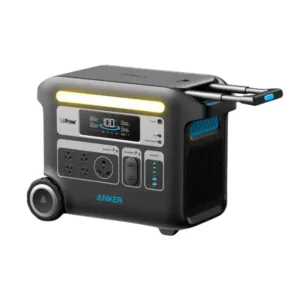
The obvious comparison is the Anker SOLIX F3000, identical in capacity, with the EcoFlow Delta Pro 3 representing the tier above.
| Feature | Pecron F3000 | Anker SOLIX F3000 | EcoFlow DELTA Pro 3 |
|---|---|---|---|
| Price tier | Upper mid-range | Upper mid-range | Premium |
| Value tier | Exceptional | Exceptional | Good |
| Rated capacity | 3,072Wh | 3,072Wh | 4,096Wh |
| Usable through AC | 2,750Wh (89%) | 2,760Wh (89%) | 3,810Wh (93%) |
| Usable through DC | 2,823Wh (91%) | 2,796Wh (91%) | 3,660Wh (89%) |
| Wall charging | 1,800W | 3,840W | 4,000W |
| Solar input | 1,600W, 25–120V | 2,400W, to 165V | 2,600W, to 150V |
| UPS switchover | 8.6ms | 9.8ms | 9.7ms |
| Self-arming inverter | No | No | Yes |
| Battery cycles | 3,500 | 4,000 | 4,000 |
| Weight | 63 lbs | 91 lbs | 113 lbs |
Set against the Anker F3000, the two machines are nearly identical where it counts on paper: same capacity, same conversion figures, both unable to arm themselves, and this one actually hands over marginally faster.
The Anker spends its extra money on charging (more than twice the mains input, 800 more watts of solar, a much higher voltage ceiling) and on 500 additional cycles. The Pecron spends nothing and gives you twenty-eight fewer pounds to carry.
So the choice is unusually legible. If the machine lives on an array or needs to be filled quickly, pay for the Anker. If it needs to be moved, or if cost per watt-hour is the metric that determines your purchase, this is the better buy, and nothing else in this dataset undercuts it.
Who Should Buy It, and Who Should Skip It
Buy It If
- Cost per watt-hour is the number of purchases our purchase turns on.
- You want three kilowatt-hours in a package one determined person can shift.
- Your panels are properly wired and produce well above 25 volts.
- It will live in a workshop, garage, or outbuilding.
Skip It If
- You need a fast top-up when a warning arrives with an hour’s notice.
- Your solar is a single small foldable panel.
- The house has to be protected while it is empty.
- The machine will run anywhere quietly.
The Bottom Line
On the metric that strips away every other difference (how much energy each pound of purchase price buys), this machine leads the entire dataset, delivering 89% of its pack through the outlets and weighing twenty-eight pounds less than its direct rival.
The savings are real, and so is where they came from. Half the mains charging speed, a solar input that ignores small panels, and fans loud enough to decide where the unit lives.
For a workshop, an outbuilding, or an off-grid setup with a proper array, that is an easy trade and an unusually large amount of capability for the money. For a hallway cupboard guarding a house, it is the wrong machine.


There are no reviews yet.