
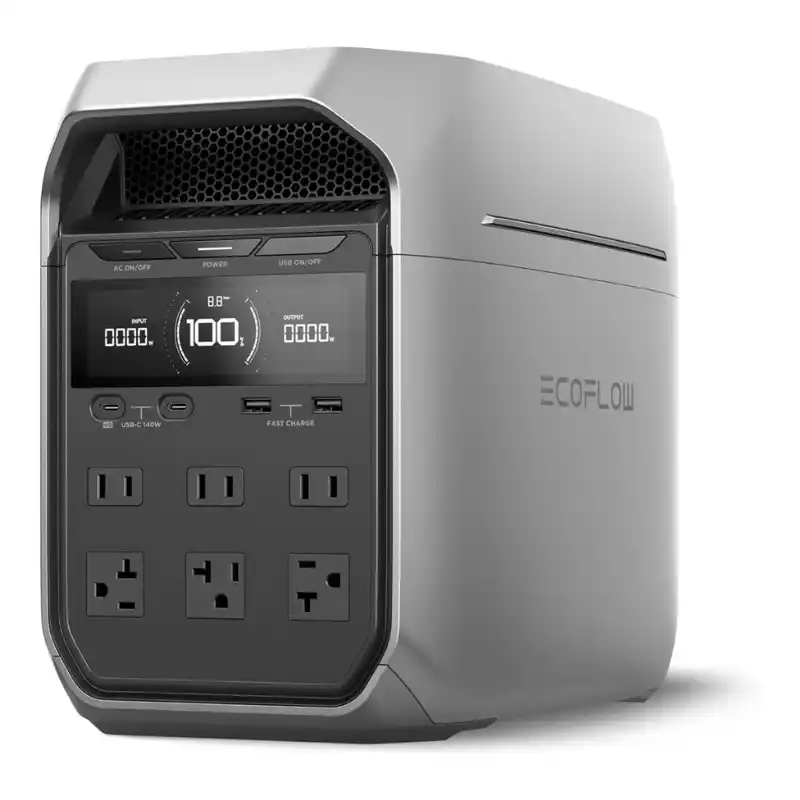
EcoFlow Delta 3 Plus Review

Built on 4,000-cycle LiFePO4 cells, EcoFlow Delta 3 Plus 1,024Wh power station delivers 1,800W of continuous output and a 3,600W surge, enough to start a full-size refrigerator. Whisper-quiet 41dB fans and a 10.2ms blackout switchover make it a mid-range pick for indoor emergency backup.
My Quick Verdict
The EcoFlow Delta 3 Plus is a Mid-Size All-in-One Mobile Power Station that falls into the High-Demand Utility Class, the 1,000W to 1,800W band, as the sweet spot for home blackout resilience. I have spent a lot of time around units in this class, and this is one of the few I would keep in my own hall closet.
It does the two things that matter most during a blackout. It switches over fast enough that my desktop and router never blinked. And it stays quiet enough that I could sleep in the same room while it ran.
It is not the value leader in this class. Not even close. But the extras you get are the kind you notice at 2 a.m. during an ice storm.
Best for: Emergency Home Resilience, Medical and CPAP Backup, and anyone who wants to add a second battery later.
Not for: buyers chasing the strongest value tier. If value tier is your only test, skip to my comparison table below.
Introduction
A gas generator solves the power problem and creates three new ones. It needs fuel that you have to store. It puts out fumes, so it can never come indoors. And it is loud enough to annoy every neighbour on the block at three in the morning.
The EcoFlow Delta 3 Plus is built to solve the same problem without any of that. It sits in a closet, stays silent, and produces nothing you can smell.
Inside are LiFePO4 cells rated for 4,000 charge cycles. That is the safer battery chemistry, which is why I am comfortable running this one in a bedroom. Charge it and drain it once a day, and you are looking at more than ten years before it drops to 80% of its original capacity.
Key Stats
| Badge | Stat |
|---|---|
| Battery Chemistry and Longevity | LiFePO4 | 4,000+ Cycles |
| Continuous AC Power Output | 1,800W AC | 3,600W Peak |
| Energy Storage Capacity | 1,024Wh | 880Wh Usable |
| Rapid AC Wall Recharge | 1,500W Input | Adjustable Speed |
| Uninterrupted Emergency Backup | 10.2ms UPS | Auto Failover |
| Maximum Solar Input and MPPT | 1,000W Solar | Built-in MPPT |
| Ultra-fast USB-C Power Delivery | 140W USB-C PD |
| Low Noise Operational Level | 41dB | Whisper Quiet |
| Modular Capacity Expansion | Expandable | Extra Battery Port |
| Smart App Remote Control | Wi-Fi + Bluetooth App |
What It Can Actually Run
The inverter puts out 1,800W continuously and can surge to 3,600W for a moment. That surge headroom is what lets it start a refrigerator compressor instead of tripping when the motor kicks on.
Rated capacity is 1,024Wh, but you never get all of it. Turning battery power into wall power costs you some energy. Independent testing measured 880Wh coming out of the AC outlets, which works out to 85% efficiency. Every number below is built on that 880Wh figure, not the number on the box.
- Full-size refrigerator at 150W: about 5.9 hours.
- CPAP machine at 40W with the humidifier off: about 22 hours, or two full nights.
- Starlink dish at 50W: about 17.6 hours.
- Laptop at 70W: roughly 12 full recharges through the 140W USB-C port.
The inverter is a pure sine wave, measured at 121 volts with 1.8% distortion. That is clean enough for a CPAP machine or a laptop power supply.
Charging and Smart Features
From a wall outlet, it pulls up to 1,500W, and you can dial that speed down in steps when you are not in a hurry. From solar, it accepts up to 1,000W across two ports, at 11 to 60 volts. That wide range means most third-party panels will work without a special adapter.
You can leave solar connected all day, and pass-through charging lets the unit power your fridge while it charges itself.
For blackouts, the switchover time was 10.2 milliseconds, and the inverter has an auto-on setting, so it takes the load on its own. The app connects via Bluetooth and Wi-Fi, and the expansion battery port lets you add capacity later instead of buying it all today.
On cost, this one lands in the mid-range price tier, but it sits in the premium value tier for what you get per watt-hour. Same-capacity units in this class, like the Bluetti Elite 100 V2 and the Anker SOLIX C1000, sit a full tier below on both counts. The rest of this review is mostly about whether that premium is worth paying.
Charging Speed Benchmarks
Recharging speed for the EcoFlow DELTA 3 Plus against the 30 units in the 1,000Wh to 1,999Wh capacity class, the quickest charging bracket on the site. Mains input there averages 1,085W and solar 641W. The Low, Average and High bands are terciles drawn inside this class, so they place the unit among its own size peers rather than site-wide.
Wall charging of 1,500W clears the 1,085W bracket average by a wide margin and passes the 1,300W threshold into a High rating. Against a 1,024Wh pack that is roughly 0.7 hours from flat, the quickest full recharge of any unit we have reviewed in this class. Inputs across the bracket span 200W to 2,400W. The step-by-step rate control matters as much as the ceiling here, because there is no reason to push 1,500W into the cells overnight when the pack is not needed until morning.
Panels are equally strong. 1,000W is more than half again the 641W bracket average and a comfortable High rating, against a 1,400W class ceiling. A full solar refill takes about 1.0 hour in strong light, which is one of only a handful of units at any capacity where panels match the wall socket for speed. For a 1kWh machine that is a genuinely different proposition: a single good day of sun replaces a mains recharge entirely rather than topping the pack up.
Need more capacity behind the same fast charging? The Bluetti AC240 holds 1,536Wh and draws 2,400W from a wall socket, the highest mains input recorded anywhere in this bracket. It refills half again as much energy in about 0.6 hours, faster in absolute terms despite the larger pack. Solar drops to 900W, so this is the choice when grid recharging before a storm matters more than daytime panel throughput.
Real Capacity: What You Actually Get
Every power station loses some energy when it turns battery power into wall power. That loss is normal. Companies just do not put it on the box.
The Delta 3 Plus is sold as a 1,024Wh unit. In independent bench testing, it delivered 880Wh through the AC outlets. That works out to 85% efficiency.
On the DC side,e it did better. Testers pulled 909Wh, or 88% of the rated capacity. If you run a 12V fridge straight off the car socket, you get more usable energy than you would through the outlets.
My takeaway: plan every runtime around 880 Wh, not 1,024 Wh. That one habit will keep you from being surprised on the second night of an outage.
85% is a solid result. It is right at the line most reviewers use to separate good units from mediocre ones.
Power Output and Surge
Two numbers decide what you can plug in. They are not the same, and mixing them up is the most common mistake I see buyers make.
- Continuous output is 1,800W. This is what the unit can run all day long.
- Surge output is 3,600W. This is the short burst it can handle when a motor kicks on.
That surge headroom is the important one. A full-size refrigerator draws only about 150W while running. But the compressor can spike past 1,200W for a second or two when it starts.
With 3,600W of surge on tap, the Delta 3 Plus has plenty of room for that. I would not worry about it tripping when the fridge cycles on.
The inverter output measured 121 volts, which sits comfortably in the normal range. Distortion came in at 1.8%, under the 2% line. That is clean enough for a CPAP machine or a laptop.
Real Appliance Runtimes
Here is what 880Wh of usable power looks like in real life. I use the same appliance draws for every unit I write up, so you can compare across reviews.
A quick note on the fridge number. Refrigerators do not run nonstop. They cycle on and off. In a real blackout, you will likely stretch that 5.9 hours into 8 or more.
Recharging: Wall and Solar
From a Wall Outlet
The Delta 3 Plus pulls up to 1,500W from a standard outlet. That is a lot for a unit this size, and it means very fast top-offs.
What I appreciate more is the charging speed control. You can set the charge rate in steps rather than choosing between slow and full blast. If a storm is two days out, I slow it down to be gentle on the cells. If a storm is two hours out, I let it rip.
From Solar Panels
Solar input maxes out at 1,000W across two ports, at 11 to 60 volts and 15 amps per port. That is a wide voltage window, so most third-party panels will work without a special adapter.
With enough panels and clear sun, a full recharge takes about two and a half hours. That is fast enough to matter on a multi-day trip.
You can also leave solar connected around the clock, and the unit supports pass-through charging. So it can charge itself while it powers your fridge at the same time. For dry camping, that combination is the whole ball game.
Dual charging works too. Feed it wall power and solar together, and it accepts up to 1,500W.
Blackout Backup: The Part I Care About Most
If you want a power station to act like a true backup system, switchover speed is everything. When the grid drops, the unit has to take over before your electronics notice.
The Delta 3 Plus measured a 10.2-millisecond switchover. Anything under 20 milliseconds is generally safe for a desktop PC or a router. Under 11 milliseconds is excellent.
It also has an auto-on setting for the inverter. That sounds small. It is not. It means the unit will wake up and take the load on its own, even if nobody is home to press a button.
Why this matters to me: my home office runs a NAS drive that hates dirty shutdowns. This feature determines whether a power station is a backup system or just a big battery.
Noise and Living With It
Fan noise measured 41dB. That is the quietest number in this whole capacity class, and it is not a close race. Several rivals sit in the mid-50s, and a few push past 60dB.
For reference, 41dB is about the level of a quiet library. You can sleep next to it. You can run it in a tent without waking the person beside you.
The unit weighs 27 pounds, or 12.5 kilograms. That is a two-hand carry for most people, but it is manageable. I can move it from the garage to the kitchen without planning.
Battery chemistry is LiFePO4, rated for 4,000 cycles. If you cycled it every single day, it would take more than ten years before it dropped to 80% of its original capacity. It is also safer chemistry, which is why I am comfortable running it indoors.
The app connects over both Bluetooth and Wi-Fi. Bluetooth is what matters when you are off-grid with no signal.
Where It Falls Short
No unit is perfect, and a review that pretends otherwise is not worth reading. Three things here are worth knowing before you buy.
1. It Sits in the Premium Value Tier
At 1,024 Wh, this unit falls into the premium value tier. Same-capacity units in the High-Demand Utility Class, including the Bluetti Elite 100 V2 and the Anker SOLIX C1000, sit in the exceptional value tier instead. That is a real gap, and for some buyers it will be the deciding factor.
2. Idle Drain Is Higher Than I Would Like
With the AC inverter switched on and nothing plugged in, the unit loses about 2.5% of its charge per hour. Leave it sitting in standby overnight, and you will notice.
The fix is easy. Turn the AC inverter off when you are not using it. But you have to remember to do it.
3. The 12V Socket Tops Out Below 150W
The car socket delivers 139W. Most 12V gear will be fine with that. But if you run a larger 12V cooler or a DC accessory that draws more current, you will hit the ceiling.
How It Compares
Here is the Delta 3 Plus against the two Mid-Size All-in-One units I would cross-shop it with. All three sit in the High-Demand Utility Class and target the Emergency Home Resilience use case.
| Feature | EcoFlow Delta 3 Plus | Bluetti Elite 100 V2 | Anker SOLIX C1000 |
|---|---|---|---|
| Price Tier | Mid-range | Entry | Entry |
| Rated Capacity | 1,024Wh | 1,024Wh | 1,056Wh |
| Usable (Tested) | 880Wh (85%) | 890Wh (86%) | 910Wh (86%) |
| Value Tier | Premium | Exceptional | Exceptional |
| Continuous Output | 1,800W | 1,800W | 1,800W |
| UPS Switchover | 10.2ms | 8.7ms | 16.1ms |
| Fan Noise | 41dB | 51dB | 59dB |
| USB-C Port | 140W | 140W | 100W |
| Battery Cycles | 4,000 | 4,000 | 3,000 |
| Expansion Battery | Yes | No | Yes |
Read that table, and the trade-off is obvious. The Bluetti Elite 100 V2 gives you nearly the same performance at a lower price point, and it actually switches over faster.
But it will not take an expansion battery. Ever. If you plan to start with 1kWh now and grow to 2kWh later, that single row rules it out.
The Anker SOLIX C1000 is the entry-tier pick, and it is a decent unit. It is just louder, slower to switch, and has a weaker USB-C port.
So the Delta 3 Plus premium buys you three things: the quietest fans in the High-Demand Utility Class, an expansion path into a Modular and Expandable Battery System, and an auto-on inverter. Whether that is worth a full price tier depends on what you are buying it for.
Who Should Buy It, and Who Should Skip It
Buy It If
- You want real home blackout backup, and you own gear that hates losing power.
- You run a CPAP machine and need something quiet enough to sleep beside.
- You plan to add an expansion battery later instead of buying everything at once.
- You charge from solar often and want the widest panel compatibility.
Skip It If
- Your main goal is the strongest value tier. Look at the Bluetti Elite 100 V2 first.
- You need more than 139W out of the 12V socket.
- You need something you can carry a long way with one hand.
The Bottom Line
The EcoFlow Delta 3 Plus is not the value pick in the High-Demand Utility Class, and I would not pretend otherwise. You can get the same watt-hours at a tier one level lower.
What you are paying for is the stuff that shows up at the worst possible moment. Fans are quiet enough to sleep through. A switchover fast enough that nothing reboots. An inverter that wakes itself up when the grid dies.
If a power station is going to sit in your closet waiting for a storm, those are the right things to pay for. That is why this one earns 8.5 out of 10 from me.


There are no reviews yet.