
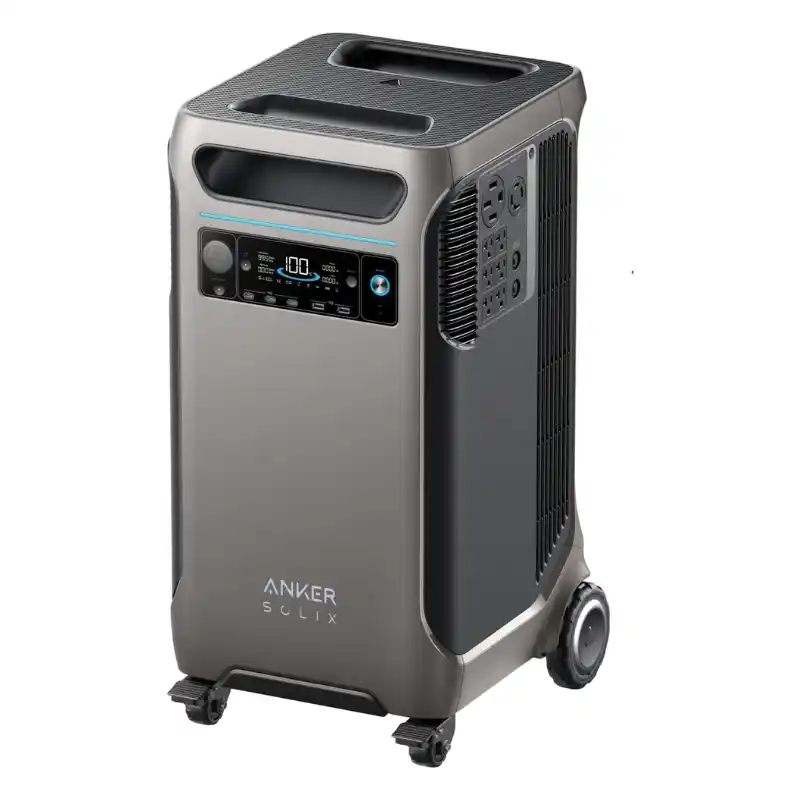
Anker SOLIX F3800 Review

The Anker SOLIX F3800 runs a 6,000W split-phase inverter producing 120V and 240V and delivers 3,310Wh of its 3,840Wh rating. Solar accepts 2,400W with an unusually generous 27-amp channel, though wall charging is limited to 1,800W.
My Quick Verdict
Run this machine at its rated output, and the pack will be empty in about 33 minutes. Refill it from a wall socket,t and you wait over two hours.
That ratio is the worst mismatch between output and input anywhere in this dataset, and it is not a subtle flaw. A 6,000-watt split-phase inverter is whole-property capability, and an 1,800-watt charger is what a mid-size portable unit uses.
It also cannot arm its own inverter, and it is the only machine reviewed here without pass-through charging, so it will not power anything while it refills.
The cells, the inverter, and the solar current allowance are all genuinely good. The rest of the design does not keep up with them.
Best for: Off-grid installations refilled by a large array, where mains charging is not part of the plan.
Not for: grid-tied backup, storm preparation, or protecting an empty house.
Key Stats
| Badge | Stats |
|---|---|
| Battery chemistry and longevity | LiFePO4 | 3,000 cycles |
| Continuous AC power output | 6,000W AC | 12,000W peak |
| Split-phase output | 120V and 240V |
| Energy storage capacity | 3,840Wh | 3,310Wh usable |
| AC wall recharge | 1,800W input | Adjustable speed |
| Uninterrupted emergency backup | 13.5ms UPS | Manual arm |
| Maximum solar input and MPPT | 2,400W solar | 27A channel |
| Pass-through charging | Not supported |
| Low-noise operational level | 55dB | Loud under load |
| Modular capacity expansion | Expandable | Extra battery port |
Introduction
Balance is the thing nobody checks on a specification sheet. A large inverter suggests a serious machine, and it is easy to assume the rest of the design was scaled to match it.
Here it was not. The inverter can deliver 6,000 watts on split phase, enough to run a well pump, a range, and most of a house at once. The charger behind it accepts 1,800 watts, which is what a portable unit at a third of the price can handle.
Inside are lithium iron phosphate cells rated for 3,000 cycles with five years of coverage; the briefest life of anything this size.
What It Can Actually Run
Six thousand watts held continuously, twelve thousand in a burst, across 120 and 240 volts. As raw capability, that is at the top of everything reviewed here.
Rated at 3,8400 Whh, the outlets returned 3,310 Wh, for an efficiency of 8%. Every figure below uses 3,310Wh.
- Refrigerator at 150W: about twenty-two hours.
- CPAP at 40W without the humidifier: nearly eighty-three hours.
- Starlink dish at 50W: sixty-six hours.
- Laptop at 70W: around forty-seven charges.
Both legs measured correctly at 121 and 240 volts, distortion sat at 1.20%, and electrical noise of 1,500mv puts it among the tidier outputs here.
Charging and Smart Features
Main input stops at 1,800 watts. On a 3,840Wh pack, that is over two hours from empty, and it is the specification that governs how this machine can realistically be used.
Two solar channels together take 2,400 watts. The first spans 11 to 15 volts at 10 amps; the second runs 16 to 60 volts and allows a full 27 amps, which is among the widest current headroom measured on this site.
The changeover clocked in at 13.5 milliseconds, achievable only after a person has raised the inverter.
Pass-through charging is not supported, which is unique among the machines reviewed on this site. Premium price tier, good value tier.
Charging Speed Benchmarks
Wall and array charging on the standard Anker SOLIX F3800, set within the Over 3,000Wh capacity class, benchmarked against all 16 machines in our charging database. Mains charging in that group averages 2,802W and solar averages 2,681W, with each band calculated inside the bracket alone.
The charger is the bottleneck that defines this machine. 1,800W is the lowest figure that still avoids a Low rating here, roughly 1,000W under the 2,802W class average, which means about 2.1 hours to refill 3,840Wh while the 6,000W inverter behind it can empty that pack in around half an hour. Pass-through is absent as well, so charging and supplying loads are mutually exclusive. The Plus version of the same machine accepts 6,000W on the input side, which is the entire difference between them.
Panels are better judged. 2,400W comes in a little under the 2,681W class average and holds Average where the bracket peaks at 6,400W, refilling the pack in roughly 1.6 hours, faster than the wall socket manages. The 27-amp channel is among the most generous current allowances we have measured, which suits a wide parallel bank. The 60-volt ceiling is the counterweight: long series strings are ruled out, so the array has to be built around current rather than voltage.
Same inverter, faster on both inputs. The Anker SOLIX F3800 Plus carries the identical 3,840Wh pack and 6,000W split-phase inverter but charges at 6,000W from mains and 3,200W from solar through a 165-volt path, with pass-through supported. That turns 2.1 hours into roughly 0.6 hours and removes the downtime. It weighs four pounds more and sits a value tier higher, which is a straightforward decision if the machine is wired to a transfer switch.
Real Capacity: What You Actually Get
Conversion is even-handed here, with both paths landing on the same figure.
Metered output reached 3,310 Wh against a 3,840 Wh label. 86%; over the bar, though not by a margin worth remarking on.
The twelve-volt route returned 3,367 Wh (also 86%) within a whisker. Unusually, there is nothing to gain by choosing one path over the other, so organise loads however suits you.
Retention is the soft spot: roughly 1.9% per hour is lost while the inverter idles, brushing the limit of what I consider tolerable. The twelve-volt path holds far better at 0.08%.
My takeaway: 3,310Wh either way. But at 1.9% an hour, leaving this armed for a fortnight would consume roughly two-thirds of the pack, and with 1,800-watt charging, you would not get it back quickly.
Power Output and Surge: What It Can Turn On
The inverter is genuinely excellent and deserves to be separated from the rest of the machine.
Six thousand watts, sustained on split-phase, covers 240-volt equipment, a well pump, a workshop, and household circuits simultaneously. Twelve thousand watts of surge places every domestic motor start well inside its comfort zone.
Distortion of 1.20% and electrical noise of 1,500 mV are both respectable, better than those of several machines at this capacity.
The minor ports are what disappoint: one USB-C output at 100 watts, a car socket at 142, and nothing about either that matches the machine’s cost.
Real Appliance Runtimes
3,310 Wh laid out in hours against the appliance loads; this site applies to every machine.
| Appliance | Power Draw | Runtime | What That Means |
|---|---|---|---|
| Full-size refrigerator | 150W | About 22.1 hours | A full day on the fridge before cycling extends it. |
| CPAP machine (no humidifier) | 40W | About 82.8 hours | Eighty-two hours of overnight running. |
| Starlink dish | 50W | About 66.2 hours | Sixty-six hours of uptime with no mains. |
| Pellet grill or smoker | 100W | About 33.1 hours | Thirty-three hours of smoking time. |
| Laptop (70W) | 70W | About 47 recharges | One port, taken in sequence. |
Read these against the inverter rating rather than in isolation. At full 6,000-watt output, the same pack lasts about thirty-three minutes, which is the scenario the charging speed needs to support, and it does not.
Recharging: Wall and Solar
From a Wall Outlet
Eighteen hundred watts into a 3,840 Wh pack via a 6,000-watt inverter is the least balanced charging arrangement in this dataset.
From empty, that is a little over two hours. Anker’s own Plus version of this machine takes 6,000 watts and does the same job in roughly forty minutes.
The absence of pass-through charging compounds it. Every other machine reviewed on this site can power loads while it refills; this one cannot, so charging and using are mutually exclusive.
For a grid-tied backup system expected to recover between outages, that combination is a serious practical limitation rather than an inconvenience.
From Solar Panels
Solar is where the design is genuinely well judged, and it is clearly the intended way to feed this machine.
Two channels take 2,400 watts in total. The first covers 11 to 15 volts at 10 amps for small panels; the second runs 16 to 60 volts at 27 amps.
Twenty-seven amps is among the most generous current allowances measured at this site, and current is usually the limit a large parallel array hits before wattage does. A substantial bank of panels wired in parallel will deliver what it generates rather than being clipped.
The trade is voltage. Sixty volts is where it stops, which forecloses a lengthy series string and leaves the cabling carrying more current than it otherwise would.
Panels may stay connected around the clock, though the unit cannot supply loads while charging.
Blackout Backup: The Part I Care About Most
Backup performance here is adequate in speed and unfinished everywhere else.
Handover measured 13.5 milliseconds, inside the twenty-millisecond safety threshold with a reasonable margin, and roughly half again slower than the best machines at this capacity.
Nothing wakes on its own here; the inverter has to be live before the mains fail and stay that way.
That habit costs 1.9% an hour, which is expensive, and refilling what it loses takes over two hours. The three specifications work against each other in a way they do not on the Plus version.
Why this matters to me: a whole-property inverter that must be armed by hand, drains 1.9% per hour while armed, and refills slowly is not a system you can install and leave. It is a system you have to manage.
Noise and Living With It
Fifty-five decibels under load, excluding any room where people are sleeping or working quietly, is fine in a plant room, garage, or outbuilding.
For an inverter this size, this is a reasonable outcome, though it is a decibel louder than the Plus version and four decibels louder than the quietest machines at this capacity.
The weight is 132 pounds (59 kilograms) in one sealed body. This is a permanent, two-person installation.
The app runs on Wi-Fi and Bluetooth, and Anker keeps a telephone line open behind the five-year cover.
Where It Falls Short
Four limitations, and the first three compound one another.
1. Eighteen Hundred Watts of Charging Behind a 6,000-Watt Inverter
The least balanced input-to-output ratio in this dataset. The machine can empty itself in about half an hour and needs over two hours to recover.
For an off-grid inverter refilled by panels over the course of a day, that is workable. For grid-tied backup during a storm week, it is the specification that will let you down.
2. No Pass-Through Charging
This is the only machine on this site that cannot supply loads while charging. Refilling and using are mutually exclusive.
Combined with the slow charger, it means every recovery period is time the system is unavailable.
3. No Self-Arming Inverter, and 1.9% Standby Drain
Somebody has to switch the inverter on before an outage and leave it running, which costs nearly 2% of the pack’s capacity per hour.
A fortnight armed and untouched would consume around two-thirds of the capacity, which the slow charger then struggles to replace.
4. A 60-Volt Solar Ceiling and 3,000 Cycles
The 27-amp channel is excellent, but the 60-volt limit rules out a long series string, so a large array needs heavier cabling than it would on the Plus.
Cell life is also the shortest at this capacity, where rivals offer 4,000 or 6,000 cycles.
How It Compares
The essential comparison is between Anker’s own Plus version and the EcoFlow Delta Pro 3 as the outside alternative.
| Feature | Anker SOLIX F3800 | Anker SOLIX F3800 Plus | EcoFlow Delta Pro 3 |
|---|---|---|---|
| Price tier | Premium | Premium | Premium |
| Value tier | Good | Premium | Good |
| Usable through AC | 3,310Wh (86%) | 3,270Wh (85%) | 3,810Wh (93%) |
| Sustained output | 6,000W split phase | 6,000W split phase | 4,000W split phase |
| Wall charging | 1,800W | 6,000W | 4,000W |
| Pass-through charging | No | Yes | Yes |
| Self-arming inverter | No | Yes | Yes |
| Solar input | 2,400W to 60V, 27A | 3,200W to 165V | 2,600W to 150V |
| Idle drain per hour | 1.9% | 1.6% | 0.91% |
| Battery cycles | 3,000 | 3,000 | 4,000 |
| Weight | 132 lbs | 136 lbs | 113 lbs |
Against the Plus version, this machine saves a value tier and gives up the three specifications that make a whole-property system practical: fast charging, pass-through, and an inverter that arms itself. Four pounds and one decibel separate them physically.
That makes the choice sharper than most in this dataset. If the machine will live on a large array and be refilled by daylight, the standard version is a good value with an excellent 27-amp solar channel. If it is going anywhere near a transfer switch, the Plus is not a luxury version; it is the working one.
The Delta Pro 3 converts 7 points better, weighs 19 pounds less, charges at 4,000 watts, arms itself, and carries more cycles, all at the same value tier. It gives up 2,000 watts of continuous output, which most households will never need.
Who Should Buy It, and Who Should Skip It
Buy It:
- Your only real recharge route, and mains charging speed is irrelevant.
- You are running a large parallel array that needs 27 amps of current headroom.
- You need 240 volts at 6,000 watts and will accept manual operation.
- The value-tier savings over the Plus version matter more than automation.
Skip It If
- The machine is going to a transfer switch. Buy the Plus version instead.
- You need it to power anything while it charges.
- Storm preparation with short notice is the use case.
- You want to install it and stop thinking about it.
The Bottom Line
There is a very capable inverter in this machine, a well-judged solar channel, and a sensible cell package, and they are attached to a charging system that cannot keep up with any of them.
Eighteen hundred watts behind a 6,000-watt output, with no pass-through, no self-arming, and a 1.9% hourly drain, add up to a system that has to be managed rather than installed.
Fed by a large array in an outbuilding, it is honest value, and the 27-amp channel is genuinely useful. Wired into a house, Anker’s own Plus version is not so much an upgrade as the version that actually works.


There are no reviews yet.