
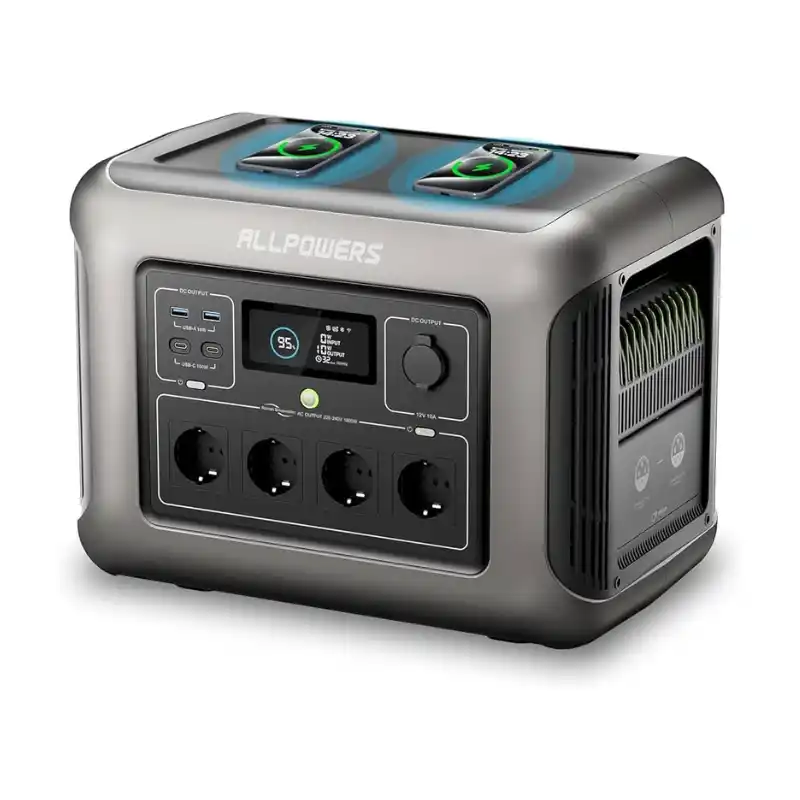
ALLPOWERS R1500 Review

The ALLPOWERS R1500 holds 1,152Wh behind an 1,800W inverter with 3,000W of surge capacity and accepts solar input up to 95 volts—high enough to wire rigid panels in series, unlike most rivals. Four-stage charging, expansion support, and exceptional value per watt-hour in the mid-range price tier.
My Quick Verdict
Read the R1500’s charging specifications side by side, and the unit’s intended life becomes obvious. Wall input tops out at 900W, the slowest here. Solar accepts 95 volts, well above the 60-volt ceiling most rivals impose.
Feed it both at once, and it draws 1,500W, which is more than either input can provide on its own. This is a machine designed to be charged by the sun, with mains power as a supplement rather than the primary source.
It is also the cheapest usable watt-hour on this page, sitting in the mid-range price tier while delivering exceptional value.
What holds it back is a lopsided conversion figure, no phone support, and an inverter that will not arm itself.
Best for: Overland, RV, and Remote Dry Camping, plus cost-driven Emergency Home Resilience.
Not for anyone whose recharge plan is a wall socket and an hour’s warning.
Key Stats
| Badge | Stat |
| Battery Chemistry and Longevity | LiFePO4 | 3,000 Cycles |
| Continuous AC Power Output | 1,800W AC | 3,000W Peak |
| Energy Storage Capacity | 1,152Wh | 950Wh Usable |
| Rapid AC Wall Recharge | 900W Input | Four-stage |
| Uninterrupted Emergency Backup | 11.6ms UPS | Manual Arm |
| Maximum Solar Input and MPPT | 650W Solar | 12–95V MPPT |
| Ultra-fast USB-C Power Delivery | 100W USB-C PD |
| Low-noise Operational Level | 54dB | Audible Under Load |
| Modular Capacity Expansion | Expandable | Extra Battery Port |
| Dual Charging Input | 1,500W Combined |
Introduction
Most power stations treat solar as an accessory and the wall socket as the real charger. Wall input runs to 1,200W or 1,500W, solar caps at 500W or 600W, and the voltage window stops at 60 volts because that covers the foldable panels the manufacturer also sells you.
The R1500 inverts that arrangement. Main charging is the weakest figure in this comparison at 900W. Solar climbs to 95 volts, enough to wire rigid panels in series for a permanent installation.
The cells are lithium iron phosphate, with 3,000 cycles claimed and a five-year warranty. Daily use puts that at about 8 years before capacity eases to 80%.
What It Can Actually Run
The inverter sustains 1,800W and peaks at 3,000W. Sustained governs what runs; peak governs the instant a compressor engages.
Nominal storage is 1,152 Wh, and metering the sockets returned 950 Wh. That is 82%, the weakest AC conversion in this comparison. Everything below uses 950Wh.
- A domestic fridge pulling 150W: a bit past six hours.
- CPAP at 40W without humidifier: close to 24 hours.
- Starlink dish at 50W: about 19 hours.
- Laptop at 70W: near fourteen refills over USB-C.
Voltage measured 122. Harmonic distortion is absent from the bench data, so verify it with ALLPOWERS before running anything medical.
Charging and Smart Features
Wall charging reaches 900W across four selectable stages, offering finer control than most units and slower charging than all of them.
Solar output climbs to 650W between 12 and 95 V at 13 A. The wattage is ordinary; the voltage ceiling is not, and it is the specification that defines this unit.
Crossover measured 11.6 milliseconds, just outside the excellent band, with no self-arming mode on the inverter. Panels can remain permanently attached, and loads can run while charging.
Dual charging is the interesting one. Mains and sun together accept 1,500W, which exceeds either input on its own by a wide margin. Mid-range price tier, exceptional value tier.
Charging Speed Benchmarks
Recharge times for the ALLPOWERS R1500 measured against every machine in the 1,000Wh to 1,999Wh capacity class our charging database covers. Thirty units make up that group, with mean inputs of 1,085W from the wall and 641W from panels. Banding is internal to the bracket.
Mains input of 900W sits just under the 933W boundary and records a Low rating, roughly 185W below the 1,085W class average. That fills 1,152Wh in about 1.3 hours. Four-stage rate control is the redeeming detail, because most machines in this price region offer two speeds and the finer adjustment makes a gentle overnight charge a real option rather than a compromise between full rate and nothing.
Panels take 650W, marginally above the 641W class average and enough for an Average rating where the bracket high is 1,400W, refilling the pack in roughly 1.8 hours of good sun. The number worth acting on is the 95-volt ceiling rather than the wattage: most machines at this capacity stop at 60, so this one will take three or four rigid panels in a single series string, with lower current and thinner cable over a long run from a roof or ground mount.
Want faster charging at a similar capacity? The Pecron E1500LFP holds 1,536Wh and accepts 1,400W from mains and 800W from panels, both High ratings in this bracket, on the same generous 95-volt solar window. Empty to full drops to about 1.1 hours on AC or 1.9 hours on solar despite the larger pack, and it sits in the entry price tier.
Real Capacity: What You Actually Get
The R1500 splits noticeably between its two output paths, and the split favours careful users.
Metered on the AC side, 950 Wh was recorded against a claimed 1,152 Wh. 82%, and the poorest AC conversion of anything on this page.
On the twelve-volt side, it managed 1,003 Wh, or 87%. That is a five-point gap, worth about 53Wh, and it is unusually wide.
Standby loss runs around 1.4% per hour with the inverter awake. On DC, the meter recorded no measurable drain.
My takeaway: 950 Wh through the sockets, 1,003 Wh through DC. That gap is larger here than on almost anything else reviewed, so anything that can run on twelve volts should.
Power Output and Surge: What It Can Turn On
Two ratings, two different jobs. The 1,800W sustained figure indicates the maximum the unit can handle indefinitely; the 3,000W peak determines whether a motor starts or a breaker trips.
3,000 watts of peak power is a comfortable middle ground. A refrigerator compressor pulling roughly 1,200W at startup has ample room, and a second modest load alongside it will not push you to the ceiling.
The measured output voltage was 122, at the upper end of the safe band but inside it.
No distortion figure was recorded. That is a gap rather than a fault, but it matters if a CPAP machine is on your list.
Real Appliance Runtimes
The table converts 950 Wh into hours based on the standard appliance draw for this site.
| Appliance | Power Draw | Runtime | What That Means |
| Full-size refrigerator | 150W | About 6.3 hours | An evening and a good part of the night counted once as cycling. |
| CPAP machine (no humidifier) | 40W | About 23.8 hours | Comfortably, a second night before it needs anything. |
| Starlink dish | 50W | About 19 hours | A full day of remote work and the evening after. |
| Pellet grill or smoker | 100W | About 9.5 hours | An unhurried all-day cook. |
| Laptop (70W) | 70W | About 14 recharges | USB-C at 100W covers it. |
These runtimes come from a 1,152 Wh pack behaving as if it were a 950 Wh one. The capacity is genuinely there; the conversion is what costs you, and it is the single clearest place this unit trails its rivals.
Recharging: Wall and Solar
From a Wall Outlet
Nine hundred watts is the lowest mains input among all units on this page, and it takes well over an hour to fill an empty pack.
The four-stage rate control is a genuine feature and finer than the two-speed switches common here, but finer control over a slow charger is still a slow charger.
If your scenario is a storm warning arriving with an hour’s notice, this is the wrong unit. If it is a vehicle that spends its days under panels, the figure hardly matters.
From Solar Panels
The voltage ceiling is the reason to buy this machine.
Panel input runs from 12 to 95 volts at 13 amps, up to 650W. 95 volts is well beyond the 60-volt limit most units in this class impose, and it changes what you can build.
At 60 volts, you are restricted to two rigid panels in series before exceeding the input. At 9.5, you can wire three in parallel or run a longer cable at higher voltage with lower losses along the way. For a roof rack, a van, or a cabin, that is the difference between a real array and a pair of foldables.
Clear sky returns an empty pack in roughly 2.5 hours. Panels may stay attached permanently while loads run.
Best of all, dual charging accepts a combined 1,500W, so mains and sun together deliver considerably more than either route alone.
Blackout Backup: The Part I Care About Most
Backup here is competent and unfinished, in that order.
Crossover measured 11.6 milliseconds, which falls just outside the sub-11 band I consider excellent and comfortably within the 20-millisecond safety line. Nothing with a processor should notice it.
But there is no auto-on mode, so the inverter must be armed manually and left running.
The standby cost of doing so is a moderate 1.4% per hour, making it more practical to leave it armed here than on units that leak faster.
Why this matters to me: 11.6 milliseconds is fast enough that I would trust it with a desktop, which makes the missing auto-on mode more frustrating rather than less. The hardware can do the job; the firmware will not let it do the job unattended.
Noise and Living With It
The fans reach 54dB, which is past the point I would accept in a bedroom and unremarkable everywhere else.
It is a steady working noise rather than a whine. A garage or a vehicle absorbs it without complaint; a small room at night does not.
It comes in at 36 pounds (16 kilograms). The casing is clearly built for abuse rather than for walking distances, and the mass follows from that.
One gap worth knowing before you buy: ALLPOWERS offers no telephone support. Warranty issues and faults are handled via email or a web form, which is a significant drawback for a five-year commitment.
Where It Falls Short
Four things to weigh, and the first two are the ones that will actually affect you.
1. The Weakest Conversion Here
82% through the sockets is the lowest AC figure among the units on this page. A rival returning 86% from a smaller pack delivers comparable energy.
The DC side redeems it at 87%, so users running twelve-volt loads escape most of the penalty. Anyone relying on the AC outlets does not.
2. Mains Charging Is the Slowest in This Comparison
Nine hundred watts, where rivals manage 1,200W to 1,440W. Filling from empty takes well over an hour.
This is a deliberate design choice rather than an oversight, given the attention paid to the solar side. But it means the unit is poorly suited to short-notice storm preparation.
3. No Self-Arming Inverter, and No Phone Support
The 11.6-millisecond crossover is wasted unless somebody armed the inverter in advance, which rules the unit out for unattended backup.
Separately, ALLPOWERS does not run a telephone support line. On a unit carrying a five-year warranty, that is worth factoring in.
4. Heavy, Loud, and Unmeasured on Distortion
Thirty-six pounds for 1,152 Wh is at the heavy end; 54dB rules out quiet rooms; and no harmonic distortion figure exists in the bench data.
None of these decides the purchase on its own. Together, they describe a unit built for a truck bed rather than a bedside table.
How It Compares
The two closest comparisons are the Bluetti AC180, which matches it on capacity, and the Pecron E1000LFP, the other value-focused unit with a strong DC story.
| Feature | ALLPOWERS R1500 | Bluetti AC180 | Pecron E1000LFP |
| Price Tier | Mid-range | Mid-range | Entry |
| Value Tier | Exceptional | Exceptional | Exceptional |
| Rated Capacity | 1,152Wh | 1,152Wh | 1,024Wh |
| Usable Through AC | 950Wh (82%) | 990Wh (86%) | 880Wh (85%) |
| Usable Through DC | 1,003Wh (87%) | 981Wh (85%) | 923Wh (90%) |
| Solar Voltage Ceiling | 95V | 60V | 60V |
| Wall Charging | 900W | 1,440W | 1,100W |
| Dual Charging | 1,500W | 1,440W | 1,150W |
| UPS Switchover | 11.6ms | 8.7ms | 13.5ms |
| Expansion Battery | Yes | No | Yes |
The AC180 holds the same nominal capacity, converts it more efficiently, charges from the wall at 60% higher wattage, and crosses over faster. Where it stops is expansion, which it does not support at all, and solar, capped at 60 volts and 500W.
So the choice is unusually clean. Buy the AC180 if the wall socket is your charger and you will never grow the system. Buy the R1500 if panels are the plan and you want the option of more capacity later.
The Pecron E1000LFP is the better unit for anyone whose loads are mostly 12-volt, since its 90% DC yield and 300W XT60 output outperform the R1500’s standard car socket. But its solar also stops at 60 volts, which is exactly where the R1500 pulls ahead.
Who Should Buy It, and Who Should Skip It
Buy It If
- Solar is your primary recharge route, and you want to wire a real array rather than foldables.
- You run 12-volt loads, where this unit gives back 5 points more than the sockets.
- You want expansion support at the lowest cost per usable watt-hour on this page.
- The unit will live in a vehicle, a workshop, or a garage.
Skip It If
- Fast wall charging before a storm is your priority. Nine hundred watts is the slowest here.
- You need unattended backup for a computer or a NAS drive.
- Telephone support matters to you over a five-year warranty.
- Every watt-hour counts through the AC outlets, where conversion is weakest.
The Bottom Line
The ALLPOWERS R1500 makes sense once you stop reading it as a general-purpose unit and start reading it as a solar unit. The 95-volt input, the 1,500W dual-charging ceiling, and the strong DC yield all point in the same direction.
Judged as a mains-charged home backup box, it looks mediocre: slow to fill, weakest conversion here, no auto-on, no phone line to call.
Considered the charging hub of a vehicle or cabin with roof panels, it is the cheapest capable option on this page, and its voltage ceiling is something none of its rivals can match at any price tier.


There are no reviews yet.