

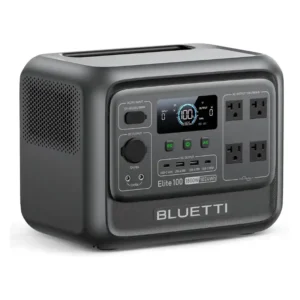
The Bluetti Elite 100 V2 pairs 1,024Wh of 4,000-cycle lithium iron phosphate with an 1,800W inverter that spikes to 3,600W for motor startups. Its 8.7ms failover is among the quickest at this capacity, and it lands in the entry price tier while delivering exceptional value.
★★★★★
More details +
If somebody asks me what to buy first, this is the unit I name, because it does the difficult part well and asks very little in return: 8.7 milliseconds to catch a blackout, an inverter that arms itself, and standby losses near 1% an hour that mean it is still full when you finally need it. The meter returned 890 Wh of the rated 1,024 Wh, a solid 86%. The 51dB fans are louder than I would like beside a bed, the 12V socket falls just short of useful, and the total absence of an expansion path is a permanent ceiling rather than an inconvenience. But it sits in both the entry-price and exceptional-value tiers at once, which almost nothing else here manages, so if you know that 1kWh is all you will ever need, this is the one I would buy.
PROS:
- Fastest switchover in this class at 8.7ms, with an auto-on inverter that works when nobody is home.
- Entry price tier and exceptional value tier at the same time, a rare combination here.
- Very low idle drain near 1% per hour, so it holds a charge sitting in standby.
- 4,000-cycle LiFePO4 cells give over ten years of daily use before dropping to 80%.
- The 140W USB-C port charges a laptop without a wall brick.
- Light enough for its 25-pound capacity, so it is a genuine one-hand carry.
CONS:
- No expansion battery support at all. What you buy is your ceiling, permanently.
- Fan noise of 51dB sits at the edge of comfortable bedside use.
- The 12V car socket caps at 146W, just under the 150W I look for.
- Wall charging at 1,200W is slower than the fastest units in this class.
- DC yield of 85% is no better than AC, so there is no efficiency gain running 12V gear.
- Solar input caps at 60 volts, limiting how many rigid panels you can wire in series.
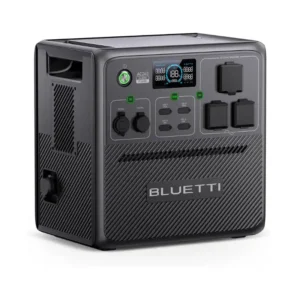
The BLUETTI Pioneer 150 (AC240) portable power station behaves less like gear and more like an appliance: 1,536Wh behind a 2,400W inverter, humming at 47dB, refilling from the wall at 2,400W. Six years of warranty and expanded battery support make it a fixture in the upper-mid-range home backup market.
★★★★★
More details +
The AC240 answers two different questions and earns two different verdicts. As a quiet, high-capacity fixture, it is very good: 47dB under a 2,400W inverter; 1,310 Wh of the rated 1,536 Wh delivered in independent testing; wall charging at 2,400W that refills it in under an hour when a storm warning lands; and a six-year warranty on 3,500-cycle cells. As an automatic backup, it is the weakest in its class because the measured 19.2ms switchover barely clears the safety line, and there is no auto-on setting, so an outage while it sits idle catches nothing. At 72 pounds, it is furniture, not gear, and it sits in the premium value tier while the Montek X1200 sits a tier below. Buy it to sit in a utility room and keep a refrigerator and a space heater running quietly. For protecting a PC or a NAS drive unattended, buy the EcoFlow Delta 3 Plus instead.
PROS:
- Quiet at 47dB despite a 2,400W inverter, so it can live in a room where people sleep.
- Wall charging up to 2,400W, roughly double the class, so it refills in under an hour before a storm.
- A 2,400W continuous rating is sufficient for running space heaters and portable air conditioners as steady loads.
- Six-year warranty, a year longer than the class standard.
- 3,500-cycle LiFePO4 cells and phone customer support behind them.
- Takes expansion batteries, so capacity can grow later.
CONS:
- Switchover measured 19.2ms, barely inside the safety line and slower than the manufacturer claims.
- No auto-on inverter setting, so it will not catch an outage unless somebody armed it first.
- At 72 pounds, it is a two-person lift. This is a fixture, not a portable unit.
- It sits in the premium value tier, above most of its competition per watt-hour.
- Solar input caps at 60 volts, limiting how large an array you can wire.
- Inverter distortion was not measured, which is important for sensitive medical equipment.
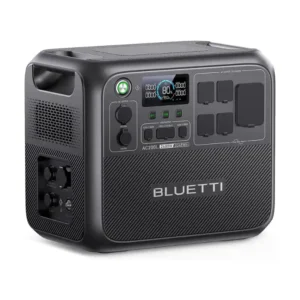
The Bluetti AC200L delivers 1,830 Wh of its 2,048 Wh rated capacity, an 89% return, powered by a 2,400W inverter. Solar accepts up to 145 volts, more than double what most units at this capacity permit, and wall charging reaches 2,400W. Upper mid-range price tier, exceptional value.
★★★★★
More details +
One figure here reshapes what the unit is for: the solar input accepts 145 volts, where most machines at this capacity stop at 60. That is not a marginal advantage but a different installation entirely, because it lets you wire four or five panels in a single series string the way a permanent array is designed, with lower current, thinner cable,le and smaller losses over a long run. Around it sit genuinely strong numbers: 1,830Wh delivered from a 2,048Wh pack, an 89% conversion rate second only to one rival at this capacity; 2,400 watts of wall charging that fills it from empty in under an hour; 48-decibel fans behind a 2,400-watt inverter; and a standby loss of 0.5% per hour. What decides against it are two facts that will not change. It weighs 61 pounds, the heaviest at this capacity and a two-person lift, and its inverter cannot arm itself, so a 13.8-millisecond crossover only helps while somebody is home. Install it beside a fixed array, and it is the best unit here for that job. Ask it to be portable or to guard an empty house, and it cannot do either.
PROS:
- Solar input to 145 volts, more than double what most units at this capacity permit and enough for a genuine series string.
- Conversion of 89% at the sockets, second best at this size, and four points above most rivals.
- Wall charging at 2,400 WW, filling the pack from empty in under an hour.
- Fans at 48dB despite a 2,400W inverter, quiet enough for a room adjoining a bedroom.
- Distortion of 1.10% and standby loss of 0.5% per hour, both better than the class average.
- Solar input of 1,200W, tied highest at this capacity, with panels able to stay connected permanently.
CONS:
- Sixty-one pounds, the heavy capacity at this capacity, and a two-person lift.
- The inverter cannot arm itself, so a 13.8ms crossover only protects an occupied house.
- Cells rate for 3,000 cycles, while the strongest rivals at this capacity offer 4,000.
- The USB-C port supplies 100W, where the best units now provide 140W, often across two ports.
- The DC path returns only 82; unusually, there is no efficiency gain from twelve-volt loads.
- A crossover of 13.8ms is adequate, not good, and well behind the sub-nine leaders.
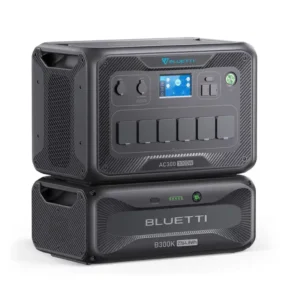
The Bluetti AC300 pairs an inverter head containing no battery with a B300K module, delivering 2,620Wh behind a 3,000W inverter. Cells are rated at 6,000 cycles, fans run at 44dB, and up to four modules can be added over time.
★★★★★
More details +
Every other machine on this site is one sealed object holding a fixed amount of energy behind a fixed amount of electronics; grow your needs, and you buy both again. Bluetti splits them: the AC300 head contains the inverter, controllers, display,y and port, with no cells at all, and it takes up to four B300K modules underneath. Buy the expensive half once, then add capacity as the budget allows. The supporting numbers are strong: a 6,000-cycle rating, the joint-highest in this dataset; 0.70% distortion and 990 mV of electrical noise, among the cleanest at this capacity; 44 decibels behind a 3,000-watt inverter; and 5,400 watts of combined charging. Weighed against that: 85% conversion, where sealed rivals manage 89, 127 pounds with just one module fitted, and 2% of the charge is lost for every hour it waits armed. That last figure is the discordant one, because it fights the permanent installation the whole design is built around. Buy it if the capacity you want today is not the capacity you want in three years. Otherwise, a sealed machine does more for less.
PROS:
- A modular head unit that accepts up to four battery modules, so capacity can grow without replacing electronics.
- Cells rated at 6,000 cycles, the joint highest figure recorded in this dataset.
- Distortion of 0.70% and 990mv of electrical noise, among the cleanest outputs at this capacity.
- Fans at 44dB behind a 3,000W inverter, quiet enough to install beside living space.
- Main charging at 3,000W and 5,400W combined, with headroom that matters as modules are added.
- It separates into two liftable pieces, unlike sealed machines of comparable mass.
CONS:
- Two percent standby drain an hour, awkward on a system meant to be installed and left alone.
- One hundred and twenty-seven pounds for the head and one module, before any additions.
- Conversion of 85% at the sockets, four points behind sealed rivals at this size.
- The inverter will not arm itself, which pairs badly with the standby drain.
- Good value tier rather than exceptional, so you pay for architecture rather than watt-hours.
- Twelve amps per solar channel is modest, ffavoringhigh-voltage strings over parallel banks.
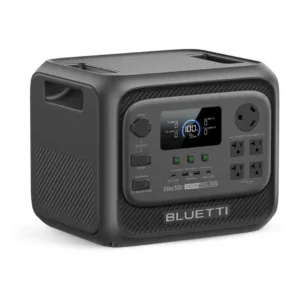
The Bluetti Elite 300 delivers 2,760Wh of its 3,014Wh rating, a 91% conversion efficiency, and an 8.1ms handover for its inverter. Cells are rated for 4,000 cycles; a 140W USB-C port and a 400W XT90 output are available; and it weighs 57 pounds. Upper mid-range price tier, exceptional value.
★★★★★
More details +
Most of the machines reviewed on this site fail at some point, which is a deciding factor for those who should not buy them. This one has a single such failure, and it is stated on the box: there is no expansion battery, and 3,014 Whis has a permanent ceiling. Everything else is unusually good. It returns 2,760 Wh at the outlets, a 91% conversion rate, among the strongest recorded here, and 93% through DC. It arms its own inverter with an 8.1-millisecond handover and sheds 0.5% per hour, a combination that actually makes automatic backup work and that most of its price tier cannot manage. It weighs 57 pounds for three kilowatt-hours, lighter than several two-kilowatt-hour units in this data, and it lands in the exceptional value tier; the cheapest three kilowatt-hours measured anywhere here. Sixty-nine hours of CPAP runtime from a sealed unit, one person can shift, is a genuinely different proposition for anyone dependent on overnight medical equipment. Just be certain about the ceiling before you buy, because buyers reaching this capacity are usually building toward more rather than settling.
PROS:
- Conversion of 91% through AC and 93% through DC, among the best figures recorded here.
- A self-arming inverter with an 8.1ms handover at an exceptional value tier.
- Fifty-seven pounds for three kilowatt-hours, lighter than several 2kWh units reviewed here.
- Sixty-nine hours of CPAP runtime, the longest recorded on this site.
- Cells rated to 4,000 cycles with standby loss of just 0.5% an hour.
- A 140W USB-C port, a 400W XT90 output, and 0.70% distortion.
CONS:
- No expansion battery support, so 3,014Wh is a permanent ceiling.
- A 2,400W inverter, the same rating as several two-kilowatt-hour units carry.
- Electrical noise above 2,000mv, at the high end of this field.
- The 60-volt solar ceiling rules out long series strings.
- Combined charging at 2,400W is adequate, rather than generous, for a pack this size.
- Fifty-two decibels sit just above what a bedroom can comfortably absorb.
The Bluetti Fridge Power holds 2,016Wh behind an 1,800W inverter, crosses over in 8.7ms with a self-arming inverter, and sheds only 0.5% of its charge per hour on standby. Its 4,000-cycle cells and 1,000W solar input sit in the upper mid-range price tier at exceptional value.
★★★★★
More details +
This is the rare unit that picked a single job and let everything else go, and that job is the one most people actually buy a power station for. The backup implementation is excellent: an 8.7-millisecond crossover, an inverter that arms itself-which fewer than a third of the units reviewed here can manage-and a standby loss of 0.5% per hour, so arming it and forgetting it for months costs almost nothing. Add 4,000-cycle cells, 1,000 watts of solar at 20 amps, 43 pounds, and 51 decibels, and, as an appliance kept permanently in a utility room, it is very hard to fault. What it gave up is startling. The USB-C port supplies 18 watts, an eighth of what rivals at this capacity provide, so a laptop has to be charged through an AC outlet instead. No twelve-volt yield or high-output DC port appears in the data at all. And at 1,800 watts, it runs the smallest inverter in this size class. Buy it knowing it can never be repurposed, because that decision has already been made for you.
PROS:
- A self-arming inverter with an 8.7ms crossover, which fewer than a third of the units reviewed here can match.
- Standby loss of 0.5% an hour, so leaving it armed for months costs almost nothing.
- Cells rated to 4,000 cycles, roughly eleven years of daily use, under five years of cover.
- Solar input of 1,000W at 20 amps, generous enough for rigid panels.
- Forty-three pounds and 51dB, both better than most rivals at two kilowatt-hours.
- Dual charging to 2,200W, with panels able to stay connected permanently.
CONS:
- An 18W USB-C port that charges a phone but cannot charge a laptop at all.
- No twelve-volt yield or high-output DC port appears in the bench data.
- An 84% conversion is just under the line most units at this capacity clear.
- The smallest inverter at this capacity, so heating loads cannot run alongside anything else.
- The output measured 118 volts, closer to the bottom of the acceptable band than to the middle.
- The 1,440W charger trails the 1,800W units at this capacity.
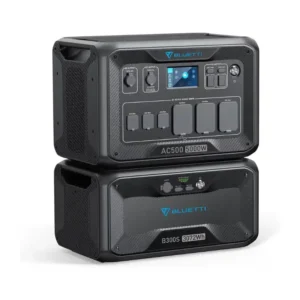
The Bluetti AC500 pairs a 5,000W inverter head, which holds no cells, with a B300S module, delivering 2,520Wh. Wall charging reaches 5,000W, and the combined input is 8,000W, both among the highest recorded, with 3,000W from solar across two 150-volt channels.
★★★★★
More details +
Five thousand watts from a wall socket is the highest mains input recorded for any machine on this site, eight thousand with panels alongside is near the top too, and a 5,000-watt continuous inverter is the largest single-phase output reviewed here; a system that empties under heavy load and recovers within half an hour, which is exactly what fails on slower rivals across a storm week. The waveform is excellent as well, with 0.70% distortion and 985 mV. Then you meter the outlets and find 2,520 Wh from a 3,072 Wh rating, 82%, the weakest conversion at this capacity, with the DC path worse again at 77%, among the lowest figures in the whole dataset. From the same rating, a 91% machine hands back roughly 280 watt-hours more. Paying the highest price per watt-hour at this size and receiving the smallest share of it is a hard combination to defend, and the 16-millisecond handover on an inverter that will not arm itself does not help. If you need 5,000 watts continuously, nothing else here delivers it. If 3,000 would do, Bluetti's own AC300 beats this on conversion, cycles, noise, weight, and value.
PROS:
- Wall charging of 5,000W, the highest mains input recorded on this site, refilling a module in under half an hour.
- Combined charging of 8,000W with solar is prioritized, among the highest figures measured here.
- A 5,000W continuous inverter with 10,000W of surge, the largest single-phase output reviewed here.
- Distortion of 0.70% and 985mv of electrical noise, among the cleanest at this capacity.
- Solar of 3,000W across two independently tracked 150-volt channels with a 12-volt floor.
- Modular architecture, so capacity grows without replacing the electronics.
CONS:
- Conversion of 82% through AC, the weakest at this capacity.
- Only 77% through DC, among the lowest figures in the entire dataset.
- A 16ms handover on an inverter that will not arm itself.
- Premium value tier, roughly double the cost per watt-hour of the best value machines at this size.
- One hundred and forty-nine pounds for a head and one module, before expansion.
- Cells are rated for 3,500 cycles, whereas the smaller AC300 in the same family offers 6,000.
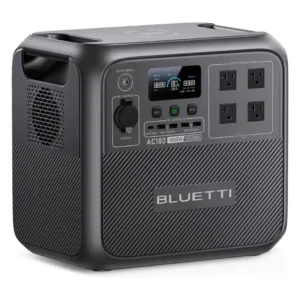
The Bluetti AC180 wraps 1,152 Wh of 3,500-cycle lithium iron phosphate around an 1,800 W inverter and crosses over in 8.7 milliseconds when the grid drops. Wall charging reaches 1,440W. It lands in the mid-range price tier while delivering exceptional value per watt-hour.
★★★★★
More details +
Every unit at this price is a set of compromises, and the AC180s are unusually easy to read: it spent its budget on cells and wall charging, and almost nothing on everything else. You get 990 Wh at the sockets from a 1,152 Wh pack, an 8.7-millisecond crossover that matches anything at this size, and mains charging at 1,440W that fills it within the hour. What you do not get is an inverter that arms itself, which makes that fast crossover conditional on somebody having switched it on; solar input above 500W, which is half the class standard; any expansion path at all; or fans quiet enough for a bedroom, at 54dB and 37 pounds. If capacity per dollar is genuinely the only thing you are optimizing for, it is a fair deal. If it is not, Bluetti's own Elite 100 V2 costs a tier less and beats it on four of the five things that go wrong later.
PROS:
- Nearly a thousand usable watt-hours, more than almost anything at this price.
- Crossover of 8.7 milliseconds, matching the fastest units in this class.
- Wall charging to 1,440W with stepped control fills it in under an hour.
- Cells rated for 3,500 cycles under a five-year warranty, with phone support included.
- Standby loss around 1.2% an hour, better than several pricier units.
- It sits in the exceptional value tier on capacity per dollar.
CONS:
- The inverter cannot arm itself, so a fast crossover protects nothing unless somebody switches it on.
- Solar input capped at 500W and 10 amps, roughly half what rivals accept.
- No expansion battery support, so the capacity you buy is your ceiling forever.
- The 2,400W surge ceiling is one-third below the class norm, limiting the simultaneous use of heavy loads.
- Thirty-seven pounds for 1,152Wh, heavy enough that stairs become a consideration.
- Bluetooth-only app and 54dB fans rule out remote monitoring and bedroom use.
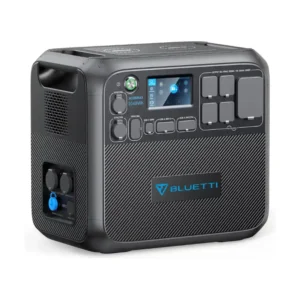
The Bluetti AC200Max has 2,048Wh of capacity, a 2,200W inverter, and delivers 1,840Wh at the outlets. Solar reaches 900W at up to 145 volts; the DC output is rated at 400W, and the cells carry a 3,500-cycle rating with four years of coverage.
★★★★★
More details +
Every other machine at this capacity reviewed on this site hands over to battery in some measurable time, anywhere from zero to twenty milliseconds. This one has no UPS mode fitted at all, so equipment plugged into it during a blackout simply loses power, a desktop restarts, a network drive shuts down uncleanly, a router drops. That is a missing function rather than a poor measurement, and in a category defined by backup, the specification decides everything. Underneath sits a decent battery: 1,840Wh returned from a 2,048Wh pack at 89%, standby drain of 0.6% an hour, so it holds its charge for months, a 145-volt solar ceiling that allows a proper series string, and a 400-watt DC output. The rest is dated. Wall charging is 470 watts via an external brick at a single fixed rate, over four hours from empty; connectivity is Bluetooth only, with no Wi-Fi; the warranty is four years rather than five; and per watt-hour, it lands in the luxury tier. Bluetti's own AC200L matches the capacity and conversion, adds a working switchover, and charges five times faster for a lower price tier.
PROS:
- Conversion of 89% at the outlets, stronger than most machines at this capacity.
- Standby drain of 0.6% an hour, so it holds a charge through months of storage.
- Solar to 145 volts, allowing a genuine series string of rigid panels.
- A 400W DC output, roughly three times a typical car socket.
- Cells rated to 3,500 cycles with pass-through charging and expansion support.
- Fifty-four decibels, quieter than several machines at this size.
CONS:
- No UPS is installed, so connected equipment loses power when the grid does.
- Wall charging of 470W through an external brick, with no adjustable rate.
- Luxury value tier, among the most expensive energy at two kilowatt-hours.
- Bluetooth-only connectivity, with no Wi-Fi for remote monitoring.
- Four-year warranty, a year short of the class standard.
- Sixty pounds, heavy for the capacity, with a 2,200W inverter below the class norm.
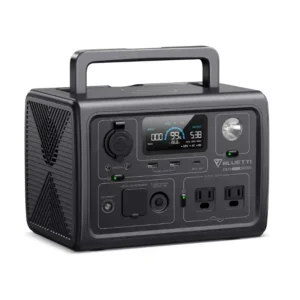
The Bluetti EB3A packs a 20ms transfer, a 600W inverter, and 430W internal charging into a 268Wh unit, with a Bluetooth app and 49dB operation. It sheds 5% of its charge every hour the inverter is armed.
★★★★★
More details +
Remarkable Specification, Worst Standby Drain Measured
Power stations at 268Wh normally charge devices quietly and do nothing else. This one carries a 600-watt inverter (more output than several units holding twice as much), a 20-millisecond transfer function that makes it the smallest machine in our database to offer one at all, 430 watts of internal charging that fills the pack in around thirty-seven minutes, adjustable charge rates, dual charging, a Bluetooth app that works off-grid, a correct 120-volt output and 49 decibels. For 10.1 pounds,s that is an extraordinary specification sheet. Then the standby figure: 5% of the charge disappears every hour the inverter sits armed (the worst idle loss recorded on any machine we have tested at any capacity), and it empties a full pack in roughly 20 hours of doing nothing. That cancels most of what the transfer function exists for, since waiting for a power cut is precisely what drains it. Charge it, use it, switch it off, and it is genuinely clever. PROS:
- A 20ms transfer, the smallest machine in our database to offer one at all.
- Internal charging at 430W with adjustable speed, filling the pack in under forty minutes.
- A 600W inverter on 268Wh, more output than several machines holding twice as much.
- A correct 120V output with no audible whine from the inverter, and 49dB fans.
- A Bluetooth app that works off-grid, plus dual charging and pass-through support.
- Ten point one pounds, a genuine one-handed carry, with solar that refills within the window.
CONS:
- Standby drain of 5% an hour, the worst figure recorded on any machine we have tested.
- Only 78% through AC, seven points below the class line.
- A 28-volt solar ceiling that excludes most rigid panels.
- Priced among the higher figures per watt-hour in our database.
- A 136W twelve-volt socket that falls just under the 150-watt threshold.
- Two thousand cycles under two years of cover, modest for the class.
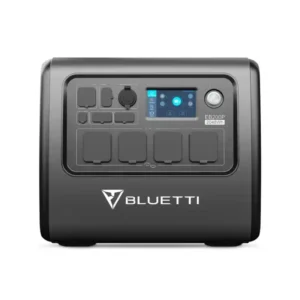
The Bluetti EB200P stores 2,048Wh behind a 2,200W inverter and returns 1,780Wh at the outlets. Solar reaches 900 W at up to 145 V, and the DC output is rated at 400 W, though there is no app and no expansion support.
★★★★★
More details +
Manufacturers routinely sell two machines built on the same hardware, one with features enabled and one without, and the gap is usually modest. Here it is not. The EB200P shares a pack, an inverter, and a solar input with Bluetti's AC200Max, and comes with no app at all, no expansion port, 3 points less AC conversion, 5 points less through DC, and more than 3 times the standby drain at 2% an hour. It inherits both of its siblings' worst traits too: a 470-watt external charging brick at a single fixed rate, over four hours from empty, and no automatic transfer function whatsoever — equipment plugged in during a blackout simply loses power. What survives intact is the solar input, and it is genuinely good: 900 watts accepted from 10 volts up to 145, which allows a proper series string of rigid panels while still working with foldables. As a battery charged by panels for planned trips, it does its job. For waiting, monitoring,g or growing a system, Bluetti's AC200L beats both of these machines and costs a tier less.
PROS:
- Solar to 145 volts at 900W, allowing a proper series string of rigid panels.
- A 400W DC output, roughly three times a typical car socket.
- Cells rated to 3,500 cycles with pass-through charging supported.
- A 10-volt solar floor, so foldable panels work alongside a rigid string.
- Conversion of 86% at the outlets, over the class line.
- Combined charging of 1,400W, marginally better than the AC200Max.
CONS:
- No UPS mode is fitted, so connected equipment loses power during a blackout.
- No app of any kind — no Bluetooth, no Wi-Fi, no firmware updates.
- No expansion battery support, so capacity is permanently fixed.
- Standby drain of 2% per hour, more than three times that of its sibling.
- Wall charging of 470W via an external brick at a single fixed rate.
- Sixty-one pounds and a four-year warranty, both behind current rivals.
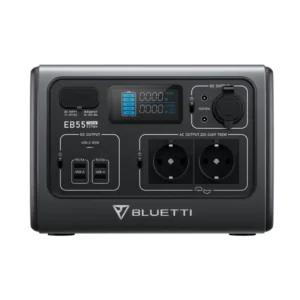
The Bluetti EB55 delivers 468Wh of its 537Wh rating, features a 700W inverter, runs at 48dB, and supports dual charging at 400W. Output measures 110 volts, charging runs through an external brick, and there is no app.
★★★★★
More details +
Judged on performance, this is a decent compact machine: 87% returned through the sockets and 89% through DC, both above the class line; 48 decibels, quiet enough to sleep beside in a tent; a 700-watt inverter that is generous for 537Wh; a 100-watt USB-C port; and dual charging at 400 watts combined, the highest figure of any compact unit we have measured. Judged on price, it sits among the most expensive machines per watt-hour we have reviewed, ahead of the flagship split-phase systems and the modular home installations several times its size. What that premium buys is an external 200-watt charging brick, no app of any kind, no transfer function, a 28-volt solar ceiling that excludes rigid panels, 2,000-cycle cells under two years of cover, and an output measuring 110 volts, below the accepted band and harder on any motor. The Pecron E600LFP offers greater capacity, converts four points more efficiently, outputs the correct voltage, delivers 1,500 more cycles, and takes nearly triple the solar, for considerably less per watt-hour.
PROS:
- Forty-eight decibels under load, quiet enough to sleep beside in a tent.
- Returns 87% through AC and 89% through DC, both above the class line.
- Dual charging at 400W combined, the highest of any compact machine we have tested.
- A 700W inverter, generous for 537Wh, with a 100W USB-C port.
- Solar that can refill the pack within the usual window, with the array permanently connectable.
- Bluetti's support network with a 24-hour response commitment.
CONS:
- The highest price per watt-hour of any machine in our entire database.
- Output measured 110 volts, below the accepted band and hard on motors.
- Wall charging of 200W through an external brick with no adjustable rate.
- A 28-volt solar ceiling that excludes most rigid panels.
- No UPS mode, no app, and no expansion path.
- Two thousand cycles under two years of cover, and an audible inverter whine.
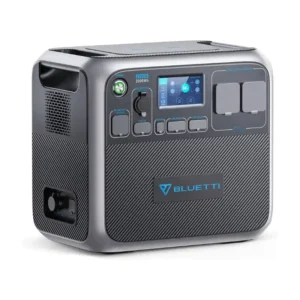
The Bluetti AC200P holds 2,000Wh behind a 2,000W inverter and returns 1,750Wh at the outlets. Solar reaches 700W at up to 150 volts, and the DC output is rated at 335 W, though there is no app, no expansion, and no transfer function.
★★★★★
More details +
This is the third machine from the same manufacturer in this database with no automatic transfer function at all, which stops being a quirk and becomes a generation: hardware built before switchover speed was something anyone competed on. Equipment plugged in during a blackout simply loses power. Beside that sit two more specifications from an earlier era, a USB-C port supplying 60 watts, half what nearly every rival provides and beaten by only one machine in this whole database, and 700 watts of solar, the lowest ceiling at this capacity, on an input that ignores anything below 35 volts. Wall charging is 470 watts via an external brick; there is no app of any kind, no expansion port, and the pack sheds 2% per hour while it waits. What survives is real: 88% conversion is above the class line, the 150-volt solar ceiling is among the best at this size, and a 335-watt DC output carries proper twelve-volt equipment. But Bluetti's own AC200L replaced this machine and beats it on every single line while costing a tier less.
PROS:
- Conversion of 88% at the outlets, above the class line and ahead of several newer machines.
- A 150-volt solar ceiling, among the highest at this capacity.
- A 335W DC output, roughly two and a half times a typical car socket.
- The inverter itself runs silently, with only the fans audible.
- Cells rated to 3,500 cycles with pass-through charging supported.
- Telephone support is behind the warranty.
CONS:
- No UPS mode is fitted, so connected equipment loses power during a blackout.
- A 60W USB-C port, half what nearly every rival provides.
- Solar wattage is capped at 700W, the lowest at this capacity, with a 35-volt floor.
- Standby drain of 2% an hour, enough to empty most of the pack in a fortnight.
- No app and no expansion support, so no monitoring and no growth.
- Wall charging at 470W via an external brick, with only three years of cover.

The Bluetti EB70 runs at 48dB, among the quietest machines in its class, and delivers 580 Wh of its 716 Wh rating via DC at 86% efficiency. Mains power arrives at 200W via a separate brick, with no handover function and no connectivity.
★★★★★
More details +
Quiet Enough for a Tent, and a Generation Behind Everywhere Else
Noise says more about a camping power station than most buyers expect, because a tent offers no sound insulation, and a power station two feet from your head is either tolerable or not. The EB70 reads 48 decibels under load, while its closest rivals at this capacity run at 60, and that 12-decibel gap is the whole reason to consider it. Two 100-watt USB-C ports are generous at this size too, and the DC path returns a solid 86%. Everything else belongs to an earlier generation: 200 watts of wall charging through an external brick, more than three and a half hours from empty; an output measuring 110 volts, below the accepted band and harder on motors; a 175-watt solar ceiling capped at 28 volts that excludes most rigid panels; 2,000 cycles under a two-year warranty; and no app or transfer function at all. The uncomfortable comparison is the Acevolt Campower 700, which is quieter still at 46 decibels, converts s7points better, outputs the correct voltage, and charges 2.5 times faster. PROS:
- Forty-eight decibels under load, quiet enough to sleep beside in a tent.
- Two 100W USB-C ports, where most rivals at this size fit one.
- Returns 86% through DC, clearing the class line on the twelve-volt path.
- A 132W DC socket and pass-through charging, with the array able to stay connected.
- Bluetti's support network, with a 24-hour response commitment, is behind the warranty.
- LiFePO4 chemistry rather than older NMC cells.
CONS:
- Wall charging at 200W with an external brick, from empty to full in over 3.5 hours.
- Output measured 110 volts, below the accepted band and hard on motors.
- Only 81% through AC, four points below where machines this size should land.
- A 175W solar ceiling capped at 28 volts, excluding most rigid panels.
- No UPS mode, no app, and no expansion path.
- Two thousand cycles under two years of cover, the shortest pairing at this capacity.