
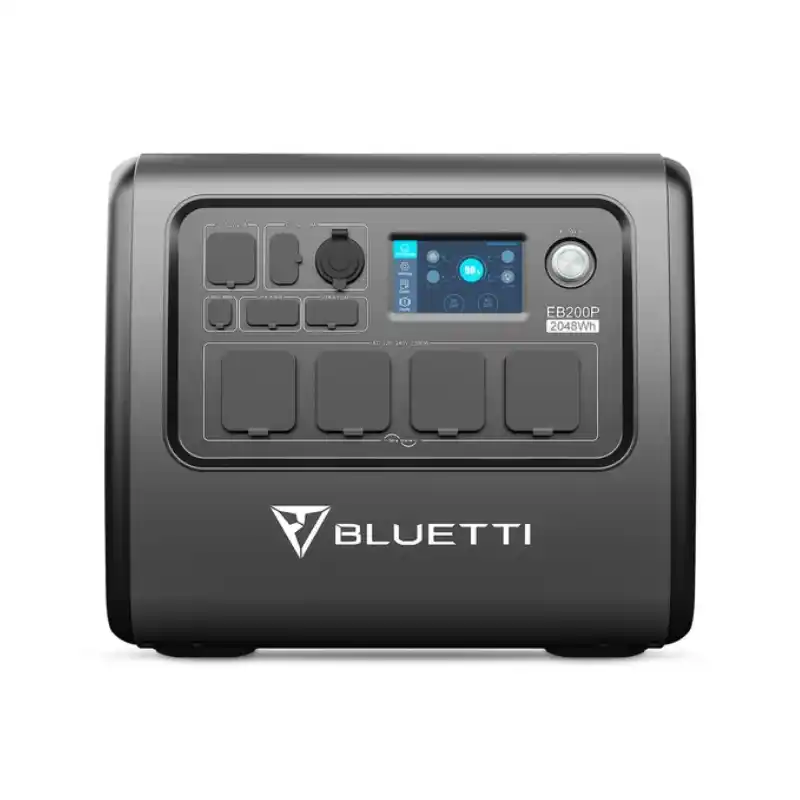
Bluetti EB200P Review

The Bluetti EB200P stores 2,048Wh behind a 2,200W inverter and returns 1,780Wh at the outlets. Solar reaches 900 W at up to 145 V, and the DC output is rated at 400 W, though there is no app and no expansion support.
My Quick Verdict
Set this beside Bluetti’s AC200Max and the family resemblance is total: identical capacity, identical inverter, identical solar input, a pound apart on the scale.
What the EB200P does is remove things. No app of any kind. No expansion battery support. Three points less conversion. More than three times the standby drain.
It keeps the AC200Max’s worst trait too: a 470-watt external charging brick and no automatic switchover function at all.
It costs less, and it gives up more than it saves.
Best for: Camping and off-grid storage, where the machine is charged from panels, and no monitoring is needed.
Not for: backup of any kind, remote monitoring, or anyone who might want more capacity later.
Key Stats
| Badge | Stats |
|---|---|
| Battery chemistry and longevity | LiFePO4 | 3,500 cycles |
| Continuous AC power output | 2,200W AC | 4,800W peak |
| Energy storage capacity | 2,048Wh | 1,780Wh usable |
| AC wall recharge | 470W via external brick |
| Emergency backup switchover | No UPS mode fitted |
| Maximum solar input and MPPT | 900W solar | 10–145V |
| High-output DC | 400W output |
| Smart app control | None fitted |
| Modular capacity expansion | Not supported |
| Low-noise operational level | 54dB | Audible under load |
Introduction
Manufacturers often sell two machines built around the same hardware, one with the features enabled and one without. The savings are usually modest, and the differences are usually small.
Here, the differences are not small. The EB200P shares a pack, an inverter, a solar input, and nearly a chassis with Bluetti’s AC200Max, and it arrives without an app, without an expansion port, and with 3ee points less of its own battery.
It also inherits the two things that most limit its sibling: a 470-watt external charging brick and the lack of an automatic transfer function.
The chemistry is lithium iron phosphate, 3with 500 cycles claimed, and a 4-year warranty
What It Can Actually Run
2,200 watts sustained, with 4,800 in a burst. Enough to carry a heater, or a fridge with lights running alongside.
Rated at 2,048 Wh, the sockets returned 1,780 Wh (86%), which clears the class line without distinction. Everything below uses 1,780Wh.
- Refrigerator drawing 150W: close to twelve hours.
- CPAP at 40W without humidification: forty-four and a half hours.
- Starlink dish at 50W: thirty-five hours.
- Laptop at 70W: about twenty-five charges.
The line read 120 volts, the inverter itself was logged as silent, and electrical noise came in at 1,695 mV, nothing remarkable in either direction.
Charging and Smart Features
Wall input is 470 watts through an external charging brick, with no adjustable rate. From flat, that is over four hours.
The panel side accepts 900 watts across 10 to 145 volts at 15 amps, and it is the only input figure here worth praising.
There is no UPS mode, so nothing happens automatically when the grid fails.
Both inputs together reach 1,400 watts. Premium price tier, premium value tier.
Charging Speed Benchmarks
Recharging performance for the Bluetti EB200P compared with the 2,000Wh to 3,000Wh capacity class, using every one of the 26 units in our charging database rather than just the reviewed subset. Wall charging there runs to a 1,641W mean and solar to 1,123W. Ratings are relative to the bracket alone.
A 470W external brick against a 2,048Wh pack ties this machine for the lowest mains input in the class, less than a third of the 1,641W class average, and needs roughly 4.4 hours to reach full. Combined charging lifts the ceiling to 1,400W when panels are also feeding it, which is the only way to get a same-day recharge out of it. Set against a bracket topping out at 5,000W, this is a machine built before charging speed was something manufacturers competed on.
Solar is genuinely good and is how this unit is meant to be filled. 900W comes in below the 1,123W class mean yet still earns an Average rating, refilling the pack in around 2.3 hours, nearly twice as fast as the brick. The input runs from 10 volts to 145, one of the widest windows at this capacity, so a single foldable on a camp table and a roof-mounted series string both work without adapters or a second port.
Want a system that grows and charges quickly? The Bluetti AC300 + B300K takes 3,000W from mains and 2,400W from panels, roughly six times and nearly three times the EB200P respectively, filling a larger 2,764Wh stack in about 0.9 hours on AC. It also accepts up to four battery modules, where the EB200P has no expansion path at all, so capacity and charging headroom both stay open.
Real Capacity: What You Actually Get
Conversion sits below its own sibling on both paths, which is the clearest sign that these are not simply the same machine with a badge change.
The sockets delivered 1,780 Wh against a 2,048 Wh label. 86% trails the AC200Max by three points from the very same pack.
The twelve-volt route was weaker again at 1,615 Wh (78%), 8 points behind the AC side and among the lower DC figures at this capacity.
Standby is the bigger gap. This machine sheds about 2% per hour with the inverter on, compared to 0.6% on its sibling. Over a fortnight left armed, that is the difference between losing a fifth of the pack and losing most of it.
My takeaway: Reckon on 1,780 Wh, and remember it drains at 2% per hour. Fill this one close to the day you need it, not the season before.
Power Output and Surge: What It Can Turn On
The inverter is identical to the AC200Max and adequate for the capacity: 2,200 watts sustained, 4,800 in a burst, comfortably enough for household loads one at a time.
The 400-watt DC output is carried over too and remains the most useful port on the machine, enough to run a compressor fridge and a heater with the inverter bypassed.
With only 78% coming back through DC, treat that socket as a question of what fits rather than what saves energy.
Electrical noise of 1,695mv is unremarkable, and no harmonic distortion figure exists in the data.
Real Appliance Runtimes
1,780 Wh set out in hours, based on the loads applied to everything reviewed here.
| Appliance | Power Draw | Runtime | What That Means |
|---|---|---|---|
| Full-size refrigerator | 150W | About 11.9 hours | Most of a day of refrigeration before cycling extends it. |
| CPAP machine (no humidifier) | 40W | About 44.5 hours | Nearly two days of overnight use. |
| Starlink dish | 50W | About 35.6 hours | A day and a half of satellite time. |
| Pellet grill or smoker | 100W | About 17.8 hours | Seventeen hours of low and slow. |
| Laptop (70W) | 70W | About 25 recharges | Twenty-five, one after another. |
Read these alongside the standby figure rather than on their own. A pack losing 2% an hour is not delivering these numbers if it has been sitting armed for a week.
Recharging: Wall and Solar
From a wall outlet, a 2,048 Wh pack takes over 4 hours to charge from empty, and it charges via an external brick rather than a built-in charger.
There is no rate adjustment, so that is the only speed available.
Run both inputs, and the total reaches 1,400 watts, a hundred more than its sibling, and still short of what modern machines this size draw from a socket unaided.
As with the AC200Max, solar is not a supplement here. It is the practical way to fill the thing.
From Solar Panels
The solar input is inherited intact from the AC200Max, and it remains the best thing about either machine.
Nine hundred watts comes in over a 10 to 145-volt range at 15 amps, and 145 volts sits well above the 60-volt caps typical for this size.
Four or five rigid panels in series will work, keeping current low and cable losses down across a long run.
Because it operates from 10 volts, a folding panel works too, covering weekend use and fixed installations equally well.
Panels can remain connected around the clock while the machine supplies loads.
Blackout Backup: The Part I Care About Most
As with its sibling, this machine has no automatic transfer function.
The grading entry records the UPS mode as not applicable. Equipment plugged into AC outlets during a blackout loses power, just as it would from a wall socket.
This is worth being blunt about, because a 2,048Wh machine at a premium price tier is exactly the kind of thing people buy expecting blackout protection.
The 2% hourly standby drain compounds it. Even when used manually, this machine needs to be charged shortly before use rather than kept ready.
Why this matters to me: a lack of transfer function and a fast-draining pack together remove both halves of emergency readiness. This is equipment for a planned trip, not for an unplanned outage.
Noise and Living With It
Fifty-four decibels under load, the same as its sibling, and past the point where a room with a sleeper is comfortable.
Weight is 61 pounds (27.6 kilograms), heavy for a two-kilowatt-hour unit, with the lightest machines at this capacity weighing around 40 pounds
There is no app at all. No Bluetooth, no Wi-Fi, no remote monitoring, no firmware updates over the life of the product.
The warranty is four years, with telephone support, a year short of the class standard.
Where It Falls Short
Five limitations, and four of them are things its own sibling has.
1. No UPS Mode
No automatic transfer function of any kind. Connected equipment loses power when the grid does.
Every current machine at this capacity offers some measurable switchover. This offers none.
2. No App and No Expansion
There is no Bluetooth or Wi-Fi connectivity, so there is no remote monitoring, no charge-rate control from a phone, and no firmware updates.
There is also no expansion battery port, so 2,048 Wh is a hard limit. Its sibling has both.
3. 2% Standby Drain
More than three times what the AC200Max loses from an identical pack, and enough that a fortnight armed would empty most of the machine.
For a unit likely to be stored between trips, that is a meaningful operational difference.
4. Four Hundred and Seventy Watts Through a Brick
Over four hours from empty at a single fixed rate, delivered by an external charger.
This is inherited from the AC200Max and is no longer defensible here.
5. Weaker Conversion on Both Paths
86% through AC and 78% through DC, three and eight points behind its sibling,g respectively.
From the same rated pack, that is roughly sixty fewer usable watt-hours through the outlets and nearly ninety fewer through DC.
How It Compares
The essential comparison is its own sibling, with Bluetti’s newer machine at this capacity as the outside reference.
| Feature | Bluetti EB200P | Bluetti AC200Max | Bluetti AC200L |
|---|---|---|---|
| Price tier | Premium | Premium | Upper mid-range |
| Value tier | Premium | Luxury | Exceptional |
| Rated capacity | 2,048Wh | 2,048Wh | 2,048Wh |
| Usable through AC | 1,780Wh (86%) | 1,840Wh (89%) | 1,830Wh (89%) |
| Usable through DC | 1,615Wh (78%) | 1,703Wh (83%) | 1,697Wh (82%) |
| Idle drain per hour | 2% | 0.6% | 0.5% |
| UPS switchover | None fitted | None fitted | 13.8ms |
| Wall charging | 470W via brick | 470W via brick | 2,400W internal |
| App connectivity | None | Bluetooth only | Wi-Fi + Bluetooth |
| Expansion battery | No | Yes | Yes |
| Weight | 61 lbs | 60 lbs | 61 lbs |
Compared to the AC200Max, this machine saves money and gives up an app, an expansion port, three AC conversion points, five DC conversion points, and more than three times the standby retention. It gains a hundred watts of dual-charging headroom.
That is not a value trade. It is the same machine with capabilities removed, and the removals outweigh the savings.
Bluetti’s own AC200L is the machine that makes both of these look dated. Same capacity, 89% conversion, a working 13.8-millisecond switchover, 2,400 watts of internal charging, Wi-Fi, expansion support, and an exceptional value tier.
Who Should Buy It, and Who Should Skip It
Buy It If
- You want a large battery for planned trips and will charge it shortly beforehand.
- Your solar is a rigid series array that suits the 145-volt ceiling.
- Twelve-volt equipment is your main load, where the 400-watt DC port helps.
- You genuinely have no use for an app or an expansion path.
Skip It If
- Blackout protection is part of your reason for buying.
- The machine will sit charged for weeks between uses.
- You want remote monitoring or scalable capacity. AC200L is available at a lower price tier.
The Bottom Line
This is a stripped version of a machine that was already showing its age, and the strip went deeper than the price cut.
Losing the app and the expansion port would be a fair trade for real savings. Losing three points of conversion, five points on DC, and more than three times the standby retention on top is not.
The solar input remains genuinely good, and as a battery charged by panels for planned use,e it works. For anything that involves waiting, monitoring, or growing, Bluetti’s newer machine at this capacity does all three for less.


There are no reviews yet.