
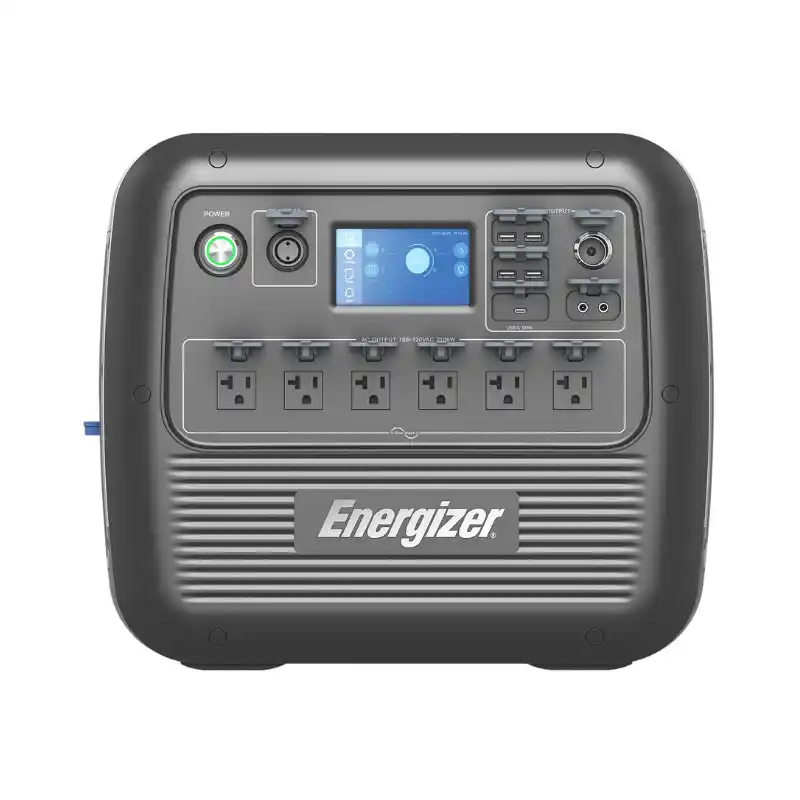
Energizer PPS2000W Review

The Energizer PPS2000W has a 2,150Wh capacity, a 2,100W inverter, and delivers 1,780Wh at the outlets. Wall charging runs through an external brick at 470W; there is no app or expansion support, and cells are rated for 2,000 cycles.
My Quick Verdict
Four hundred and seventy watts. That is what this machine accepts from a wall socket into a 2,150Wh pack. From empty, that is more than 4.5 hours.
No machine in this database refills so slowly relative to its capacity, and the power comes from an external brick rather than a built-in charger, another component that can be misplaced.
Around it sit the weakest set of numbers I have recorded at this capacity: 82% conversion, 76% through DC, a 2,000-cycle rating, no expansion path, and no app of any kind.
And it costs more per watt-hour than anything else at two kilowatt-hours.
Best for: Buyers who specifically want the Energizer name and will charge the machine overnight every time.
Not for almost anyone else in this capacity.
Key Stats
Introduction
Energizer is one of the most recognised names in batteries, and that recognition is doing a lot of work on the box this machine came in.
The specifications behind it do not support the reputation. Almost every figure here sits at or near the bottom of what I have measured at this capacity, and one of them is not close to anything else in the database.
That figure is charging. Four hundred and seventy watts from a wall socket, into a 2,150Wh pack, delivered through an external brick.
Chemistry is lithium iron phosphate with only 2,000 cycles claimed, the briefest life of anything this size.
What It Can Actually Run
2,100 watts held continuously, 4,200 in a burst. That is modest for the capacity, but sufficient for a heating appliance or a refrigerator with something alongside it.
Rated at 2,150 Wh, the outlets returned 1,780 W (82%), the weakest conversion at this capacity. All figures below use 1,780Wh.
- Refrigerator at 150W: nearly twelve hours.
- CPAP without humidification at 40W: forty-four and a half hours.
- Starlink dish at 50W: thirty-five hours.
- Laptop at 70W: around twenty-five charges.
Electrical noise measured at 1,671 mV, mid-field for this category. Harmonic distortion was not measured, and there is no switchover figure in the data either.
Charging and Smart Features
The wall input is the defining specification: 470 watts, arriving through an external charging brick rather than an internal charger.
The panel input handles 900 watts at 10 volts, up to 145 amps. That upper figure is the single specification on this machine that beats most of its rivals.
Running mains and solar together lifts the combined ceiling to 1,100 watts, which is still below what most machines at this capacity accept from the socket alone.
There is no app, no expansion port, and no switchover measurement in our data. Premium price tier, luxury value tier.
Charging Speed Benchmarks
Charging benchmarks for the Energizer PPS2000W set against the full 2,000Wh to 3,000Wh capacity class in our database, a set of 26 machines whose wall input averages 1,641W and whose solar averages 1,123W. Each band is a within-class tercile, so these ratings measure the unit against its own size peers.
This is the weakest charging-to-capacity ratio in the class. 470W through an external brick into the largest pack of the slow group, 2,150Wh, works out at about 4.6 hours from empty, longer than any other machine in this bracket, and it is barely a quarter of the 1,641W class average. There is no rate adjustment and no internal charger, so that figure is fixed. Rivals at the same capacity fill in a little over an hour, and the fastest in the bracket manages 5,000W.
Panels are the redeeming input. 900W is below the 1,123W class mean but holds an Average rating against a 2,400W ceiling, and it refills 2,150Wh in roughly 2.4 hours, half the time the brick takes. The 145-volt window is well above the class norm and suits a permanent series array, with a 10-volt floor that keeps small panels usable. If you intend to charge this machine from a fixed array and rarely touch a socket, the picture changes considerably.
Need a machine that recovers between outages? The Bluetti AC200L charges internally at 2,400W, more than five times the PPS2000W, and brings 2,048Wh back in about 0.9 hours against 4.6. Solar rises to 1,200W on a similar 145-volt window, so the array advantage carries over and the grid weakness disappears.
Real Capacity: What You Actually Get
Both delivery figures sit at the bottom of the range for this capacity.
The sockets produced 1,780 Wh against a claimed 2,150 Wh, or 82% of the claimed amount. That is the weakest AC conversion among machines at two kilowatt-hours.
DC came back worse still at 1,647 Wh, a 76% return, so moving loads to 12 volts buys you nothing here.
Armed and idle, it sheds roughly 2% per hour, brushing the limit of what I count as tolerable, and 0.5%atn twelve volts.
Put another way: a 91% converter with a comparable pack gives you about 180 watt-hours more to spend, which is about another hour of refrigeration.
My takeaway: Work from 1,780Wh; the least any machine this size returns. Pair that with 2% an hour on standby, charging it, then walking away is not a plan.
Power Output and Surge: What It Can Turn On
The inverter is the least remarkable part of an unremarkable machine, which is not quite a criticism.2,100 watts sustained handles a space heater or a refrigerator with lighting. 4,200 watts of surge power covers a compressor start without difficulty.
Both figures are below the 2,400W and 3,000W ratings common at this capacity, but neither poses a practical problem for ordinary household loads.
The ports are plain: one 100-watt USB-C output and no high-output DC socket documented. Electrical noise of 1,671mv is mid-field, and no distortion figure exists to check against.
Real Appliance Runtimes
11,780 W expressed as runtime, using the standard loads applied throughout.
These figures are respectable in isolation. The problem is not how long the machine runs, but how long afterwards it takes to be useful again.
Recharging: Wall and Solar
From a Wall Outlet
Four hundred and seventy watts into a 2,150Wh pack is the worst charging-to-capacity ratio anywhere in this database, and it means more than four and a half hours from empty.
For comparison, machines at this capacity routinely accept 1,800 watts and refill in a little over an hour. Several take 2,400 watts and manage it in under one hour.
It also arrives with an external charging brick rather than an internal charger. That is one more component to carry, one more to lose, and one more to fail outside the machine’s warranty.
Combining mains and solar lifts the ceiling to 1,100 watts, which helps considerably and is still below what most rivals draw from the socket alone.
From Solar Panels
This is the one area where the machine genuinely competes.
Nine hundred watts arrives across a 10 to 145 volt band at 15 amps. Reaching 145 puts it well beyond the 60-volt limit most machines of this size impose, and it allows a genuine string of four or five rigid panels.
Lower current for the same delivered power means a thinner cable and less loss over a long run, which is exactly what a permanent array wants.
The 10-volt floor also keeps small foldable panels usable.
Given how slow the socket is, solar is not optional here. It is the only sensible way to refill this machine in a reasonable time, and fortunately, the implementation is good.
Blackout Backup: The Part I Care About Most
There is no switchover measurement for this machine in our data, and no record of whether the inverter arms itself.
That is a significant gap on a machine sold at this capacity, since blackout backup is the primary reason most people buy one.
Standby drain operating at 2% an hour sits at the threshold I consider acceptable, and it means leaving the inverter armed for a fortnight would consume most of the pack, which this machine then needs 4.5 hours to replace.
Until a switchover figure exists, I would not rely on this unit to protect a computer or a network drive.
Why this matters to me: an unmeasured switchover on a machine that drains 2% an hour and refills at 470 watts is three problems compounding. Even if the transfer speed turns out to be good, the surrounding behaviour undermines it.
Noise and Living With It
No fan noise measurements are available in our data for this machine, leaving an important question unanswered. Noise decides which room a unit can occupy.
It reads 66 pounds, 29.9 kilograms; substantial for two kilowatt-hours, where the leanest machines this size sit near forty.
There is no app of any kind: not Bluetooth, not Wi-Fi. Every other machine at this capacity offers at least one, and several offer both.
That means no remote monitoring, no charge-rate adjustment from a phone, and no firmware updates over the life of the product.
Where It Falls Short
Five limitations, and they reinforce one another rather than sitting independently.
1. Four Hundred and Seventy Watts of Wall Charging
The worst charging-to-capacity ratio in this entire database is more than 4.5 hours from empty to full.
It also arrives via an external brick rather than an internal charger, adding a component to carry, lose, or replace.
Two hours between the forecast and the weather is not enough time to fill this one.
2. No App, and No Expansion
There is no Bluetooth or Wi-Fi connectivity at all, so no remote monitoring, no rate control from a phone, and no firmware updates ever.
Nor will it take a battery module, which fixes the capacity at 2,150 Wh for good.
3. Two Thousand Cycles
The shortest cell life at this capacity, where rivals now routinely offer 3,500 or 4,000.
At one cycle a day, that is roughly five and a half years to the 80% mark, compared to eleven for the best machines here.
4. It Returns Less of the Pack Than Anything Its Size
82% through the outlets and 76% through DC. A rival returning 91% from a similar pack hands you roughly 180 watt-hours more.
Standby drain of 2% per hour compounds, since the pack empties itself faster than most while waiting.
5. Luxury Value Tier
Per watt-hour, this is the most expensive machine in our data, at 20 kilowatt-hours.
Paying the most and getting the least back, with the slowest recharge and no app, is a difficult combination to justify on any grounds other than brand familiarity.
How It Compares
Two machines at the same capacity make the comparison clear, and both cost less.
Both rivals cost less per watt-hour, convert better, charge from the wall roughly four times as fast, offer twice the cycle rating, include an app, and accept an expansion battery. Both weigh substantially less.
There is no specification on which this machine leads between them except for the solar voltage ceiling, where its 145-volt input genuinely beats both.
That is a real advantage for someone building a permanent series array. It is not enough to offset everything else, and two machines further down the price scale do the same job better in every other respect.
Who Should Buy It, and Who Should Skip It
Buy It If
- You specifically want the Energizer name and are comfortable with everything below.
- The machine will be refilled by a permanent solar array rather than a wall socket.
- You are building a series string, and the 145-volt input is suitable for it.
- Overnight charging is your normal routine,e and speed never matters.
Skip It If
- You need to fill the machine quickly when the weather is coming.
- Remote monitoring or firmware updates matter to you.
- You want the most usable energy per pound spent, where two rivals beat it comfortably.
- Long cell life matters, where rivals offer twice the cycles.
The Bottom Line
This is the lowest score I have given a machine on this site, and it is not because anything about it is dangerous or broken. It works. Imply beaten on nearly every measurable specification by machines that cost less.
The 470-watt charger is the defining flaw, and the external brick that powers it makes the system fragile as well. Four and a half hours from empty is not a limitation you work around; it is one you plan your life around.
The 145-volt solar input is genuinely good and deserves credit. If you are running a permanent array and never touch a wall socket, that softens the picture considerably. On any other basis, two machines at this capacity do more for less.


There are no reviews yet.