
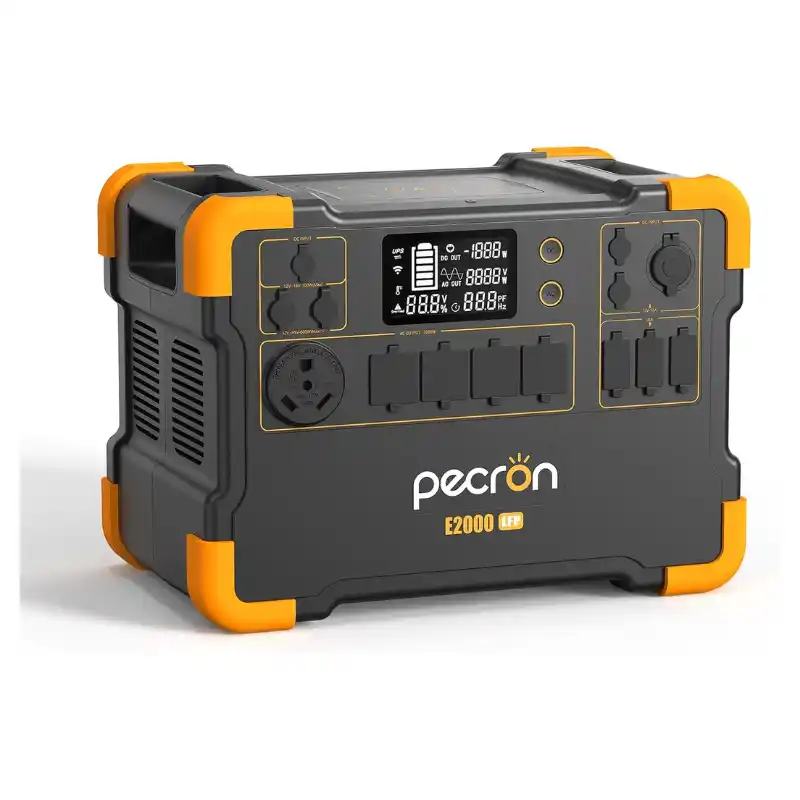
Pecron E2000 LFP Review

The Pecron E2000 LFP returns 1,830Wh of its 1,920Wh rating through the outlets and 1,838Wh through DC, both 95%, the only machine we have measured to reach that on both paths. It runs a 2,000W inverter and accepts 1,200W of solar.
My Quick Verdict
Of the power stations measured at this site, exactly one returns 95% of its rated capacity through both the AC outlets and the 12-volt side. This is it.
That is remarkable. Most machines lose between 10% and 18% of stored energy when converting it into usable energy, and a handful of the best reach 91% or 92% efficiency on a single path.
Then you check the output voltage. One hundred and ten volts, against a working band of 117 to 123. It is the second machine in this database to fall outside it.
Undervoltage causes motors to draw more current and run hotter, leading to damage you discover months later rather than that night.
Best for: Heating loads and off-grid storage in setups where no motor relies on it.
Not for: refrigerators, pumps, any kind of backup, or anyone who wants an app.
Introduction
Conversion loss is the tax nobody itemises. A machine rated at 1,920 Wh that returns 84% has quietly kept 307 Wh you paid for and will never use.
This one keeps almost none of it. 95% survives the trip to the outlets, and 95% survives the trip to the 12-volt socket. No other machine in this database reaches that figure on both paths.
It is also light for its 48-pound capacity, and its inverter runs unusually clean at 786 mV of electrical noise.
Its pack claims 3,500 lithium iron phosphate cycles. Pecron will stand behind them for two years, the briefest cover for anything this size.
What It Can Actually Run
2,000 watts sustained, with 4,000 in a burst, sufficient for a heating appliance or a refrigerator with lighting.
Rated at 1,920 Wh, the sockets returned 1,830 Wh. Every calculation below rests on that figure.
- Refrigerator at 150W: better than twelve hours.
- CPAP without humidification at 40W: forty-five hours.
- Starlink dish at 50W: 36.5 hours.
- Laptop at 70W: about twenty-six charges.
Output measured 110 volts, which is the specification this review turns on, and the grading entry separately records audible noise on the inverter.
Charging and Smart Features
The wall input is 520 watts through an external charging brick. From empty, that is close to four hours.
Panels do better. Two channels take 600 watts apiece, each spanning 32 to 95 volts, for a total of 1,200 watts.
Nothing here reacts on its own when the mains drop, and there is no phone connectivity to tell you it happened.
Both inputs together reach 1,200 watts. Premium price tier, premium value tier.
Charging Speed Benchmarks
Recharging performance for the Pecron E2000 LFP across the 1,000Wh to 1,999Wh capacity class, covering the 30 machines we hold data on. Wall charging in that group averages 1,085W and solar averages 641W. The three bands are terciles inside the class, so they compare this unit only with machines of similar capacity.
This machine reverses the usual pattern. Mains charging of 520W is less than half the 1,085W class average and a firm Low rating, so refilling its 1,920Wh pack from a socket takes roughly 3.7 hours, one of the longest waits in a bracket where the leader manages 2,400W and finishes in well under an hour. If a wall socket is your primary source, this is a machine that will keep you waiting.
Panels are where it belongs. 1,200W is nearly double the 641W class average, a clear High rating, and close to the 1,400W ceiling for this class. The array fills the whole 1,920Wh pack in about 1.6 hours, less than half the time the mains charger needs, which is a reversal only a handful of machines anywhere in our data show. Buy this one to live beside a proper array and the slow socket becomes a footnote rather than a flaw.
Need the grid side to keep pace with the panels? The Pecron E1500LFP charges at 1,400W from a socket, closer to three times this machine, and still takes 800W of solar to a 95-volt ceiling. A 1,536Wh pack comes back in about 1.1 hours on AC or 1.9 hours on panels, so neither channel leaves you stranded and the entry price tier stays intact.
Real Capacity: What You Actually Get
This section is the reason to look at the machine at all.
The sockets delivered 1,830 Wh against a 1,920 Wh label. 95% equals the best AC figure anywhere on this site.
The 12-volt route returned 1,838 Wh, which is also 95%. Two other machines return more through DC alone, and none returns 95% on both paths.
Put plainly: the label says 1,920 Wh,h, and you got 1,830 of them. Ordinary machines this size leave you nearer 1,700.
Retention is good as well; 0.6% each hour armed, a tenth of that on twelve volts.
My takeaway: 1,830 Wh from a 1,920 Wh pack is the best return in this database. What you cannot do is feed it to anything that requires a low supply voltage.
Power Output and Surge: What It Can Turn On
The inverter ratings are ordinary and adequate. Two thousand watts sustained covers ordinary household loads one at a time, and 4,000 watts of surge handles a compressor start.
The voltage at which those watts arrive is not ordinary. One hundred and ten volts sits seven volts below the bottom of the accepted 117-123 band.
Resistive loads (heaters, kettles, incandescent lighting, anything that simply turns electricity into heat) run at slightly reduced power and are unharmed. Electronics on switching supplies also cope because they accept a wide input range.
Motors are the problem. A compressor rated for 120 volts draws more current at 110 to do the same work, and that extra current dissipates as heat in the windings. The damage is cumulative rather than immediate.
One output measurement is excellent and sits strangely beside the rest: electrical noise at 786 mV, among the tidiest in this data.
Real Appliance Runtimes
1,830 Wh converted into hours, with the loads applied uniformly across this site.
Sort that table into two groups. Switching supplies shrug at 110 volts. Anything with a compressor inside is expected to operate at its design voltage.
Recharging: Wall and Solar
From a Wall Outlet
At 520 W into a 1,920 Wh pack, it takes close to 4 hours to charge from flat, and it charges via an external brick rather than a built-in charger.
That is a component to be carried, misplaced, or replaced separately from the machine, and it is a design most manufacturers moved away from some years ago.
Running both inputs together also caps at 1,200 watts, which is less than half what current machines at this capacity take from the socket alone.
From Solar Panels
Given how slow the socket is, panels are the sensible way to fill this machine, and the implementation is decent.
Six hundred watts per channel across a 32 to 95 volt span, twelve hundred all told. Ninety-five volts at the top means three or four rigid panels can share a single string.
The 32-volt floor is the catch. A single small foldable panel producing under 32 volts will not engage the input at all, so casual solar charging needs at least two panels in series.
Each channel tracks separately, so a bank in shadow will not drag a bank in the sun down with it.
The array can remain bolted on permanently, with output continuing throughout.
Blackout Backup: The Part I Care About Most
There is no automatic transfer function on this machine.
Its grading row indicates that the UPS mode is not applicable. Whatever is plugged into the sockets goes dark the moment the mains do, precisely as it would on a household circuit.
That is the third machine reviewed on this site with no switchover function at all, and the same conclusion applies: this is a battery, not a backup system.
The 0.6% hourly standby drain is genuinely good, so it will be full when you reach for it. It simply will not reach for itself.
Why this matters to me: the efficiency figures here are the best in the database, and none of them helps during a blackout. A machine that cannot transfer is one you plug things into afterwards.
Noise and Living With It
Fifty-eight decibels under load, among the louder readings recorded here and beyond what an occupied indoor room will tolerate.
The sheet logs the inverter as audible on its own account, so the fans are not the only thing you hear.
Weight is 48 pounds (21.7 kilograms), which is reasonably light for nearly two kilowatt-hours.
Nothing connects to the phone, neither Bluetooth nor Wi-Fi, so no remote viewing and no updates arriving. Cover runs for two years, with a number to ring.
Where It Falls Short
Four limitations, and the first is the one I would weigh most heavily over the efficiency figures.
1. Output Measured 110 Volts
Seven volts below the bottom of the accepted 117 to 123 volt band, and the second machine in this database to fall outside it.
Motors compensate for undervoltage by drawing more current, which raises winding temperature and shortens service life. Cycle a fridge on this often enough, and it will have had a harder life than one fed by a rival.
Resistive loads and switching supplies are unaffected, which prevents the machine from receiving a lower score than it already has.
2. No UPS Mode and No App
There is no automatic transfer function, so a blackout takes connected equipment down.
Wireless of any sort is absent too, which rules out checking on it from elsewhere, adjusting the charge rate remotely, or ever receiving an update.
3. A Two-Year Warranty and a 520-Watt Brick
Two years is the shortest coverage of anything at this capacity, where five is the class standard and several offer six or seven.
And 520 watts through an external charger takes close to four hours from empty, on a design most makers abandoned.
4. Fifty-Eight Decibels, With Audible Inverter Noise
It is loud enough to rule out every occupied indoor room, and the inverter itself is logged as audible in addition to the fans.
How It Compares
Two comparisons put it in context: the efficiency leader at a similar size and the best-value machine at this capacity.
The Anker SOLIX S2000 matches the 95% AC conversion, operates at the correct 119 volts, includes a self-arming inverter, charges three times faster, weighs 13 pounds less, and comes with a 5-year warranty at a lower price point.
There is no measure on which this machine leads, except DC conversion, and Anker’s DC path was never tested, rather than being worse.
The AFERIY P280 converts four points less and beats this machine on everything else, including a seven-year warranty against two.
Who Should Buy It, and Who Should Skip It
Buy It If
- Your loads are resistive or electronic, and nothing with a motor depends on it.
- You want the largest usable return from a rated pack recorded in this database.
- Solar is your recharge route, and you can wire two or more panels in series.
- It will live somewhere where the noise reaches no one.
Skip It If
- A refrigerator, freezer, or pump will run on it regularly.
- Blackout protection is part of your reason for buying.
- You want an app, a longer warranty, or faster charging.
- Anker’s S2000 is available and matches the efficiency at thethe correct voltage.
The Bottom Line
This machine records the best conversion figures in the entire database, and it does so on both output paths simultaneously, something nothing else here does.
Every other specification undercuts that achievement. A 110-volt output that sits outside the safe band, no transfer function, no app, a two-year warranty, and a 520-watt external brick.
For resistive loads charged from panels in an outbuilding, the efficiency is real, and the flaws mostly are not. Ask it to protect a fridge or a computer, and the one number it leads to stops mattering.


There are no reviews yet.