
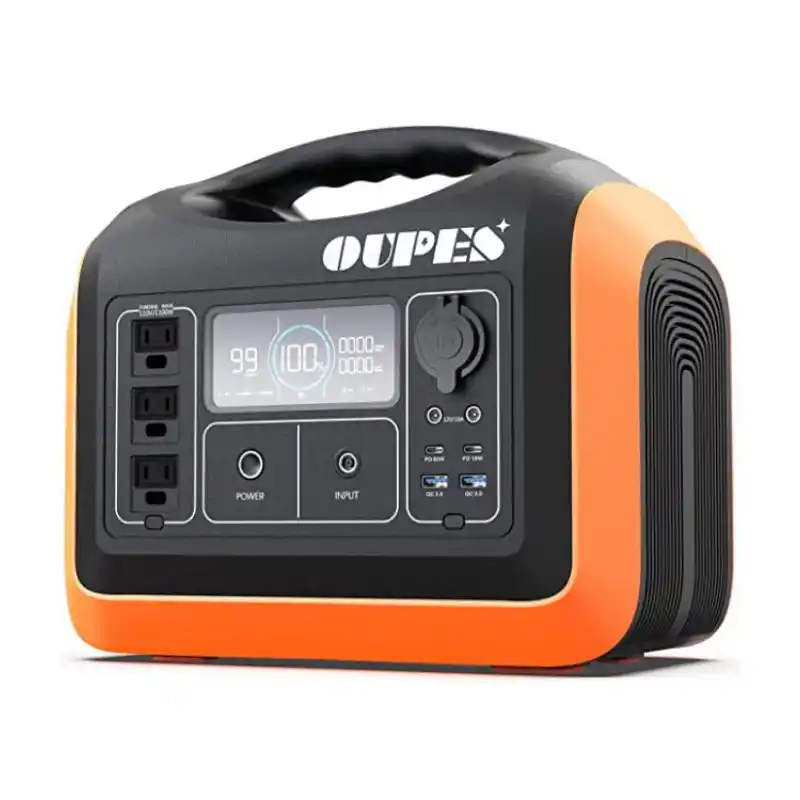
Oupes 1100 Review

The Oupes 1100 delivers 810 Wh of its 992 Wh rating through a 1,100 W inverter. Main power comes in at 180W via a separate brick; panels stop at 161W and 30 volts, and neither a handover function nor connectivity is fitted.
My Quick Verdict
Three machines from this manufacturer now sit in our database sharing the same set of gaps: no automatic transfer function, an external charging brick, no app, and a solar input capped around 30 volts.
The Oupes 1100 is the smallest of them and repeats every one. It charges at 180 watts and takes over 5 hours to charge from empty.
Its output measures 110 volts, below the accepted band, and its conversion is the weakest of the three, at 81.6% for AC and 80% for DC.
There is no single catastrophic failure here. There is a pattern that runs across the brand.
OUPES 1100W Portable Power Station has largely been phased out on major marketplaces such as Amazon.com and replaced by newer-generation models, including the OUPES Exodus 1200 and the OUPES Mega 1 Lite.
Best for: Planned camp and workshop use, where the machine is charged overnight, and nothing depends on it being ready.
Not for: backup, motors, rigid solar panels, or anyone charging between uses.
Key Stats
| Badge | Stat |
|---|---|
| Battery chemistry and longevity | LiFePO4 | 2,000 cycles |
| Continuous AC power output | 1,100W AC | 2,200W peak |
| Energy storage capacity | 992Wh | 810Wh usable |
| AC wall recharge | 180W via external brick |
| Emergency backup switchover | No UPS mode fitted |
| Maximum solar input and MPPT | 161W solar | 12–30V |
| USB-C power delivery | 60W only |
| Measured output voltage | 110V | Below the safe band |
| Smart app control | None fitted |
| Modular capacity expansion | Not supported |
Introduction
By the third machine from a manufacturer, patterns start to mean something. Two units sharing a flaw is a coincidence; three is a design philosophy.
Across the Oupes 600, 1100, and 1800, the same list repeats: no automatic transfer function, mains charging via an external brick, no app of any kind, and a solar input that cuts off around 30 volts.
This is the middle machine of that group, and it adds a 110-volt output and the weakest conversion figures of the three.
Cells are lithium iron phosphate, rated for 2,000 cycles under a two-year warranty.
What It Can Actually Run
Eleven hundred watts sustained with 2,200 in a burst. That runs a refrigerator with lighting and devices alongside, and stops short of any heating appliance.
Rated at 992 Wh, the sockets returned 810 Wh, 81.6% below the class line. Everything below uses 810Wh.
- Refrigerator at 150W: 5.5 hours.
- CPAP at 40W with the humidifier off: twenty hours.
- Starlink dish at 50W: sixteen hours.
- Laptop at 70W: about eleven charges, though slowly through a 60-watt port.
The output measured 110 volts, below the accepted working band. No electrical noise figure was recorded for this machine.
Charging and Smart Features
Wall input is 180 watts through an external charging brick at a single fixed rate. From empty, that is more than five hours.
Solar takes 161 watts across a 1- 30-volt window. That ceiling excludes most rigid panels entirely.
Dual charging is not supported, so mains and panels cannot run together.
There is no UPS mode and no app. Upper mid-range price tier, premium value tier.
Charging Speed Benchmarks
Recharge speeds for the Oupes 1100 compared with the full 300Wh to 999Wh capacity class, which holds 28 machines in our charging database at an average of 279W on mains and 192W on solar. Ratings are relative to this bracket alone rather than to every machine on the site.
This machine carries the largest pack in the class and close to the smallest charger for it. 180W through a separate brick is well under the 279W class average, and against 992Wh it works out at roughly 5.5 hours from empty, longer than any other unit we have covered at this capacity takes from a socket. The charge ratio makes the mismatch plain at 0.18 watts of input per watt-hour of storage, where the class leader runs closer to 1.2.
Panels reach 161W with a 30-volt ceiling, below the 192W class average and rating Average only by the compressed banding, against a 600W bracket high. A full solar refill takes about 6.2 hours, longer again than the socket. That 30-volt limit is the tighter constraint: it rules out wiring even two rigid panels in series, so the array is capped by voltage before the wattage ceiling ever comes into play.
Need a kilowatt-hour that refills in an hour? The EcoFlow River 2 Pro charges at 940W, more than five times the Oupes 1100, filling 768Wh in about 0.8 hours against 5.5. You give up around 220Wh of capacity for that, which is the honest trade, but a smaller pack you can refill over lunch is usually worth more than a larger one that needs most of a day.
Real Capacity: What You Actually Get
Both paths fall below the class line, which is unusual; most power stations we have reviewed are strong in at least one.
A meter, compared to pockets, recorded 810 Wh against a claimed 992 Wh. 81.6% means 182 watt-hours never reach you.
DC came back marginally lower at 794 Wh (80%), so there is no gain in moving loads there.
No standby loss was measured on either path, so its behaviour after months on a shelf is unknown.
By comparison, a 90% converter of the same size returns about 80 watt-hours more, or another half hour of refrigeration.
My takeaway: Build every calculation on 810Wh; with both routes this lossy, neither deserves preference. Budget five hours to replace it.
Power Output and Surge: What It Can Turn On
The inverter is 1,100 the capacity. 1,100 watts sustained runs a refrigerator, a television, and lighting together, and 2,200 watts of surge covers a compressor start with a comfortable 2x margin.
Doubling continuous output in a burst beats what many rivals of its size offer, and it is the best line on the sheet.
The voltage is the problem. One hundred and ten volts falls below the accepted band, so motors draw excess current, run hotter, and wear out faster over repeated cycles.
USB-C is another weak point: 60 watts, which is half of what most machines at this capacity provide, and too slow for any modern laptop.
No harmonic distortion or electrical noise figure exists for this machine, so output quality beyond voltage is unmeasured.
Real Appliance Runtimes
810Wh converted into hours, on the loads applied uniformly across this site.
| Appliance | Power Draw | Runtime | What That Means |
|---|---|---|---|
| Full-size refrigerator | 150W | About 5.4 hours | An evening covered, with 110 volts the longer-term concern. |
| CPAP machine (no humidifier) | 40W | About 20.3 hours | Twenty hours between charges. |
| Starlink dish | 50W | About 16.2 hours | Sixteen hours of satellite uptime. |
| Pellet grill or smoker | 100W | About 8.1 hours | Eight hours of smoking time. |
| Laptop (70W) | 70W | About 11 recharges | Eleven, none of them are quick at 60 watts. |
These figures are respectable for the capacity. The difficulty is that replacing them takes more than five hours, so this is a machine you charge the night before rather than between uses.
Recharging: Wall and Solar
From a Wall Outlet
Charging a 992 Wh pack at 180 W takes more than five hours from empty, which is among the slowest charging rates we have measured.
Power comes via a brick outside the machine, an extra object to transport and eventually replace, and misplacing it ends mains charging.
No rate control is offered, so slow is all there is.
Dual charging is not supported either, so panels cannot shorten the wait. Both routes are slow, and they cannot be combined.
From Solar Panels
The solar input is the most restrictive part of the machine, and this pattern repeats across the brand.
One hundred and sixty-one watts across a 12 to 30 volt window. Both the wattage and the ceiling are low.
Anything rigid usually runs at over 30 volts, and the input ignores it, confining you to foldables in parallel.
One hundred and sixty-one watts pushing 992 Wh occupies most of a bright day, and the sheet confirms that panels alone miss the standard refill window.
The array can stay permanently connected, and pass-through charging is supported.
Blackout Backup: The Part I Care About Most
There is no automatic transfer function on this machine.
The grading entry records the UPS mode as not applicable, so anything plugged into the outlets loses power the instant the grid does.
This is the third Oupes machine in our database with the same gap, alongside the Oupes 600 and the Oupes 1800. Across all three, the brand treats these as batteries rather than backup systems.
That is a legitimate design position for camping and off-grid storage. It is worth knowing before you buy that it offers blackout protection.
Why this matters to me: with nothing to catch a failure, a five-hour refill, and no way to run both inputs, this is hardware you must set up beforehand. It cannot be relied on to react to anything.
Noise and Living With It
Fifty-two decibels under load, which is fair for this capacity and sits at the upper edge of what a room with a sleeper will tolerate.
That is quieter than several machines at this size and one of the better figures on the sheet.
Twenty-four pounds, 10.8 kilograms; fair for a kilowatt-hour, and liftable with one arm across a campsite.
There is no app of any kind and no expansion port. The cover lasts two years, with a promise to answer within a day.
Where It Falls Short
Five limitations, and four of them appear on every Oupes machine we have tested.
1. One Hundred and Eighty Watts Through an External Brick
Five hours and more from flat, at one unchangeable rate, reliant on a part that can go astray.
Contemporary power stations take this from a raw 940 to 1,350 watts with a built-in charger and are fully charged in roughly an hour.
2. No UPS Mode
Nothing catches the load when mains drop, so whatever is plugged in stops.
Shared with both other Oupes machines in our database.
3. A 30-Volt Solar Ceiling at 161 Watts
Rigid panels typically exceed 30 volts and go unrecognised, so parallel foldables are the only route left.
Nor will 161 watts fill the pack inside the standard window, and there is no dual charging to assist.
4. Output Measured 110 Volts
Under the accepted band, motors pull harder and heat up across repeated starts.
Heaters, lighting, and switching supplies are unaffected.
5. A 60-Watt USB-C Port, No App, and 81.6% Conversion
At 60 watts, it delivers half of what this class typically does, and no laptop charges quickly on it.
Wireless is entirely absent, and neither output route meets the standard this class is held to.
How It Compares
Two comparisons: the strongest all-rounder at this capacity, and its own larger sibling.
| Feature | Oupes 1100 | Bluetti Elite 100 V2 | Oupes 1800 |
|---|---|---|---|
| Rated capacity | 992Wh | 1,024Wh | 1,488Wh |
| Usable through AC | 810Wh (81.6%) | 890Wh (86%) | 1,320Wh (88.7%) |
| Usable through DC | 794Wh (80%) | 879Wh (85%) | 1,211Wh (81.3%) |
| Continuous output | 1,100W | 1,800W | 1,800W |
| Wall charging | 180W via brick | 1,200W internal | 375W via brick |
| UPS switchover | None fitted | 8.7ms, self-arming | None fitted |
| Measured output voltage | 110V | 119V | 110V |
| Solar input | 161W, 12–30V | 1,000W, 12–60V | 415W, 12–30V |
| USB-C port | 60W | 100W | 60W |
| App connectivity | None | Wi-Fi + Bluetooth | None |
| Fan noise | 52dB | 51dB | 56dB |
Setting this beside its own larger sibling shows the pattern clearly. Both charge through bricks, both lack a transfer function, both output 110 volts, both cap solar at 30 volts, and both fit 60-watt USB-C ports. The larger machine converts better; nothing else changes.
The Bluetti Elite 100 V2, with almost identical capacity, charges nearly 7 times faster, hands over in 8.7 milliseconds while arming, outputs the correct voltage, accepts 6 times the solar input, and includes an app.
The gap is wide, and the better machine costs about the same. There is no configuration in which the Oupes 1100 is the better buy.
Who Should Buy It, and Who Should Skip It
Buy It If
- It is heavily discounted, and you understand what it cannot do.
- You fill it the night before whenever it is needed.
- Nothing with a motor relies on it; your loads are heating elements or electronics.
- Your existing panels fold out under 30 volts and fit the window.
Skip It If
- Blackout protection is one of your reasons for buying.
- You need it full in less than five hours.
- You own or plan to buy rigid solar panels.
- Something modern at this size sits within your budget, and it does.
The Bottom Line
The Oupes 1100 is not a broken machine. Its inverter is well-sized, its surge margin is comfortable, it runs at a reasonable 52 decibels, and it weighs 24 pounds.
What it repeats is the pattern across every Oupes unit we have tested: an external charging brick, no transfer function, no app, a solar ceiling around 30 volts, and an output below 120.
In this capacity, the alternatives are strong and widely available. Buy this one only at a substantial discount, for planned use, charged the night before.


There are no reviews yet.