
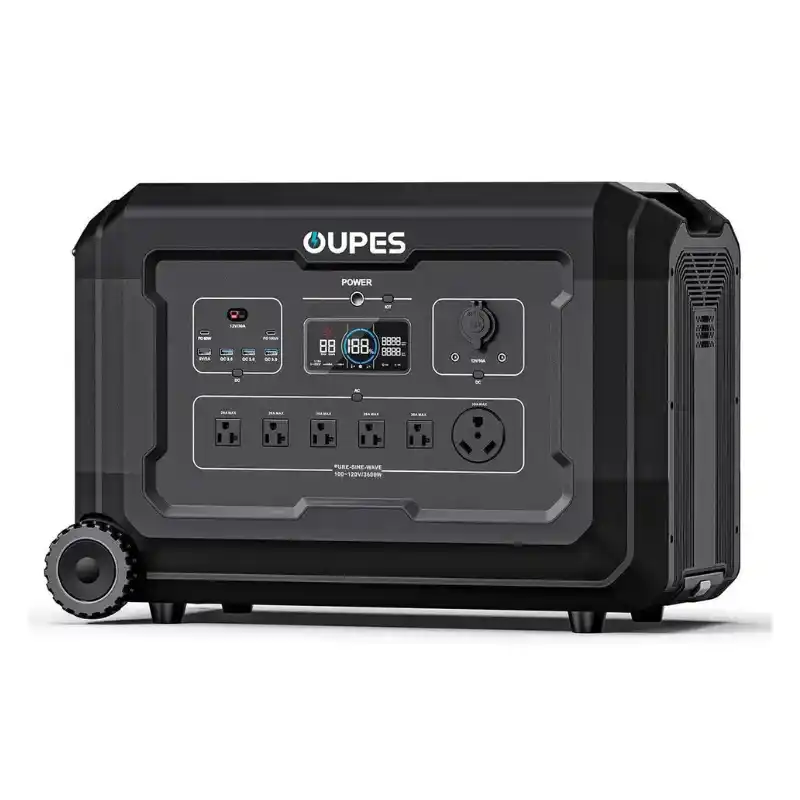
Oupes Mega 3 Review

The Oupes Mega 3 holds 3,072Wh behind a 3,600W inverter, delivers 2,620Wh at the outlets, and accepts 2,100W of solar to 150 volts. A six-year warranty backs 3,500-cycle cells, and it sits in the upper mid-range price tier at exceptional value.
My Quick Verdict
Twenty milliseconds is the line every backup machine has to stay under. It is the point beyond which connected equipment can no longer be relied on to ride through the gap when the grid fails.
Forty machines have now been measured for this site. This is the first to come in above it, at 20.1 milliseconds.
The margin is small, but the line is not arbitrary, and being on the wrong side of it changes what the machine can honestly be sold as.
That is a shame, because the value is genuinely good: exceptional cost per watt-hour, a six-year warranty, and 2,100 watts of solar at 150 volts.
Best for: Workshops and off-grid setups, treating it as storage rather than as protection.
Not for: protecting computers, network drives, or anything that cannot tolerate a gap in supply.
Key Stats
| Badge | Stat |
|---|---|
| Battery chemistry and longevity | LiFePO4 | 3,500 cycles |
| Warranty coverage | 6 years |
| Continuous AC power output | 3,600W AC | 6,000W peak |
| Energy storage capacity | 3,072Wh | 2,620Wh usable |
| AC wall recharge | 1,800W input | 3,900W dual |
| Emergency backup switchover | 20.1ms | Above the threshold |
| Maximum solar input and MPPT | 2,100W solar | 12–150V |
| Ultra-fast USB-C power delivery | 100W USB-C PD |
| High-output DC | 400W, app-controlled |
| Low-noise operational level | 61dB | Loud under load |
Introduction
Most specifications in this category are a matter of degree. A slower charger is inconvenient; a louder fan is unpleasant; a lower conversion rate costs you an hour of fridge time.
Switchover speed is different because there is an actual threshold. Below twenty milliseconds, connected equipment generally rides through the moment the grid drops. Above it, whether your computer survives becomes a question about your computer.
The Mega 3 measured 20.1 milliseconds. Of the forty machines put through this process, it stands alone on the wrong side of that mark. The pack claims 3,500 lithium iron phosphate cycles, and unusually, Oupes stands behind it for six years instead of the customary five.
What It Can Actually Run
3,600 watts continuous, 6,000 in a burst, on 120 volts. That covers a household’s essential circuits together without strain.
Rated at 3,072 Wh, the outlets returned 2,620 Wh (85%), sitting on the class line. Everything below is calculated from 2,620Wh.
- Refrigerator at 150W: 17.5 hours.
- CPAP at 40W, humidifier switched off during this period.
- Starlink dish at 50W: fifty-two hours.
- Laptop at 70W: around thirty-seven charges.
Distortion was never measured on this machine, and the electrical noise reading of 1,995mv puts it among the untidier outputs here. Both are worth confirming before running sensitive equipment.
Charging and Smart Features
The main input is limited to 1,800 watts, which, with a three-kilowatt-hour pack, yields close to two hours of runtime from empty. Running panels alongside lifts the combined ceiling to 3,900 watts, which is a genuine improvement.
Solar takes 2,100 watts between 12 and 150 volts at 15 amps, a wide window that suits both foldable and rigid series strings.
The switchover took 20.1 milliseconds, and the inverter will not shut down on its own.
A further restriction sits in the grading sheet: the array must be unhooked between sessions rather than left permanently wired. Upper mid-range price tier, exceptional value tier.
Charging Speed Benchmarks
Grid and panel recharge times for the Oupes Mega 3 across the Over 3,000Wh capacity class, using the 16 machines we hold charging figures for. Mean wall input there is 2,802W and mean solar input is 2,681W. Because the bands are internal to each class, they cannot be read across to a smaller bracket.
On its own the mains input is unremarkable. 1,800W is the minimum an Average rating allows in this bracket, well under the 2,802W class average, and refills 3,072Wh in roughly 1.7 hours. The number worth planning around is the combined one: mains and panels together reach 3,900W, more than double the wall socket alone, which is a much better ratio than several machines in this bracket that gain nothing from running both. The class runs to 6,000W at the top, so this is mid-field once solar is contributing.
Panels accept 2,100W across a wide 12 to 150 volt range, below the 2,681W class average and an Average rating where the ceiling is 6,400W, filling the pack in about 1.5 hours of strong light. That voltage span covers foldables and rigid series strings on one input, which is genuinely flexible. The limitation is procedural rather than electrical: the array cannot stay permanently connected, so a fixed roof installation is off the table and every session starts by wiring the panels back in.
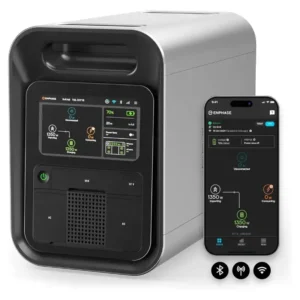
Need an array that can stay wired? The Anker SOLIX F3000 holds the same 3,072Wh, accepts 2,400W of solar through a 165-volt path that can remain connected around the clock, and charges from mains at 3,840W. Empty to full falls to roughly 0.8 hours on AC or 1.3 hours on panels, and it takes firmware updates, which this machine cannot.
Real Capacity: What You Actually Get
Delivery is unremarkable in both directions, and there is little to choose between the two paths.
The sockets delivered 2,620 Wh against a 3,072 Wh label. 85% gets over the bar and no further.
Twelve volts produced 2,526Wh; 82%, trailing by three points. On a unit fitted with a 400-watt DC socket, you would expect the reverse, yet the sockets are the better path here.
Retention is where it does well: about 0.9% goes each hour while armed, or 0.1% on twelve volts. Charged and left alone, it stays that way.
My takeaway: 2,620Wh through the sockets. The good news is the sub-one-percent standby, which means it will still be there when you need it. The bad news is what happens in the moment you do.
Power Output and Surge: What It Can Turn On
The inverter is properly sized for the capacity. 3,600 watts sustained handles refrigeration, heating, and lighting simultaneously, and 6,000 watts of surge handles any household motor starting up.
The 400-watt app-controlled DC port is a real asset, enough to carry a compressor fridge and a heater together without the inverter in the circuit.
What is missing is any measurement of output quality. No distortion figure exists in the bench data, and the electrical noise reading of 1,995mv is at the untidy end of this field.
For tools, heating, and lighting, that gap is immaterial. For a CPAP motor or a workstation, it is a second unanswered question stacked on top of the switchover reading.
Real Appliance Runtimes
What does 2,620 Wh equate to in hours, assuming the appliance set remains constant across this site?
| Appliance | Power Draw | Runtime | What That Means |
|---|---|---|---|
| Full-size refrigerator | 150W | About 17.5 hours | Seventeen hours on the fridge before the compressor cycles, extending it. |
| CPAP machine (no humidifier) | 40W | About 65.5 hours | Sixty-five hours between charges. |
| Starlink dish | 50W | About 52.4 hours | Fifty-two hours before the dish drops out. |
| Pellet grill or smoker | 100W | About 26.2 hours | A full day of smoking and then some. |
| Laptop (70W) | 70W | About 37 recharges | Thirty-seven, one after another. |
Perfectly respectable figures for the capacity. Nothing in this table is the reason to buy or avoid this machine; that decision sits in the switchover section below.
Recharging: Wall and Solar
From a Wall Outlet
Eighteen hundred watts into a 3,072Wh pack means the better part of two hours from flat, which is slow for the capacity.
The combined figure rescues it somewhat. Feed it from both at once, and the ceiling climbs to 3,900 watts, panels first; better than double the socket by itself, so bright weather shortens the wait considerably.
That does depend on the array being connected, which introduces its own complication on this machine.
From Solar Panels
The panel input is well-specified yet awkwardly restricted.
It draws 2,100 watts at 12 to 150 volts and 15 amps. That range covers everything from a single foldable panel to a series of four or five rigid panels, offering a genuinely flexible arrangement.
The restriction is that the grading data records panels cannot stay connected around the clock. Nearly every machine reviewed here permits a permanently wired array; this one expects the connection to be broken between sessions.
Occasional charging from portable panels is a minor nuisance. For a fixed roof or ground-mount installation, it is a structural problem because the whole point of a permanent array is that nobody has to touch it.
Blackout Backup: The Part I Care About Most
This section determines the score and needs to be stated plainly.
The measured switchover is 20.1 milliseconds. The conventional safety threshold in this category is 20, and across 40 machines measured at this site, every other machine has fallen below it.
The margin is a tenth of a millisecond, so this is not a catastrophic result. But a threshold that is only respected when the margin is comfortable is not a threshold, and at this speed, whether a desktop or a network drive survives the transition depends on the power supply inside it rather than on the machine you bought.
The inverter also will not arm itself, so even that 20.1 milliseconds only applies when somebody has switched it on beforehand.
Why this matters to me: buying a power station for blackout protection and getting the only machine here that misses the switchover threshold is the wrong outcome. For a fridge or lighting,g it makes no practical difference. For anything with a processor, choose something else.
Noise and Living With It
Sixty-one decibels under load is among the louder readings in this dataset and beyond what any occupied indoor room will tolerate.
A garage, workshop, or outbuilding absorbs it. A house does not, and it will be audible through a closed door.
On the scale, it reads 81 pounds, 36.7 kilograms; a job for two, and hefty compared to the leaner machines holding the same energy.
The app connects over Wi-Fi and Bluetooth, but the grading data records no firmware update capability. For a machine expected to last six years under warranty, being unable to receive fixes or improvements is a real limitation.
Where It Falls Short
Four things weigh against it, and the first is the one that defines the machine.
1. A Switchover of 20.1 Milliseconds
The only machine among forty measured for this site exceeded the twenty-millisecond threshold.
Whether connected equipment survives a transition at this speed depends on the equipment. Certain PC supplies carry through a long gap, while others drop, and the test happens for real.
Combined with an inverter that will not arm itself, this cannot honestly be recommended as backup for anything with a processor.
2. Panels Cannot Stay Connected
The grading data indicates that the array must be disconnected between charging sessions, whereas almost every other machine here allows you to leave it in place.
For a fixed installation that is a genuine structural limitation rather than an inconvenience.
3. No Firmware Updates
The app connects, but the machine cannot receive firmware updates. Over six years of warranty coverage means no bug fixes, no efficiency improvements, and no new features.
Every other machine at this capacity supports them.
4. Sixty-One Decibels, and No Distortion Measurement
Loud enough to exclude every occupied indoor room, and there is no harmonic distortion figure in the bench data to reassure anyone considering sensitive equipment.
How It Compares
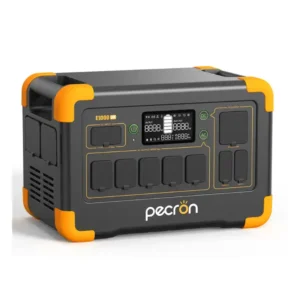
The natural comparisons are the Pecron F3000 and the Anker SOLIX F3000, both at identical capacity.
| Feature | Oupes Mega 3 | Pecron F3000 | Anker SOLIX F3000 |
|---|---|---|---|
| Price tier | Upper mid-range | Upper mid-range | Upper mid-range |
| Value tier | Exceptional | Exceptional | Exceptional |
| Rated capacity | 3,072Wh | 3,072Wh | 3,072Wh |
| Usable through AC | 2,620Wh (85%) | 2,750Wh (89%) | 2,760Wh (89%) |
| UPS switchover | 20.1ms | 8.6ms | 9.8ms |
| Solar connected 24/7 | No | Yes | Yes |
| Firmware updates | No | Yes | Yes |
| Warranty | 6 years | 5 years | 5 years |
| Solar input | 2,100W to 150V | 1,600W, 25V floor | 2,400W to 165V |
| Fan noise | 61dB | 56dB | 53dB |
| Weight | 81 lbs | 63 lbs | 91 lbs |
Both rivals convert four points better, switch over in less than half the time, allow a permanently connected array, and receive firmware updates. All three sit at the same price and value tier.
What the Oupes offers in return is an extra year of warranty and a wider solar voltage range than the Pecron. Neither is enough to offset the rest.
This is the clearest case in the dataset of a machine that is competitively priced and comprehensively out-specified by direct rivals at the same price. The value tier is honest; the machine behind it is not the one to buy.
Who Should Buy It, and Who Should Skip It
Buy It If
- The machine is a battery for tools and appliances rather than a backup system.
- You want the extra year of warranty and can live with the rest.
- It will run in a workshop or outbuilding where the noise does not reach anyone.
- Your solar is portable and gets packed away between uses anyway.
Skip It If
- A computer, server, or network drive is what you are protecting.
- You want a permanently wired solar array.
- Firmware support over the warranty period matters to you.
- Two direct rivals at the same price do more, which they do.
The Bottom Line
The pricing is honest, and the six-year warranty is genuinely better than the class standard. There is nothing dishonest about this machine.
But it is the only unit among the forty measured here that fails to meet the switchover threshold; it cannot keep an array connected, nor can it receive firmware updates. Those are three structural limitations that no amount of value offsets.
Two rivals at identical capacity and the same price tier convert better, switch twice as fast, and do neither of those things. Based on this evidence, there is no scenario where the Mega 3 is the right choice over them.


There are no reviews yet.