
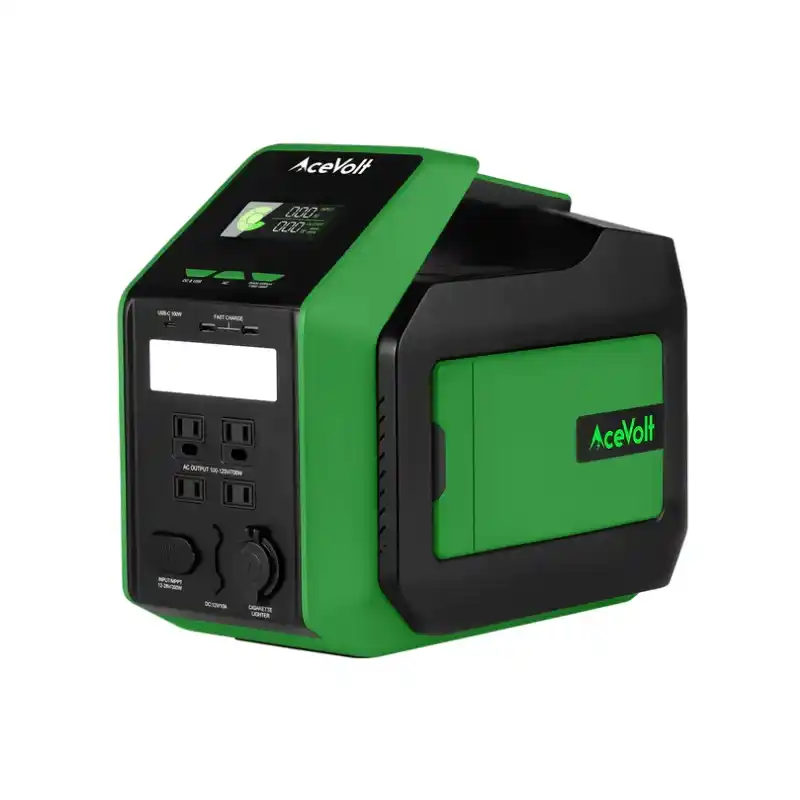
Acevolt Campower 700 Review

The Acevolt Campower 700 runs at 46dB, the quietest reading we have measured, and returns 89% through both AC and DC. Mains power arrives at 200W from a separate brick, with neither a handover function nor connectivity.
My Quick Verdict
Forty-six decibels is the lowest fan reading we have recorded on any machine at any capacity. Under canvas, no other line on the sheet counts for as much.
It converts well too, 89% through both output paths, which is unusual consistency and better than several machines costing twice as much.
Then the charging. Two hundred watts from a brick in the cable, one speed only, three and a half hours from flat.
It also has no transfer function, no app, and an output measuring 115 volts, inside the safe band, but at the bottom of it.
Best for: Tent and campsite work, filled the previous evening, with nothing to check remotely.
Not for: backup, fast recharging, rigid solar panels, or anyone who wants an app.
Key Stats
Introduction
Across every machine we have measured, at every capacity and from every brand, none runs quieter than this one under load.
Forty-six decibels is roughly the sound of a quiet refrigerator across a room. In a tent, where canvas absorbs nothing, and the machine sits an arm’s length away, that difference decides whether you sleep.
It also converts unusually evenly: 89% through the AC sockets and 89% through the twelve-volt output, so the choice of socket costs you nothing either way.
The pack claims 2,500 lithium iron phosphate cycles and comes with a two-year warranty.
What It Can Actually Run
Seven hundred watts sustained with 1,400 in a burst. Fridge, screen, lamps,s and chargers all fit inside that; nothing that makes heat does.
From a 672Wh label, the outlets yielded 600Wh, an 89% return well clear of the class bar. Everything below uses 600Wh.
- Refrigerator at 150W: four hours.
- CPAP at 40W with the humidifier off: fifteen hours.
- Starlink dish at 50W: twelve hours.
- A 45W twelve-volt camp fridge on DC: near thirteen and a half hours, at that same 89%.
Output measured 115 volts, within the accepted band but at the lower edge, with electrical noise above 2,000 mV and an audible whine from the inverter itself.
Charging and Smart Features
Wall input is 200 watts through an external charging brick at a single fixed rate. From empty, that is around 3.5 hours.
Panels contribute 175 watts at 12- 28 volts and 8 amps. That 28-volt ceiling excludes most rigid panels.
Dual charging is not supported, so mains and panels cannot run together.
There is no UPS mode and no app. Upper mid-range price tier, luxury value tier.
Charging Speed Benchmarks
Recharging performance for the Acevolt Campower 700 across the 300Wh to 999Wh capacity class, covering the 28 machines we hold data on. Wall charging in that group averages 279W and solar averages 192W. The three bands are terciles inside the class, not scores against the wider database.
Mains power arrives at 200W from a separate brick, under the 279W class average and resting on the line where Average becomes High. Against a 672Wh pack that works out at roughly 3.4 hours, one of the longer waits on this page, because the pack is generous for the class while the charger is not. There is no handover function either, so charging and covering an outage are separate activities rather than one.
Panels take 175W, a little under the 192W class average and an Average rating in a bracket reaching 600W, refilling the pack in about 3.8 hours of unbroken sun. Neither channel is meaningfully faster than the other, so there is no tactical choice between them, and the practical pattern is an overnight charge or a full day of sun rather than a top-up between uses. At 46dB this is the quietest machine we have measured, which is what it trades that speed for.
Same capacity, three times the charging speed. The VigorPool Captain 700 holds an identical 672Wh but charges internally at 600W with 240W of solar and dual charging supported, so a full refill takes around 1.1 hours against 3.4 here. It runs at 47dB, barely above the Campower, and adds an expansion battery option.
Real Capacity: What You Actually Get
Both paths return the same figure, which is unusual and makes planning straightforward.
A meter on the sockets measured 600 Wh, compared with a claimed 672 Wh. 89% clears the class line comfortably and beats several machines at twice the price.
The twelve-volt route returned 603Wh, also 89%. Neither route rewards you over the other, so plug things in wherever is convenient.
Standby is the one place the two diverge sharply. Armed, it gives up 2.4% per hour (past what I consider tolerable), while twelve volts registered nothing at all.
A week of waiting with the inverter live costs about two-fifths of the stored amount. Switch the inverter off between uses.
My takeaway: 600Wh either way, which is a genuinely good return. Just switch the inverter off when you are not using it; at 2.4% an hour, leaving it armed is expensive on a pack this size.
Power Output and Surge: What It Can Turn On
Seven hundred watts continuous suits the capacity. A refrigerator, a television, lighting, and devices all run; a kettle, a heater, or a hair dryer does not.
Fourteen hundred watts of surge covers a domestic compressor start with a reasonable margin.
The 145-watt, twelve-volt socket sits just under the 150-watt threshold and, paired with 89% efficiency, comfortably handles a camp fridge.
A single 100-watt USB-C port charges a laptop at full rate, which is better than the dual 60-watt arrangement some rivals use.
Output quality is the weaker half. The 115-volt reading passes, though barely; electrical noise exceeds 2,000 mV; and the inverter hums on its own account, which takes some shine off the headline figure.
Real Appliance Runtimes
600 Wh converted to hours: one figure serves both paths here, since they are identical.
The CPAP line is the reason to buy this machine. The duration is unremarkable for the size. Achieving it at 46 decibels beside your head is not, and nothing measured here is quieter.
Recharging: Wall and Solar
From a Wall Outlet
Charging a 672Wh pack at 200 watts takes around three and a half hours from empty, when using an external brick rather than a built-in charger.
The brick is one more thing to pack and eventually renew, and its absence ends mains charging entirely.
There is no adjustable rate, so slow is the only speed available.
For comparison, the VigorPool Captain 700 at identical capacity charges internally at 600 watts and fills in a little over an hour. Generations apart, not brands.
From Solar Panels
The panel input draws 175 watts at 12-28 volts and 8 amps.
All three figures are low. Twenty-eight volts is what constrains you, since rigid panels generally run higher and go unrecognised.
You are limited to low-voltage foldables wired in parallel, and at 175 watts the grading data records that a full solar recharge cannot be completed within the usual window.
The 12-volt floor does mean a single foldable panel works immediately, which suits casual camp charging.
The array can stay permanently connected, and pass-through charging is supported.
Blackout Backup: The Part I Care About Most
There is no automatic transfer function on this machine.
The grading entry records the UPS mode as not applicable, so anything plugged into the outlets loses power the instant the grid does.
At this capacity,y that is common rather than exceptional (most machines under 800Wh have none), but it is worth stating because buyers often assume otherwise.
Think of it as silent camp storage rather than protection, and nothing measured here does that job better.
Why this matters to me: no one hardwires 672Wh into a property, so the absent handover matters less than it would on a bigger unit. It does mean that the word “d back” should stay out of your reasoning.
Noise and Living With It
Forty-six decibels under load, which is the lowest fan reading recorded on any machine in our database.
Set against comparable EcoFlow units at 60 and 58 decibels, the difference is stark. Fourteen decibels is a very substantial difference in perceived loudness.
One qualification: the sheet logs a whine from the inverter alongside the fans, so even at gentle airflow, something is audible.
Twenty-two pounds, 9.97 kilograms, acceptable, though not lean, for what it stores. Nothing connects to a phone, and the cover lasts two years with a same-day response promise.
Where It Falls Short
Four limitations, and none of them touches the quiet that makes this machine worth considering.
1. Two Hundred Watts Through an External Brick
Three and a half hours or so from flat, unchangeable, and dependent on a part that can break or vanish.
Machines at identical capacity now charge internally at 600 watts and fill in a little over an hour.
2. No UPS Mode and No App
Nothing catches the load when mains fail; plugged-in gear stops.
Wireless of any sort is absent, ruling out remote checks and any future updates.
3. A 28-Volt Solar Ceiling at 175 Watts
Rigid panels typically exceed 28 volts and are ignored, leaving only parallel foldables.
One hundred and seventy-five watts will not fill the pack within the standard window, and no dual charging is available to assist.
4. 2.4% Standby Drain and an Audible Inverter Whine
After a week of use, the machine loses roughly 40% of its charge, which is a lot for a pack this size.
And the inverter produces its own noise in addition to the fans, which slightly undercuts the 46-decibel headline.
How It Compares
The essential comparison is a machine of identical capacity that is one decibel louder and better in almost every other way.
The VigorPool Captain 700 is the uncomfortable comparison. One decibel louder, it charges three times faster, supports dual charging, has a working transfer function, outputs a correct 120 volts, takes an expansion battery, and carries an app.
This machine delivers 5% more AC conversion and 500 more rated cycles. That is not enough to close the gap.
Against the Bluetti EB70, the Campower wins clearly: quieter, eight points better through AC, correct-band voltage, and 500 more cycles, for similar money.
Who Should Buy It, and Who Should Skip It
Buy It If
- Quiet is your single priority and the machine sleeps in the same space as you.
- You fill it the evening before, never between outings.
- You want even conversion on both output paths without thinking about it.
- Long cell life matters, where 2,500 cycles beat both rivals at this capacity.
Skip It If
- You need it full in under 3.5 hours.
- Your array is rigid panels, which the 28-volt limit shuts out.
- Connectivity, growth, or a working handover figure in your plans.
- The VigorPool Captain 700 is available and is nearly as quiet, with better performance elsewhere.
The Bottom Line
This machine holds one record, and it is a useful one. Forty-six decibels is the quietest reading we have taken, and for anyone sleeping beside a power station,n that matters more than any other number on the sheet.
It backs that with 89% conversion on both paths and 2,500-cycle cells, both genuinely good at this size.
What it asks in return is a 200-watt charging brick, no app, no transfer function, and a solar ceiling that excludes rigid panels. If quiet is the priority, it earns its place, though the VigorPool Captain 700 comes within one decibel and fixes almost everything else.


There are no reviews yet.