
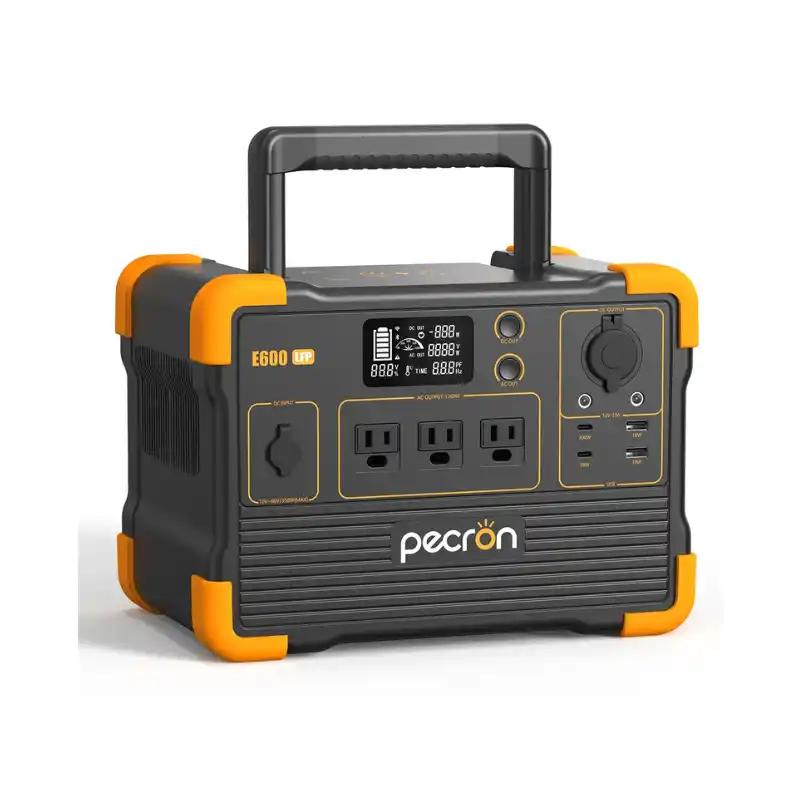
Pecron E600LFP Review

The Pecron E600LFP pairs a 1,200W inverter with 400W of solar input on a 614Wh pack, returns 91% through both output paths, and runs at 47dB with 3,500-cycle cells.
My Quick Verdict
Power stations with 614 Wh normally carry inverters rated between 500 and 700 W. This one carries a 1,200 W inverter, which is double the class norm and enough to run appliances no rival at this size can handle.
Its solar input is equally out of proportion: 400 watts across a 12- to 95-volt window, whereas machines this size typically manage 100 to 200 watts and cap out around 30 volts.
It converts at 91% on both output paths, runs at 47 decibels, and carries 3,500-cycle cells, the longest life of any machine under 700Wh we have tested.
What it lacks is everything to do with charging from the wall and knowing what it is doing: a 270-watt brick, no app, and no transfer function.
Best for: Camping and off-grid use, where solar handles charging and the loads exceed the capacity suggested.
Not for: backup, remote monitoring, or anyone charging primarily from a socket.
Key Stats
Introduction
Capacity and output are separate specifications, and this machine is the clearest illustration in our database of how far apart they can sit.
It has a 614 Wh capacity, which is modest. It delivers 1,200 watts continuously, which is double what machines at this capacity normally offer and more than several units holding twice as much.
The solar side is equally disproportionate. Four hundred watts across a 12- to 95-volt window, whereas rivals this size typically take 100 to 200 watts and stop around 30 volts.
The pack claims 3,500 lithium iron phosphate cycles, outlasting anything under 700Wh we have put through this process.
What It Can Actually Run
Twelve hundred watts sustained with 2,000 in a burst. That runs a refrigerator with lighting, a microwave, a coffee maker, or power tools, none of which its rivals at this size can manage.
Rated at 614 Wh, the sockets returned 560 Wh (91%), well above the class line. Everything below uses 560Wh.
- Refrigerator at 150W: three and three-quarter hours.
- CPAP at 40W with the humidifier off: fourteen hours.
- Starlink dish at 50W: eleven hours.
- Microwave at 1,000W: about half an hour of actual cooking time.
The line held 120 volts, and the noise measured 1,550 mV, although the sheet notes that the inverter hums audibly.
Charging and Smart Features
Wall input is 270 watts through an external charging brick at a single fixed rate. From empty, that is around two and a quarter hours.
Solar takes 400 watts between 12 and 95 volts, and the grading data records that panels alone can refill the pack within the usual window.
No dual charging is available, so the socket and panels never operate simultaneously.
There is no UPS mode and no app. Mid-range price tier, exceptional value tier.
Charging Speed Benchmarks
Panel and socket charging on the Pecron E600LFP, plotted against the 300Wh to 999Wh capacity class, a bracket of 28 machines averaging 279W of mains input and 192W of solar. Low, Average and High are worked out within this class, which is why a High rating here can sit at a wattage a larger machine would treat as trivial.
Mains charging of 270W sits almost exactly on the 279W class average and still clears the 200W threshold for a High rating, which tells you how compressed the bands are at this size. Filling 614Wh at that rate takes about 2.3 hours. Against a bracket where the quickest machine accepts 950W and finishes in under an hour, this is unremarkable, and it is the slower of this machine's two channels.
Panels are the reason to buy it. 400W is more than double the 192W class average, a firm High rating, and no other unit we have covered at this capacity accepts more from an array. The array fills the pack in roughly 1.5 hours, comfortably faster than the wall socket, which is a reversal only a handful of units anywhere in our data manage. Paired with 3,500-cycle cells, this is a machine built to be cycled daily from an array rather than parked on a charger.
Need the socket to be the quick option instead? The EcoFlow River 2 Pro charges from mains at 940W, three and a half times the E600LFP, and refills a larger 768Wh pack in about 0.8 hours. Solar halves to 220W and the cells are rated for far fewer cycles, so this makes sense only if grid recharging between short sessions is the pattern rather than daily solar.
Real Capacity: What You Actually Get
Both paths return the same strong figure, which simplifies planning.
A meter on the sockets recorded 560 Wh, compared with a claimed 614 Wh. 91% is among the better conversion figures we have recorded at any capacity, let alone this one.
The twelve-volt route returned 566Wh, also 91%. There is nothing to gain by favouring either socket.
Standby is the weaker half. Armed, it sheds 1.9% per hour (brushing my limit) compared to 0.5% on the twelve-volt side.
A week’s worth of live accounts for about a third of what is stored; kill the inverter between outings.
My takeaway: 560 Wh either way from a 614 Wh pack. That is an unusually honest return, and it means the small capacity goes further than the label suggests.
Power Output and Surge: What It Can Turn On
This is where the machine separates itself from everything else at its size.
Twelve hundred watts continuous is double the class norm and opens up a category of appliances its rivals cannot run. A microwave, a coffee maker, a circular saw, or a heat gun all work here.
The constraint becomes capacity rather than output. A 1,000-watt microwave runs for about half an hour before the pack is empty, which is fine for reheating but not for cooking a meal.
Household compressor startup falls well within the 2,000-watt burst limit.
Its 12-volt outlet delivers 161 watts, exceeding the 150-watt bar, and the USB-C port supplies a laptop with its full 100 watts.
Real Appliance Runtimes
560Wh converted into hours. One number serves both routes, since they are identical.
The microwave line is the whole point of this machine. No other unit we have tested at 614Wh could attempt it, and the limitation here is how long the pack lasts rather than whether the inverter holds.
Recharging: Wall and Solar
From a Wall Outlet
Two hundred and seventy watts through an external brick fills the pack in around two and a quarter hours.
Unhurried by any measure, but the pack is small enough to make it bearable, and the sheet still counts it as fast against a three-hour benchmark.
The brick is the more annoying part. A separate item to pack and shelve, and its absence ends mains charging entirely.
Neither rate control nor dual charging exists, so sunshine cannot speed things up.
From Solar Panels
The solar implementation is the second reason to consider this machine, and it is genuinely disproportionate to the capacity.
Four hundred watts across a 12 to 95 volt window. For comparison, machines at this capacity typically accept 100 to 200 watts and cap out around 28 to 30 volts.
Reaching 95 volts allows three or four rigid panels to share a string (rare at this size), while the 12-volt floor still accommodates foldables.
The grading data confirms that panels alone can refill the pack within the usual window, which follows from a 400-watt ceiling on a 614Wh pack.
Panels may live permanently attached with output continuing throughout. Given how leisurely the socket is, sunshine is plainly the intended supply.
Blackout Backup: The Part I Care About Most
There is no automatic transfer function on this machine.
Its grading row indicates that UPS mode is not applicable, meaning the sockets are dead when the mains are off.
At 614Wh, that is common rather than exceptional. Nobody wires a machine this size into a house, and most units under 800Wh have no transfer function at all.
The 1.9% hourly standby drain means it is not a machine to leave armed and waiting either. Charge it, switch the inverter off, and turn it on when needed.
Why this matters to me: the inverter here is large enough that some buyers will consider it backup equipment. It is not; there is nothing to catch a failure, and the pack drains while it waits.
Noise and Living With It
Forty-seven decibels under load, which is quiet by any standard and remarkable behind a 1,200-watt inverter.
Machines with inverters this size normally read 55 decibels or more. Only a handful of units anywhere in our database are quieter, and all of them carry smaller inverters.
One qualification: the sheet logs the inverter humming on its own account, so quiet airflow does not mean silence.
Weight is 20 pounds (9.1 kilograms), which is heavier than most machines at this capacity; the larger inverter accounts for this. There is no app, and the warranty runs for two years.
Where It Falls Short
Three limitations, and none of them touches what the machine can run.
1. A 270-Watt Charging Brick
Roughly two and a quarter hours from flat, unchangeable, via a part that lives outside the machine.
There is no dual charging either, so panels cannot help. For a machine this well suited to solar, the mains route is an afterthought.
2. No UPS Mode, No App, and a Two-Year Warranty
Nothing catches the load when mains fails; plugged-in gear stops.
No Bluetooth or Wi-Fi either, so nothing can be monitored or updated. And two years of coverage is short compared to cells rated for 3,500 cycles.
3. Twenty Pounds and 1.9% Standby Drain
Heavier than most machines at this capacity, because the 1,200-watt inverter and its cooling take up mass.
And, after a week of being armed, the pack loses roughly a third of its charge, so the inverter wants to switch off between uses.
How It Compares
Two comparisons at a similar capacity, both of which this machine outclasses on output and solar.
Against both rivals at this capacity, the E600LFP is a different class of machine. More than double the inverter, three to four times the solar input, correct 120-volt output, 1,500 more cycles, and eighteen points more AC conversion than the Bibene.
It costs three to five pounds, the same as the larger inverter.
All three charge through bricks, and none has a transfer function or an app. Within that shared limitation, the Pecron is comfortably the most capable and also the cheapest per watt-hour.
Who Should Buy It, and Who Should Skip It
Buy It If
- You need to run a microwave, coffee maker,r or power tool from a compact machine.
- Solar is your charging route, where 400 watts to 95 volts is far beyond the class norm.
- Long cell life matters: 3,500 cycles versus 2,000 for both rivals.
- Quiet operation matters, and you want it behind a large inverter.
Skip It If
- You charge primarily from a wall socket and want it done quickly.
- Backup or remote monitoring is any part of the plan.
- Weight is critical; both rivals are three to five pounds lighter.
- You need the machine to sit armed and ready for long periods.
The Bottom Line
This is the most capable compact machine we have tested, and the gap is not small. A 1,200-watt inverter and 400 watts of solar on a 614Wh pack are both roughly double what the class offers.
Add 91% conversion on both paths, 3,500-cycle cells, 47 decibels, and correct voltage, and the specification sheet reads like a machine that costs considerably more.
What it cannot do is charge quickly from a socket, tell you anything about itself, or catch a power cut. Feed it from panels, run heavy loads in short bursts, and it is exceptional value.


There are no reviews yet.