
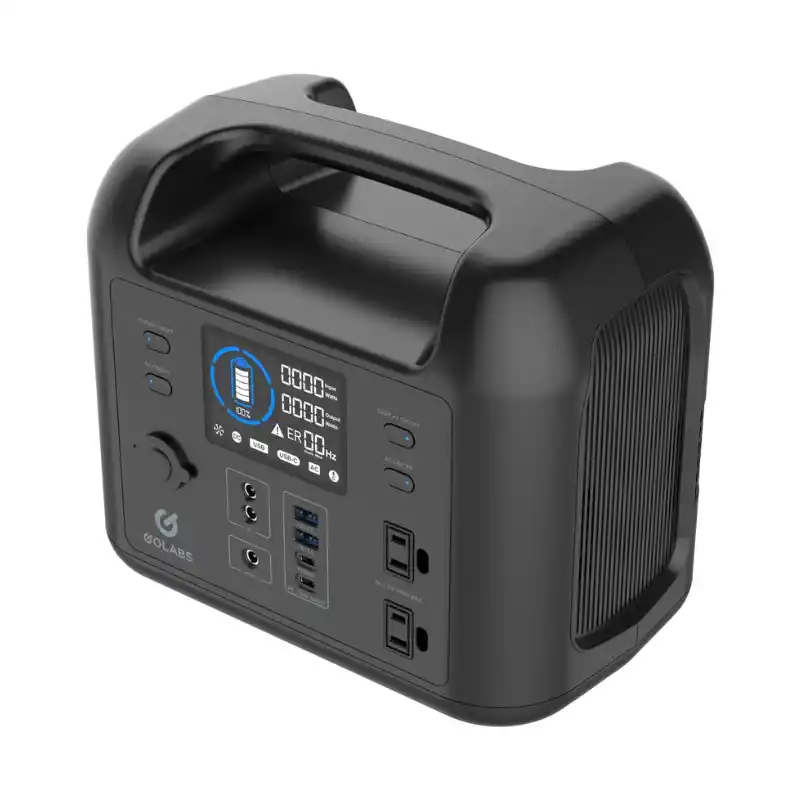
GoLabs R500 Review

The GoLabs R500 returns just 370 Wh of its 518 Wh rating via AC, the lowest conversion figure in our database. It charges at 86W via an external brick, and its solar input is capped at 23.5 V.
My Quick Verdict
Of all the power stations we have tested and reviewed, at every capacity and from every brand, none returns less of its rated power through the AC sockets than this one.
71% means 148 watt-hours of a 518Wh battery never reach you. Over a quarter of everything you put in is gone before you spend it.
Its twelve-volt path is better at 79%, though still below what most machines manage on their worst path.
It also charges at 86 watts via an external brick (six hours from empty), and its solar input is capped at 23.5 volts, among the narrowest ranges in our data.
Best for: Topping up phones and small devices, on hardware bought well below list.
Not for: almost any use where the amount of energy you receive matters.
Key Stats
Introduction
Conversion loss is the tax nobody itemises, and this machine charges the highest rate we have recorded.
71% of the rated pack reaches the AC sockets. Across every unit we have measured, none returns a lower value.
From a 518Wh cell stack, 148 watt-hours are bought and never spent, about what an entire small camping unit holds.
Cells are lithium iron phosphate rated at 2,000 cycles under a two-year warranty.
What It Can Actually Run
Five hundred watts sustained with 1,000 in a burst. Enough for a screen, lamps, a networking kit, and chargers; fridges and anything that generates heat are out.
Rated at 518 Wh, the sockets returned just 370 Wh (71%). AC figures below use 370 Wh; DC figures use 410 Wh.
- Television at 150W: two and a half hours.
- CPAP at 40W with the humidifier off: nine hours.
- Starlink dish at 50W: 7.5 hours.
- A 45W twelve-volt camp fridge on DC: roughly nine hours, drawing on 410Wh.
Output measured at 110 volts, below the accepted operating range. Electrical noise went unrecorded here.
Charging and Smart Features
Wall input is 86 W via an external charging brick at a single, fixed rate. From empty, that is around six hours.
Panels contribute 105 watts, with voltage ranging from 10.8 to 23 volts, and current at 5 amps. That ceiling is among the narrowest in our database, and the current limit is the lowest.
No dual charging exists, so socket and sun never work together.
There is no UPS mode and no app. Mid-range price tier, luxury value tier.
Charging Speed Benchmarks
Input speeds for the GoLabs R500 against the 300Wh to 999Wh capacity class, benchmarked across all 28 machines in our charging database. Mains charging there averages 279W and solar averages 192W, with each band calculated inside the bracket alone.
Wall charging of 86W through an external brick is under a third of the 279W class average and a clear Low rating, close to the 63W class minimum. Filling 518Wh at that rate takes roughly 6.0 hours. Read alongside the delivery figure, where this machine returns 370Wh of its 518Wh rating through AC, the useful capacity is small and the time to replace it is long, which is an awkward combination on a unit meant to be portable.
Panels manage 105W, just past the Low threshold for an Average rating but well under the 192W class average, refilling the pack in about 4.9 hours and beating the socket by more than an hour. The binding constraint is the 23.5-volt input cap rather than the wattage: most 100W rigid panels sit near that figure at open circuit on a cold bright morning, so the usable array is narrower than the 105W ceiling implies.
Want internal charging and a wider solar window? The VigorPool Captain 700 charges internally at 600W, seven times the R500, with 240W of solar and dual charging supported. A larger 672Wh pack refills in around 1.1 hours instead of six, it returns 93% through DC, and there is no brick to lose.
Real Capacity: What You Actually Get
This section defines the machine.
A meter on the sockets measured 370 Wh, compared with a claimed 518 Wh. 71% is the lowest AC conversion figure anywhere in our testing.
The twelve-volt route returned 410Wh, or 79%, eight points better. That is the path to use, though 79% would still rank as poor on most machines.
For context, the Pecron E600LFP returns 91% on both paths. From a comparable pack that is roughly 100 watt-hours more energy for the same charge.
Neither idle drain figure is recorded in our data, leaving storage behaviour unmeasured.
My takeaway: 370 Wh through the sockets from a 518 Wh pack. Treat the label as decorative and plan on the tested figure, which is the lowest proportion returned by any machine in our data.
Power Output and Surge: What It Can Turn On
Five hundred watts continuous is standard for this capacity and constrains the machine in familiar ways. Devices, lighting, and a television run; appliances with motors or heating elements do not.
A household fridge draws more than 1,000 watts when its compressor engages, so that is not work for this machine.
The voltage compounds it. One hundred and ten volts sits below the accepted band, so any motor draws extra current and runs hotter.
One outlet stands out: a bidirectional USB-C port rated at 100 watts, capable of charging a laptop at full speed and recharging the device from a compatible power supply.
Neither distortion nor noise was measured, so nothing beyond the voltage reading describes the power quality.
Real Appliance Runtimes
Main figures are based on 370 Wh; the DC line uses the higher 410 Wh.
Every line here is roughly a fifth shorter than the same 518Wh pack would give in a machine converting at 89%. That difference is not the battery; it is what happens between the cells and the socket.
Recharging: Wall and Solar
From a Wall Outlet
Charging 518 Wh at 86W takes around six hours from empty, which is among the slowest charging rates in our database.
Power comes from a brick on the cable (another item to pack and eventually replace), and losing it ends mains charging.
Neither rate control nor dual charging is fitted, so sunshine cannot help.
Both routes are slow, and they cannot be combined, which makes this a machine you fill the night before and nothing else.
From Solar Panels
The solar input is restrictive on all three counts.
Just 105 watts, spanning 10.8 to 23.5 volts, limited to 5 amps. That 5-amp current limit is the lowest we have recorded on any machine.
At 23.5 volts, practically no rigid panels register, leaving only compact low-voltage foldables.
The sheet notes that 105 watts will not finish a charge inside the standard window.
The array can stay permanently connected,ed and pass-through charging is supported, which are the two things this implementation allows.
Blackout Backup: The Part I Care About Most
There is no automatic transfer function on this machine.
The grading entry records the UPS mode as not applicable, so anything plugged into the outlets loses power the instant the grid does.
Ordinary at this size, where a handover is rare below 800Wh, and no particular failing of this unit.
It does confirm that this is device-charging equipment rather than backup equipment.
Why this matters to me: no one buys a 518Wh battery to ride out a power cut, so the missing handover barely registers. The conversion figure is where this machine actually loses.
Noise and Living With It
No fan noise measurements exist in our data for this machine, which is a genuine gap for a compact unit likely to be used in a tent.
Mass is where it wins: 14.3 pounds, 6.4 kilograms, lean for the capacity and easily carried one-handed.
No connectivity at all, so nothing can be checked, altered, or improved.
Two years of cover, with a promise to reply within a day.
Where It Falls Short
Four limitations, and the first is unmatched anywhere in our data.
1. 71% Through AC
The weakest AC conversion figure of any machine we have measured, at any capacity, from any brand.
One hundred and forty-eight watt-hours of a 518Wh pack never reach the sockets. That is more than a quarter of what you charged.
The 79% DC path is better and still below what most machines manage on their weaker route.
2. Eighty-Six Watts Through an External Brick
Six hours or so from flat, unchangeable, via a part that can go missing.
No dual charging exists to shorten it, so both routes are slow and neither helps the other.
3. A 23.5-Volt Solar Ceiling at 5 Amps
This is among the narrowest voltage windows in our database, and the lowest current limit we have recorded.
Rigid panels are effectively ruled out, and 105 watts leaves even foldables short of the standard window.
4. Output at 110 Volts, No App, No Fan Noise Data
Below the accepted band, which makes any motor work harder than it should.
Wireless is absent entirely, and fan noise went unmeasured, a meaningful blank on something this portable.
How It Compares
Two comparisons at a similar capacity, both of which return substantially more of their pack.
Both rivals return 14 to 16 more points of their pack through the AC sockets, which, at similar capacities, is worth roughly 90 to 100 watt-hours per charge.
Both also support dual charging, which this machine lacks, and the BigBlue delivers a correct 120 volts.
What the GoLabs offers is weight (nearly three pounds lighter than either) and a 100-watt bi-directional USB-C port. Neither compensates for giving up more than a quarter of the battery to conversion.
Who Should Buy It, and Who Should Skip It
Buy It If
- It is heavily discounted, and you accept receiving 71% of the label.
- Weight is your priority, and 14.3 pounds matters more than capacity.
- Your loads are USB and twelve-volt devices rather than AC appliances.
- You already own small low-voltage foldable panels.
Skip It If
- The amount of energy you actually receive matters, which for most buyers it does.
- You need it full in under six hours.
- You own rigid solar panels of any kind.
- No rival at this capacity is available, since both return far more of their pack.
The Bottom Line
This machine’s headline capacity and usable capacity are further apart than on any other machine we have tested. A 518Wh label delivers 370Wh at the sockets.
Everything else follows from an earlier, cheaper generation: an 86-watt charging brick, a 23.5-volt solar ceiling, no app, and 110-volt output.
It is light, and it has a good USB-C port. Those are the two honest arguments, and neither offsets giving up more than a quarter of the battery before you use any of it.


There are no reviews yet.