
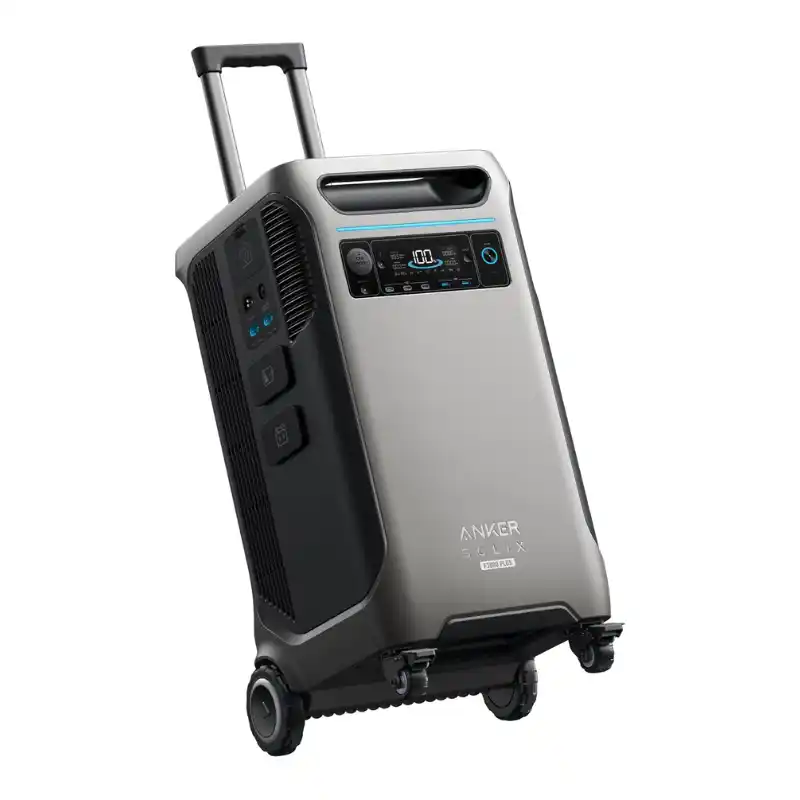
Anker SOLIX F3800 Plus Review

The Anker SOLIX F3800 Plus runs a 6,000W split-phase inverter producing 120V and 240V, delivers 3,270Wh of its 3,840Wh rating, and draws 6,000W from a wall socket. Solar reaches 3,200W across a 165-volt path, and the inverter arms itself.
My Quick Verdict
Anker sells this machine and a standard F3800 that looks nearly identical: same capacity, same 6,000-watt split-phase inverter, same cells, four pounds apart on the scale.
What the Plus adds is everything to do with getting energy in and keeping it useful. Wall charging ranges from 1,800 to 6,000 watts. Solar output ranges from 2,400 to 3,200 watts, and the voltage ceiling ranges from 60 to 165 volts. The inverter learns to arm itself. Pass-through charging appears. And the twelve-volt path gains five points of efficiency.
That is a substantial list, and it costs a value tier.
What neither version fixes is the mass. One hundred and thirty-six pounds, and a USB-C port that belongs on a machine a fifth of the price.
Best for: Whole-circuit home backup via a transfer switch and large, permanent solar installations.
Not for: anything portable, or buyers weighing cost per watt-hour.
Key Stats
| Badge | Stats |
|---|---|
| Battery chemistry and longevity | LiFePO4 | 3,000 cycles |
| Continuous AC power output | 6,000W AC | 12,000W peak |
| Split-phase output | 120V and 240V |
| Energy storage capacity | 3,840Wh | 3,270Wh usable |
| Rapid AC wall recharge | 6,000W input | Adjustable speed |
| Uninterrupted emergency backup | 14.3ms UPS | Self-arming |
| Maximum solar input and MPPT | 3,200W solar | 165V ceiling |
| Ultra-fast USB-C power delivery | 100W USB-C PD |
| Low-noise operational level | 54dB | Audible under load |
| Modular capacity expansion | Expandable | Extra battery port |
Introduction
Suffixes like Plus usually denote a modest change: a few hundred extra watt-hours, an added port, or an enabled firmware feature. Here, it covers the entire input side of the machine.
Both versions produce 6,000 watts on split-phase and hold 3,840 Wh. Only this one draws 6,000 watts from a socket, accepts 3,200 watts of solar at up to 165 volts, runs its own inverter when the grid fails, and supports pass-through charging.
Cell chemistry is lithium iron phosphate with 3,000 cycles claimed and five years warranted; roughly eight years of daily use, and the briefest rating of anything at this size.
What It Can Actually Run
Six thousand watts continuous, twelve thousand available in a burst, on both 120 and 240 volts. This is a genuine whole-property capability, not a large appliance battery.
The label reads 3,840Wh. The sockets returned 3,270 Wh, or 85%, which sits exactly on the class line and is the lowest figure among the machines it competes with. Calculations below use 3,270Wh.
- Refrigerator at 150W: nearly twenty-two hours.
- CPAP at 40W, humidifier off: over eighty hours.
- Starlink dish at 50W: sixty-five hours.
- Laptop at 70W: around forty-six charges, one port at a time.
Output measured 120 and 240 volts with 1.10% distortion, which is clean, along with 1,820 mV of electrical noise.
Charging and Smart Features
Six thousand watts from a wall socket is the specification that separates this machine from the standard version. A 3,840Wh pack fills in well under an hour.
Panels feed in at 3,200 watts across two channels, each accepting 11 to 165 volts at 17 amps. Wired that high, a string can carry five or six rigid panels.
The changeover took 14.3 milliseconds (the slowest of anything at this size), though the inverter comes up unprompted, so nobody needs to be home.
Premium price tier and premium value tier. This is expensive energy, and what you are paying for is the input side.
Charging Speed Benchmarks
Charging speed for the Anker SOLIX F3800 Plus against the 16 largest machines in our charging database, all of them in the Over 3,000Wh capacity class. Mains charging there averages 2,802W and solar 2,681W, the only class on the site where panels roughly match the grid. Ratings are terciles inside this class, so they measure the machine against comparable capacities only.
This is the fastest mains charger in our entire database. 6,000W is more than double the 2,802W class average and sets the class maximum, which empties-to-full on 3,840Wh in roughly 0.6 hours. It also supports pass-through, so the unit keeps feeding loads while it fills. Behind a 6,000W split-phase inverter that input is not excess; the standard F3800 pairs the same inverter with an 1,800W charger, which becomes the bottleneck the moment a storm week demands repeated recovery cycles.
Solar reaches 3,200W across two independently tracked channels at up to 165 volts, above the 2,681W class average and into a High rating, though the 6,400W class ceiling is double it. A full pack from panels takes about 1.2 hours in strong light. The 165-volt window is what makes that reachable in practice, because it allows five or six rigid panels in a single series string with lower current, thinner cable and less loss over a long roof run than a parallel bank would need.
Want a bigger solar ceiling still? The Pecron F5000LFP accepts 6,400W of solar at 180 volts with 25 amps per channel, double the F3800 Plus and the highest panel input recorded anywhere on this site. It fills a larger 5,120Wh pack from the array in about 0.8 hours. Mains charging drops to 3,600W and its waveform distortion rules out sensitive equipment, so this is an array-first machine rather than an all-rounder.
Real Capacity: What You Actually Get
The two paths diverge more here than on almost anything at this size, and the gap runs in a useful direction.
Metered at the sockets, 3,270 Wh was recorded against a 3,840 Wh claim. 85% is acceptable and the lowest conversion among the machines it competes with.
The twelve-volt route returned 3,523Wh, which is 91%. Six points ahead, worth 253 watt-hours, and a strong argument for routing anything DC-capable that way.
Awake and unloaded, it discharges roughly 1.6% per hour, or 0.16% on the twelve-volt side. That is on the high side for a machine designed to sit permanently armed.
My takeaway: Reckon on 3,270 Wh at the sockets versus 3,523 Wh at twelve volts. That 253Wh gap is the largest at this capacity, so anything that can bypass the inverter should.
Power Output and Surge: What It Can Turn On
The inverter is the reason to consider this class of machine at all. Six thousand watts, sustained at 120 and 240 volts, powers a well pump, an electric range, a workshop, and the rest of a house simultaneously.
Twelve thousand watts of surge means motor inrush is simply not a consideration.
Producing both voltages also allows a hard connection to a transfer switch, rather than a tangle of extension leads, and that distinction separates a backup system from a large battery.
The port array is where the machine reads “unfinished”. A single 100-watt USB-C output and a 141-watt car socket, on a machine at this price, are the specifications of something far cheaper.
Real Appliance Runtimes
3,270Wh through the AC outlets, measured against the standard appliance list applied across this site.
| Appliance | Power Draw | Runtime | What That Means |
|---|---|---|---|
| Full-size refrigerator | 150W | About 21.8 hours | A day on the fridge alone, before cycling stretches it. |
| CPAP machine (no humidifier) | 40W | About 81.8 hours | Better than three nights uninterrupted. |
| Starlink dish | 50W | About 65.4 hours | Sixty-five hours of connection with no mains. |
| Pellet grill or smoker | 100W | About 32.7 hours | Thirty-two hours of smoke on one fill. |
| Laptop (70W) | 70W | About 46 recharges | Through a single port, sequentially. |
At this scale, the runtime figures cease to be the interesting part. What matters is that a 6,000-watt inverter can discharge 3,270 Wh in about 33 minutes when used at full capacity, which is why the 6,000-watt charging rate exists.
Recharging: Wall and Solar
From a Wall Outlet
Six thousand watts into a wall socket is among the highest mains input figures anywhere in this data, and it is the single largest difference between this machine and the standard F3800.
That version draws 1,800 watts, meaning it takes over two hours from empty. This one manages the same pack in roughly forty minutes.
For a machine wired into a house and expected to ride out repeated outages across a storm week, that difference is not a convenience. It decides whether the system keeps up.
Pass-through charging is also supported here and absent on the standard version, so loads run while the pack refills.
From Solar Panels
Panels arrive through two channels, each accepting 11 to 165 volts at 17 amps, for a total of 3,200 watts.
At 165 volts, a single string carries five or six rigid panels, and the same power then travels at a lower current; so the cable can be thinner, and less of the generation is spent heating it on the way in from a roof.
Because both channels track independently, a shaded array and one in full sun will not pull each other down to a common operating point.
The eleven-volt floor also means small foldables work without a separate low-voltage input, which several machines at this size require.
The array can remain permanently wired, and the system continues to supply loads through charging.
Blackout Backup: The Part I Care About Most
This is the one area where the Plus is genuinely better, not just faster.
The handover measured 14.3 milliseconds, which clears the 20-millisecond safety threshold with room to spare but is the slowest reading among machines at this capacity. At that speed, the outcome depends somewhat on the equipment plugged in.
What redeems it is that the inverter arms itself. The standard F3800 does not, and on a machine intended to be wired into a panel and forgotten, that difference matters more than a few milliseconds. A standby drain of 1.6% per hour is the cost of leaving it ready, which, over a fortnight, would take roughly half the pack.
Why this matters to me: an installation hardwired into a panel that still waited on a human finger would be self-defeating. The ability to come up alone is what makes this version installable at all, and its absence on the standard model makes that a different product entirely.
Noise and Living With It
Fifty-four decibels under load, which puts it past what a room with a sleeper will tolerate and into ordinary utility-space territory.
For a 6,000-watt inverter, that is a fair result, though several machines at half the output run 10 decibels quieter.
The weight is the defining constraint. One hundred and thirty-six pounds, 61 kilograms, in a single sealed body that does not separate into parts.
This is a two-person installation with a plan that, once sited, stays in place. It supports Wi-Fi and Bluetooth, and Anker answers phone calls during the warranty period.
Where It Falls Short
Four things weigh against it, and none of them is about capability.
1. One Hundred and Thirty-Six Pounds, In One Piece
Heavier than any single sealed unit reviewed on this site, it does not come apart into liftable components, unlike modular systems.
Manoeuvring it down to a basement or over a threshold takes planning. Decide where it lives before you order it.
2. Premium Value Tier
Per watt-hour, this is expensive, sitting a full value tier above the standard F3800 and two above the best machines at three kilowatt-hours.
The premium buys charging speed, solar headroom,m and a self-arming inverter. If you will feed it slowly from a socket anyway, you are paying for capability you will not exercise.
3. 85% Conversion and 3,000 Cycles
Both are the weakest figures among machines at this capacity. Rivals return 8- 94 percent and offer 4,000 or 6,000 cycles.
The 91% DC path partly compensates, but only for loads you can route that way.
4. Small Ports on a Large Machine
Neither the single 100-watt USB-C output nor the 141-watt car socket justifies the cost, and the socket falls short of the 150-watt mark that makes a twelve-volt outlet worth using.
How It Compares
The essential comparison is between the standard F3800 and the EcoFlow Delta Pro 3, the outside rival in the same class.
| Feature | Anker SOLIX F3800 Plus | Anker SOLIX F3800 | EcoFlow Delta Pro 3 |
|---|---|---|---|
| Price tier | Premium | Premium | Premium |
| Value tier | Premium | Good | Good |
| Rated capacity | 3,840Wh | 3,840Wh | 4,096Wh |
| Usable through AC | 3,270Wh (85%) | 3,310Wh (86%) | 3,810Wh (93%) |
| Usable through DC | 3,523Wh (91%) | 3,367Wh (86%) | 3,660Wh (89%) |
| Sustained output | 6,000W split phase | 6,000W split phase | 4,000W split phase |
| Wall charging | 6,000W | 1,800W | 4,000W |
| Solar input | 3,200W to 165V | 2,400W to 60V | 2,600W to 150V |
| Self-arming inverter | Yes | No | Yes |
| Pass-through charging | Yes | No | Yes |
| Weight | 136 lbs | 132 lbs | 113 lbs |
Against its own standard version, the case is straightforward and almost entirely about inputs. Three and a third times the wall charging, 800 more watts of solar at nearly triple the voltage ceiling, pass-through charging, a self-arming inverter, and five extra points on the DC path.
If the machine is going into a panel and staying there, those differences are the product. If it will trickle-charge from a socket in a garage, the standard version costs a value tier less for the same inverter.
The Delta Pro 3 is the harder comparison. It converts eight points better, weighs 23 pounds less, offers greater capacity, sits a value tier higher, and also arms itself. What it gives up is 2,000 watts of continuous output and 2,800 watts of charging speed.
Who Should Buy It, and Who Should Skip It
Buy It If
- You are wiring a transfer switch and need 240 volts at 6,000 watts.
- The system must refill fast enough to ride out repeated outages across a storm week.
- You are building a large series array and want a 165-volt ceiling on two tracked channels.
- Automatic operation matters, which the standard version cannot provide.
Skip It If
- You will feed it slowly from a domestic socket, where the standard F3800 costs a tier less.
- It has to be moved after installation. At 136 pounds in one piece, it does not.
- Cost per watt-hour is your metric.
- You want the longest cycle life available at this capacity.
The Bottom Line
The Plus badge here is unusually honest. It does not add capacity or power; it adds every specification governing how energy gets into the machine and whether it acts on its own.
For a system tied to a panel, those are precisely the specifications that determine whether the installation works, and the standard version’s 1,800-watt charging is a genuine bottleneck for a 6,000-watt inverter.
But it is premium-tier energy in a 136-pound sealed box with the weakest conversion and shortest cycle life in its class. Buy it for the installation, not for the battery.


There are no reviews yet.