

Measured switchover times, usable capacity, fan noise, and charging speed for the EcoFlow Delta 2 and Bluetti AC180. See which one is better.
Summary
-
- Overview
- Review
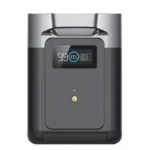
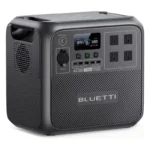
The Backup Question
Buyers put these two side by side for one reason: they want to know which will keep their devices, such as a computer, a router, or a medical device, running when the grid goes down.
That question turns on transfer time, and there is a genuine difference here. The Bluetti hands over more than twice as fast as the EcoFlow.
But there is a second question almost nobody asks, and on that one both machines give the same disappointing answer.
Tested Specifications Side by Side
| Measurement | EcoFlow Delta 2 | Bluetti AC180 |
| Rated Capacity | 1,024Wh | 1,152Wh |
| Usable Through AC (Tested) | 850Wh – 83% | 990Wh – 85.9% |
| Usable Through DC (Tested) | 870Wh – 85% | 981Wh – 85.2% |
| Continuous AC Output | 1,800W | 1,800W |
| Surge Output | 2,700W | 2,400W |
| Blackout Switchover | 19.2ms measured | 8.7ms measured |
| Self-arming Inverter | No | No |
| Pure Sine Wave Distortion (THD) | 1.70% | 1.80% |
| Standby Drain Per Hour | 0.8% | 1.2% |
| Max Wall Charging | 1,200W | 1,440W |
| Dual Charging (AC + Solar) | Not supported | 1,440W |
| Maximum Solar Input | 500W, 11–60V, 15A | 500W, 12–60V, 10A |
| USB-C Output | 100W | 100W |
| Expansion Battery | Supported | Not supported |
| Cell Chemistry and Cycles | LiFePO4, 3,000 | LiFePO4, 3,500 |
| App Connectivity | Wi-Fi and Bluetooth | Bluetooth only |
| Fan Noise Under Load | 62dB | 54dB |
| Weight | 27 lbs | 37 lbs |
UPS vs EPS: What the Measurements Actually Show
The distinction usually drawn is that a true Uninterruptible Power Supply switches under 20 milliseconds, fast enough for a desktop computer, while an Emergency Power Supply is slower and suited to lights and refrigerators.
On our bench, both machines cleared 20 milliseconds – but by very different margins.
The EcoFlow Delta 2 measured 19.2 milliseconds. That passes the threshold by less than a millisecond, and at that speed,d whether connected equipment survives depends on the power supply inside it rather than on the power station.
Neither mechanism has its own inverter. Both must be switched on in advance and left running, so neither protects a house that nobody is in.
For a fridge, lighting, or a router, both are fine. For a computer you actually care about, the Bluetti is the only one of the two I would rely on—and only while someone is home to have armed it.
Usable Capacity After Conversion Losses
The Bluetti is rated 128 Wh higher and delivers 140 Wh more once AC inverter conversion efficiency losses are accounted for, because it also converts more efficiently.
- Through the AC outlets: 990 Wh from the Bluetti, 850 Wh from the EcoFlow.
- On a 150W refrigerator that is about six hours thirty-five from the Bluetti against five hours forty from the EcoFlow.
- Through DC, the gap narrows slightly—from 981 Wh to 870 Wh—because the EcoFlow performs better at 12 volts than at AC.
Standby runs the other way. The EcoFlow loses 0.8% per hour compared to Bluetti’s 1.2%, so for a machine left charged in a cupboard for months, the EcoFlow holds its charge better.
Charging: Where the Bluetti Pulls Ahead
- Wall input is 1,440W on the Bluetti against 1,200W on the EcoFlow.
- More significantly, the Bluetti supports dual charging at 1,440W. The EcoFlow does not support it at all, so mains and panels cannot run together on the Delta 2.
- Both offer incremental charging speeds and support pass-through charging.
- Maximum solar input wattage is 500W on both. The EcoFlow allows 15 amps, compared to Bluetti’s 10, making it the better choice for a parallel bank of low-voltage panels.
The Expansion Trade
This is the clearest single difference between the two machines, and it is permanent.
- The EcoFlow Delta 2 accepts an expansion battery. Capacity can be grown later without replacing the electronics.
- The Bluetti AC180 does not, and never will. Its 1,152Wh is a fixed ceiling, and adding capacity means buying a second complete machine.
If you are confident 1kWh is all you will ever need, that costs you nothing. If there is any chance your needs grow, it is the strongest argument for the EcoFlow on this page.
Noise, Weight and Connectivity
- The EcoFlow weighs 27 pounds against the Bluetti’s 37; a ten-pound difference that is felt on stairs and in a vehicle.
- The Bluetti runs at 54 compared to the EcoFlow’s 62dB, the loudest reading in our entire database. Eight decibels is the difference between tolerable in a hallway and audible through a closed door.
- The EcoFlow app runs on Wi-Fi and Bluetooth; the Bluetti offers Bluetooth only, so you can’t check it from another building.
- The Bluetti has a 3,500-cycle rating compared to the EcoFlow’s 3,000, a difference that, over a decade of daily use, is significant.
Which One Should You Buy?
| If Your Priority Is… | Choose |
| Protecting a Computer or Network Drive | Bluetti AC180 – 8.7ms against 19.2ms |
| The Most Usable Energy | Bluetti AC180 – 990Wh against 850Wh |
| Fast Recharging, or Mains and Solar Together | Bluetti AC180 – 1,440W, and dual charging the EcoFlow lacks |
| Quiet Operation | Bluetti AC180 – 54dB against 62dB |
| Growing the System Later | EcoFlow Delta 2 – the Bluetti has no expansion path at all |
| Carrying It Regularly | EcoFlow Delta 2 – ten pounds lighter |
| Long-term Storage Between Uses | EcoFlow Delta 2 – 0.8% hourly drain against 1.2% |
| Remote Monitoring Over Wi-Fi | EcoFlow Delta 2 – the Bluetti is Bluetooth only |
Both score 7.2/10 in our overall rating, but the numbers do not tell the whole story.
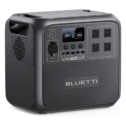
The Bluetti AC180 is our pick in this head-to-head comparison because it delivers the faster blackout switchover, more usable energy, faster charging, quieter operation, and better overall backup performance.
Bluetti AC180 Review
The EcoFlow Delta 2 remains the better fit if you value lower weight, expandable capacity, lower standby drain, or Wi-Fi monitoring. In other words, they earn the same score, but the Bluetti is the stronger choice for the specific job this comparison is testing: reliable backup power.